Introduction About Site Map

XML
RSS 2 Feed RSS 2 Feed
Navigation

Main Page | Blog Index

Wednesday, January 25th, 2023, 6:30 am

ISO Certificates Are Like NFTs (Worthless Junk)

Video download link | md5sum 826d1eaa331010c952d7b97f3736f836
ISO Certification Did Nothing
Creative Commons Attribution-No Derivative Works 4.0

Summary: The real-world threats faced by private companies or non-profit organisations aren’t covered by the ISO certification mill; today we publish the last post on this topic before proceeding to some practical examples

WORKING for a company that publicly and openly boasts 2 ISO certifications means that expectations (or perception) can be compared to reality. At Sirius ‘Open Source’, where I had worked since 2011, I saw all sorts of poor security practices, even in more recent years when ISO certifications were bragged about to existing/potential clients.

There is no point trying to deflect the attention to accuser. At the moment the company is too broke for workers to sue (and eventually truly win in a monetary sense); it’s also too broke for its clients to sue. Winning in court against an insolvent company would be a Pyrrhic victory. What matters here is the truth. It can hopefully caution others.

We still have quite a bit left to cover. We’re going to cite practical examples of stuff being done to the detriment of privacy and security of staff, not to mention clients. Free software is a pragmatic choice, but when managers use proprietary software they go not ‘get’ that.

Wednesday, January 25th, 2023, 2:45 am

International Organization for Standardization (ISO) Certification Does Not Assure Anything

The International Organization for Standardization (ISO) certification process means almost nothing. It’s just a glorified brand. Deep inside many people and organisations know it.
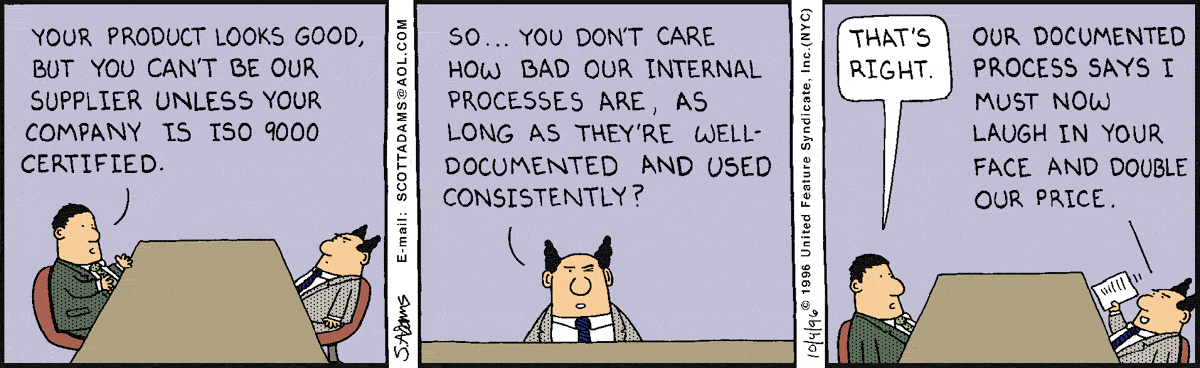
Dilbert on ISO
Dilbert on ISO 9000 Certification in 1996 (there are also 21 for ISO 9001)

Summary: Sirius ‘Open Source’ was good at gloating about “ISO” as in ISO certification (see our ISO wiki to understand what ISO truly is; ISO certification needs to be more widely condemned and exposed) while signing all sorts of dodgy deals and lying to clients (some, like the Gates Foundation, were never mentioned because of a mysterious NDA); security and privacy were systematically neglected and some qualified as criminal negligence (with fines/penalties likely an applicable liability if caught/reported)

THE past few days were spent explaining ISO certification in relation to Sirius. The next few days will be spent giving an example or a sub-set of examples of how Sirius handled sensitive data. It probably hasn’t improved at all since I left last month.

For some essential background, Sirius Open Source Inc. (not SIRIUS CORPORATION LIMITED) was grabbing Gates Foundation money back in 2019 — all this while registering in the US for this “first US client”, letting Windows users who adore surveillance get involved in decision-making while outsourcing more and more of what’s left of the company to dubious companies with NSA connections.

The problem here is that Sirius had British clients with their clients’ data on the systems. Some was medical data. What does the law say about access from another country and why was Google (American company) getting/drowning in legal hot waters for involvement in the NHS?

What’s more, it’s not clear if ISO 9001 certifiation allows personal computers at home, purchased and maintained by staff along with many other uses and applications, to be used as work machines (deemed “Secure”? Really???). Remember that, as we noted repeatedly in the past, the managers never bothered supplying the staff with anything; the company does not even provide a chair and a desk, as already explained in length here (mostly back in December). Did that pass muster at ISO’s cash register (ISO just wants the money)?

Well, maybe in the ISO forms the company can pretend that those computers were supplied by the company to staff when in fact the staff receives almost nothing from the company except a very old phone (Cisco-branded, Ethernet only; maybe 2 decades old).

While I’m not going to report this as a former insider, I do wish to explain what’s at stake here, at least as a cautionary tale. ISO doesn’t care; it has no quality control of its own; its workers are like corporate staff and they might not even care anyway; they got the money, and that’s what’s important to ISO. Many questions remain, e.g. which actual shell was the certification for? Do they realise they deal with a hydra or a polymorphous entity here (some of its shells are based in another continent, without actual boundaries within the company)? Even the pension schemes seem to be struggling to keep track and they need to be lectured on how the company splits and then illegally compels staff to sign papers without legal advice (nor proper understanding), as we noted here before. It was covered a lot roughly one week ago.

And sure, many lessons are to be learned outside the company, too. If regulators could find E-mails, they would not struggle to see incriminating stuff (we plan to add examples to the wiki), including NHS medical data “oopsies” (admission on the record, too), even for people do not consent to data sharing. ISO probably doesn’t care. As we said several times already, ISO only cares about money. With ‘anonymisation’ not working, accidents aside, there’s a big scandal brewing under the surface, but then again the privatisation of the NHS would likely misplace the blame. The media has several examples of known incidents and it’s a very big deal because the NHS has been pushing towards it, moreover offering to send some of this data abroad.

To be clear, NHS was not a client, except indirectly (contractors). But if someone wishes to find some major scandal/blunder, we welcome further investigation, i.e. people can do what ISO ‘cannot’ do because it would discredit ISO.

“There are 2 problems to track,” an associate noted, “one is the scam of the ISO 9000 certification. The other is the destruction of ISO as an organisation by Microsoft.”

Tuesday, January 24th, 2023, 1:05 pm

Office for National Statistics Responds to My Query About Undercounted Deaths, But Does Not Answer the Question

Earlier today I noted that the Office for National Statistics (ONS) hadn’t replied within the time frame or ‘window’ specified in their automated reply. I therefore prodded ONS again, politely, and within hours I received the following response:

Good morning Dr Schestowitz

Thank you for your email. Apologies for the delay in responding, we have a large volume of enquiries at the moment.

Deaths in the last week of December and the first week of January are impacted by bank holidays where registry offices are closed. These deaths are then usually registered in the following week.

This isn’t an undercount, rather we see a lower number of death registrations on weeks with a bank holiday followed by a larger number of death registrations the week after a bank holiday. So the numbers will stay the same, we just ask people to use caution when comparing trends as they need to be aware of this short-term displacement effect that happens across weeks with bank holidays and the week after.

Kind regards

Anne

Anne

Customer Services Team

Health Analysis and Pandemic Insight (HAPI)

Office for National Statistics | Swyddfa Ystadegau Gwladol | www.ons.gov.uk | @ONS

I quickly responded:

Hi Anne,

Thank you for the reply.

The reply does not address my question however. I did not ask about the last week of December or bank holidays.

My query was about the week ending 9th of December. I took a screenshot of your site: (PNG file)

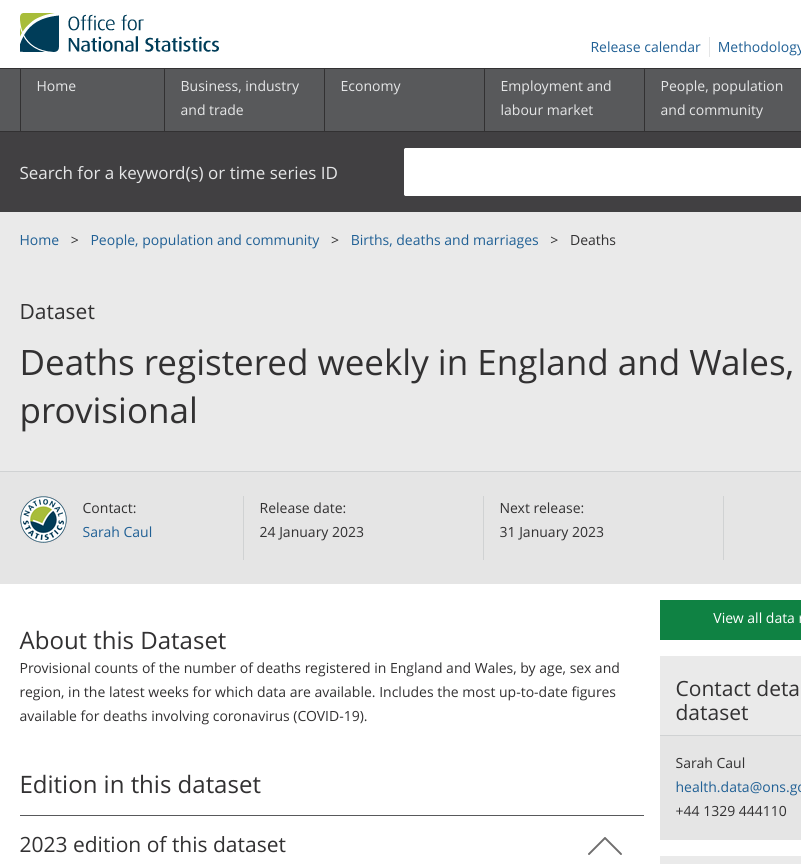
Over the Christmas period we will not be publishing Deaths registered weekly in England and Wales so the next publication will be available on the 5th of January and shall cover the weeks ending 16th and 23rd of December. Due to a processing issue, there has been an undercount of death occurrences in week ending 9th of December. Due to this the figures for week 49 will now be published in the next weekly mortality publication coming out on the 5th of January.

Undercount of deaths

In your own words, there was a “processing issue”, resulting in “undercount of death occurrences”. It said the figures for week 49 would be “published in the next weekly mortality publication”, but in all subsequent weeks after that the number was the same and not corrected. In other words, the number you gave while stating “undercount of death occurrences” is still an undercount almost 1.5 months after the week in question. This needs to be corrected or clarified, otherwise it is a contraction that lessens quality in your data.

Please can you explain what happened to week 49?

Kind regards,

Let’s see if this time they will actually answer the question rather than address something I did not ask at all.

Tuesday, January 24th, 2023, 10:19 am

In Young Adults in the UK Deaths Have Soared by 31%

As per the latest data, which is alarming:

Deaths weeks 2023

How does that compare to 2019? Let’s check the official records. The numbers below are the total deaths (not a sub-sample).

Babies:

2019: 50. 2023: 55 (10% increase).

Kids (ages 1-14):

2019: 20. 2023: 24 (20% increase).

Adults (ages 15-44):

2019: 280. 2023: 365 (30.57% increase).

Ages 45-64):

2019: 1419. 2023: 1798 (26.7% increase).

Ages 65-74):

2019: 2179. 2023: 2609 (19.7% increase).

Ages 75-84):

2019: 3590. 2023: 5094 (42% increase).

Age 85+:

2019: 5071. 2023: 7436 (46% increase).

So deaths are off the chart. And young people are not exempted.

Tuesday, January 24th, 2023, 9:56 am

National Crisis and Catastrophic ‘New Normal’: UK Deaths Soaring Even More While the Government and Media Stay Silent

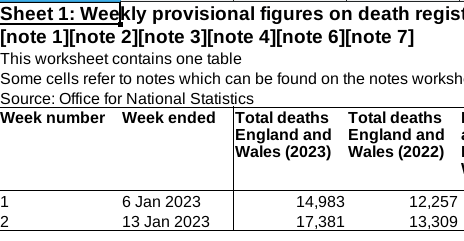
ONS data week 2 2013

ONS data week 2 2013 - image

IMAGINE the media not talking about this….

With over 17.3k deaths last week (in Wales and Eng alone; Scotland and Northern Ireland probably have well over a thousand more), as per the data published 20 minutes ago, the public deserves an explanation. These deaths are off the chart! Here it is compared (pre-pandemic and present time, with media trying to convince us it’s “over” and “back to normal”).

17,381 deaths

Tuesday, January 24th, 2023, 9:11 am

7 Days Have Passed, Office for National Statistics Has Not Replied to a Very Simple Query From Me (About ‘Missing’ Deaths Data)

Over a month ago the Office for National Statistics (ONS) had a glaring omission. It never bothered to correct it (more than a month had already passed!), so a week ago I made this polite inquiry.

This is what I received:

Thank you for your email.

Due to the high volume of enquiries we aim to respond to your enquiry within 5 working days.

This inbox will be actively managed Monday to Thursday 0830 – 1630 and Friday 0830 – 1530.

We appreciate your patience.

Kind regards

Health Analysis and Life Event Customer Service Team.

Office for National Statistics

Any further attempts to contact them give me this generic (not personalised) response:

Thank you for your email.

This inbox is actively managed Monday to Thursday 0830 – 1600 and Friday 0830 – 1500.

Due to the high volume of enquiries we aim to respond to your email within 10 working days.

We appreciate your patience.

HAPI Customer Services Team

Health Analysis and Pandemic Insight

Office for National Statistics | Swyddfa Ystadegau Gwladol

Tel. 01329 444 110 | www.ons.gov.uk | @ONS

So now it is 10, not 5? That’s not even consistent. Anyway, maybe by next week?

Sigh.

So when are they actually going to respond to my query? It’s the taxpayers that fund them to do this simple job.

Tuesday, January 24th, 2023, 5:27 am

International Organization for Standardization is an Elaborate Scam

Video download link | md5sum cc29a588d814b375a666bda5d567b58f
What Sirius Teaches Us About ISO
Creative Commons Attribution-No Derivative Works 4.0

Summary: Based on my experiences inside Sirius ‘Open Source’ — as I was there for nearly 12 years — I finally tell what I’ve witnessed about ISO certification processes (see ISO wiki for prior experiences)

Sirius ‘Open Source’ taught me a whole bunch of things; some were valuable technical skills, but many were negative experiences that I can finally explain out in the open, expressing in words various ideas that I formed (or formulated) years ago.

The above video concerns ISO and it is relatively long because it covers two parts instead of just one, starting with background and proceeding to real-life examples in the form of redacted E-mails.

The conclusion I reached years ago is that ISO is somewhat of a scam. It creates a barrier that mostly protects monopoly and it makes a lot of money by giving worthless papers, essentially turning managerial ‘religion’ into a fat cash cow. If more people understood the business model of ISO, maybe there would be no ISO anymore.

Real-time Posts

Posts by @schestowitz

Retrieval statistics: 23 queries taking a total of 0.091 seconds • Please report low bandwidth using the feedback form
Original styles created by Ian Main (all acknowledgements) • PHP scripts and styles later modified by Roy Schestowitz • Help yourself to a GPL'd copy
|— Proudly powered by W o r d P r e s s — based on a heavily-hacked version 1.2.1 (Mingus) installation —|