Filed under:


Monday, September 26th, 2022, 4:25 am
COVID-19 Spreads Very Freely This Past Summer

The above helps show the positive effect of distancing and masks (2020).
Monday, September 26th, 2022, 4:17 am
Survival After COVID-19 Takes More Than 4 Weeks (the ‘Gold Standard’ for Measuring Fatalities’ Correlation and Cause)
What I’m saying: we need better metrics to assess the impact of COVID-19 on long-term health.
What I’m not saying: anything but the above.
Passed away on 9 April 2021 at the age of 99, less than 2 months after this (left the hospital after four-week stay):

Died weeks ago after publicly complaining that COVID-19 had left her weak and exhausted:

It is undeniable that mortality is soaring this year. This is based on statistically-significant deviations and very large datasets from many countries. This merits further exploration rather than suppression, censorship, and name-calling.
Monday, September 26th, 2022, 3:35 am
Excess Deaths in England and Wales – Office for National Statistics (Spring and Summer 2022 by Far the Worst So Far)
The Office for National Statistics (ONS) published the following data 5 days ago. This does not yet contain summer figures, but those should come later (it’s worse than spring). Maybe by year’s end, even if there are efforts to hide data.
Even before this past summer, which was horrendously deadly (record highs), we saw peaks in terms of mortality. As per the data:

Total deaths (equivalent points in the year, left is 2020, middle is 2021, and 2022 on the right)

Raw numbers
The summer figures will be far more interesting. For reasons that are easily observed.
Underlying data (ODF; ONS foolishly used only Microsoft’s proprietary format for this)
Sunday, September 25th, 2022, 7:05 pm
British Government Stops Properly Reporting How Many COVID-19 Patients Are Admitted to Hospital and Die (as Winter Approaches and Numbers Already Go Up)
If you don’t have the figures from Scotland, then you can only ever compare apples to oranges:
No further update to hospital admissions in Scotland and UK
Public Health Scotland have changed the definition of patients admitted to hospital and are no longer reporting admissions using the existing definition. The new measure is intended to reflect “community-acquired” COVID-19 and therefore is not comparable to the measures in use in the other three nations, so has not been included in dashboard reporting. Therefore the latest data for hospital admissions in Scotland is 11 September 2022. UK and Scotland hospital admissions will no longer be updated beyond that date. Data for England, Wales and Northern Ireland will continue to be added weekly.
Weekly deaths with COVID-19 on the death certificate do not include data from Scotland
Deaths with COVID-19 on the death certificate registered in the week ending 09 September 2022 are not available for Scotland. The UK total number includes England, Northern Ireland and Wales only. Numbers for Scotland will be included in next week’s release, and the UK total will be updated to include them.
Problem solved! No data, no problems! The numbers thus ‘go down’…
Screenshots for archival purposes (those pages won’t exist anymore… in a couple of years):


Saturday, September 24th, 2022, 2:47 am
GNU Project Turning 39
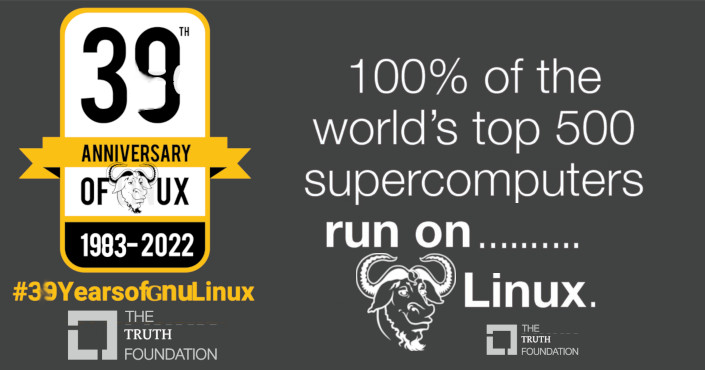
Summary: This coming Tuesday is a special day; 39 years since the message (announcement) below, so next year it’s 40 (a time leap in the context of software development; not much stuff lasts this long)
From CSvax:pur-ee:inuxc!ixn5c!ihnp4!houxm!mhuxi!eagle!mit-vax!mit-eddie!RMS@MIT-OZ
From: RMS%MIT-OZ@mit-eddie
Newsgroups: net.unix-wizards,net.usoft
Subject: new Unix implementation
Date: Tue, 27-Sep-83 12:35:59 EST
Organization: MIT AI Lab, Cambridge, MA

Free Unix!

Starting this Thanksgiving I am going to write a complete
Unix-compatible software system called GNU (for Gnu's Not Unix), and
give it away free(1) to everyone who can use it.
Contributions of time, money, programs and equipment are greatly
needed.

To begin with, GNU will be a kernel plus all the utilities needed to
write and run C programs: editor, shell, C compiler, linker,
assembler, and a few other things.  After this we will add a text
formatter, a YACC, an Empire game, a spreadsheet, and hundreds of
other things.  We hope to supply, eventually, everything useful that
normally comes with a Unix system, and anything else useful, including
on-line and hardcopy documentation.

GNU will be able to run Unix programs, but will not be identical
to Unix.  We will make all improvements that are convenient, based
on our experience with other operating systems.  In particular,
we plan to have longer filenames, file version numbers, a crashproof
file system, filename completion perhaps, terminal-independent
display support, and eventually a Lisp-based window system through
which several Lisp programs and ordinary Unix programs can share a screen.
Both C and Lisp will be available as system programming languages.
We will have network software based on MIT's chaosnet protocol,
far superior to UUCP.  We may also have something compatible
with UUCP.


Who Am I?

I am Richard Stallman, inventor of the original much-imitated EMACS
editor, now at the Artificial Intelligence Lab at MIT.  I have worked
extensively on compilers, editors, debuggers, command interpreters, the
Incompatible Timesharing System and the Lisp Machine operating system.
I pioneered terminal-independent display support in ITS.  In addition I
have implemented one crashproof file system and two window systems for
Lisp machines.


Why I Must Write GNU

I consider that the golden rule requires that if I like a program I
must share it with other people who like it.  I cannot in good
conscience sign a nondisclosure agreement or a software license
agreement.

So that I can continue to use computers without violating my principles,
I have decided to put together a sufficient body of free software so that
I will be able to get along without any software that is not free.


How You Can Contribute

I am asking computer manufacturers for donations of machines and money.
I'm asking individuals for donations of programs and work.

One computer manufacturer has already offered to provide a machine.  But
we could use more.  One consequence you can expect if you donate
machines is that GNU will run on them at an early date.  The machine had
better be able to operate in a residential area, and not require
sophisticated cooling or power.

Individual programmers can contribute by writing a compatible duplicate
of some Unix utility and giving it to me.  For most projects, such
part-time distributed work would be very hard to coordinate; the
independently-written parts would not work together.  But for the
particular task of replacing Unix, this problem is absent.  Most
interface specifications are fixed by Unix compatibility.  If each
contribution works with the rest of Unix, it will probably work
with the rest of GNU.

If I get donations of money, I may be able to hire a few people full or
part time.  The salary won't be high, but I'm looking for people for
whom knowing they are helping humanity is as important as money.  I view
this as a way of enabling dedicated people to devote their full energies to
working on GNU by sparing them the need to make a living in another way.


For more information, contact me.
Arpanet mail:
  RMS@MIT-MC.ARPA

Usenet:
  ...!mit-eddie!RMS@OZ
  ...!mit-vax!RMS@OZ

US Snail:
  Richard Stallman
  166 Prospect St
  Cambridge, MA 02139