Introduction About Site Map

XML
RSS 2 Feed RSS 2 Feed
Navigation

Main Page | Blog Index

Saturday, March 3rd, 2012, 5:43 pm

Looking Back at 5.5 Years of Techrights and 15,000 Posts

BACK in 2004 I set up this Web log where I posted every day, and almost without a single exception (usually I posted around 3 posts per day). It was only in 2006 that I started to focus on more specific issues and developed an expertise in particular subjects. Techrights was a lot more focused than this personal blog, which has not produced about 2,000 posts.

Last Thursday I crossed the 15,000-article milestone over at Techrights. It still serves a lot of requests owing (for the most part) to the huge archives. Now, just to clarify, there is also a lot of traffic in some other sites such as this one, but when I stopped writing on a regular basis here in schestowitz.com the traffic dropped from about 20,000 hits per day (gradual decline). I wrote 15,000 articles/posts in Techrights, which now serves about a quarter of a million hits per day (since 2010), giving me little reason to post in this personal blog any longer. At Techrights, over the course of 5+ years, I have been posting at the pace of almost 8 posts a day for 5 years (but at the highest points a lot more than the average, with a peak of 31 posts in one day).

Techrights has reached a sort of plateau now — a point where it stays about the same when it comes to traffic, despite expansion in content. The visitors count stopped growing some time around 2009 when I was entering Twitter and was on Twit TV, a TV show I was invited to be in for 1.5 hours or so, speaking for the site. These days I am busier with my jobs and my fiancée, but I still find a lot of time to dent, tweet, blog, and occasionally record shows (although not as much as of late because my co-host and I are exceedingly busy). Thanks to all those who are supporting my work and spreading the key points (even contributing time, HT to “wallclimber” among others). I will carry on doing this for a long time to come. Activism, to me, always comes first (well, family comes first, but it’s a close second).

2009

2012

Friday, March 2nd, 2012, 5:47 pm

New Masks (With Holes) for GMDS

Despite the fact that I cannot rollback to old versions of the algorithm — those that worked much better — I have run experiments on half of the entire Texas database. The performance was vastly inferior because of changes that I have made over the past couple of months.

Over the past few days I experimented with other smoothing schemes, as a colleague once suggested that I do. The improvements were very minor once performance was assessed with some ROC curves (few dozens of pairs). The general idea was, by removing areas or artifacts that distract from identity-related entropy, we can improve overall performance. The impediment has always been that, given too lenient and sensitive a measure, the items being compared are not identity-related but pose-related, noise-related, etc.

In my most recent experiments I have been looking into more kinds of masks, but none so far offers a magic solution with state-of-the-art performance.


Symmetric mask where eyes are removed and the nose tip too, in order to accentuate topology and delve into areas more “stable” than eye surface


Examples of correct matches where the mask is symmetric (the “classic” mode)


Examples of correct matches where the mask is cut at nose level


Examples of correct matches where the mask is intentionally asymmetric (to avoid flipping over)

I decided to tweak this further, testing GMDS for surfaces with holes.

Dealing with the existing algorithm, which performs more weakly than months ago (due to experimental changes that are hard to selectivity rollback), I have some new results. I have tested it with and without support (difference in dilation/distance for FMM cutoff), but in both cases the ROC curves were too disappointing to be worth plotting and showing. The approach does not seem suitable for good performance to be reached. With or without the most performance-promising algorithm, the general observation is that GMDS does not deal well with these holes (connected torus-like shapes).


Example of pairs of surfaces where eyes and nose tip got removed


An increasing level of geodesic dilation where eyes are cropped out but not the nose tip


ROC curves for the above

Thursday, February 23rd, 2012, 10:08 pm

MediaCityUK – My Favourite Part of Greater Manchester

Here is a not-so-recent video of the new area that’s so wonderful for running, cycling, or even just sunbathing.

Thursday, February 23rd, 2012, 9:59 pm

Further Validation With GMDS

I RECENTLY uploaded a report exceeding 500 pages. The report has been narrowed down to include some of the better results that we have and some of the more important points worth getting across. A lot of the text is new and a lot in the content and organisation can be improved given more time. This too will be uploaded soon.

I’ve been running further experiments while the report was being worked on (still work in progress) and some interesting results were reached when particularly fast configurations of the GMDS algorithm were attempted, giving (so far) perfect classification for 30 pairs.

Previously, in experiments shown in the report, verification performance reached through GMDS was limited and primarily impeded not only by failures at the topology level but also finer-level issues where the 3-D surfaces provided not enough information to correctly distinguish between identities. A lot of the topological failures were averted by further optimising the algorithm such that support is made broader.

The first ROC curve shows the performance where only GMDS is used and the mask omits much of the cheeks, whereas the latter mostly includes them. By altering the configurations to the best we’ve found so far, significantly better performance can be assured (with GMDS and 3-D alone), but it would be nowhere near the accuracy levels we compete against. Cross-individual entropy seems to lie somewhere in the combination of many 3-D features, but accurate segmentation is not easy on smooth surfaces.

Wednesday, February 22nd, 2012, 11:14 pm

IRC Chat/Communication Panel

IN PREVIOUS posts I wrote about my work desktop, one of 12 workspaces/desktops that include desktop 2 for mail and collaboration, excepting a third screen mounted on a separate machines and connected nicely with Synergy for a seamless experience. In order to shed light on how I communicate online in real-term, here is desktop 4 on my main machine. What’s out of sight here is the weather widget; the wallpapers on the left changes based on the weather. In the other two screens — centre and right — it cycles at random (slideshow). In future posts I will show my other desktops and how I arranged them for improved productivity.

Monday, February 20th, 2012, 1:28 am

Sunlight by Kevin Lettau

ONE NICE things about vacations is that they leave visions and sights in one’s mind. From the special suite at the 20th floor (facing the sea) my girlfriend and I carry last weekend’s memories with this song.

Monday, February 20th, 2012, 1:28 am

State-of-the-art Results for Verification in 3-D Alone

THE task of comparing atomically-meaningful 3-D surfaces is not simple. The plethora of diffusion-based techniques have not managed to overcome the drawbacks and ever surpass the performance attained through geodesic distances. The main issue, to summarise this very briefly, is that when the differences are very small between one subject and another (no topological differences) there is not enough that can be done to distinguish by kernel-based score.
I have meanwhile returned to geodesics again. Based on literature surveys from a few years ago (I read three with great interest), for 3-D in isolation the verification rates are almost always worse than for 2-D (and of course 3-D plus 2-D), which brings up the question, what type of performance levels are expected from 3-D alone in order to make a technique publishable? With our best methods we hover around the mid-nineties. With further refinements that do not require 2-D data we can make further improvements, but there are inherent difficulties. For example, as I showed a colleague at the lab some pairs of different range image (in 3-D) she was unable to tell if there were the same or not. When the similarity is high it becomes almost about gut feeling or guesswork, even for verification as opposed to identification (one-to-many or many-to-many).

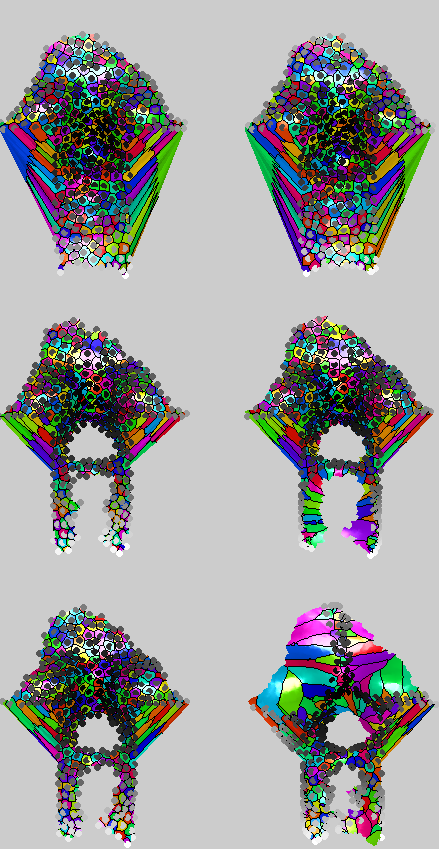
Additionally, spectral methods degrade poorly compared to geodesics, as shown in the images below (first a meaningful slicing, then improper).

Spectral examples

Spectral examples

Spectral problems

Spectral problems

I am currently working on a concise report about this project (which has exceeded a year in duration so far). There’s a lot more coming. I also added some list of side projects (totally unrelated) I’ve been working on recently. I hope to focus more on ERC-funded work and not whatever pays more (industry pays more than academic). But all these are a matter to be discussed another day.

Real-time Posts

Posts by @schestowitz

Retrieval statistics: 23 queries taking a total of 0.116 seconds • Please report low bandwidth using the feedback form
Original styles created by Ian Main (all acknowledgements) • PHP scripts and styles later modified by Roy Schestowitz • Help yourself to a GPL'd copy
|— Proudly powered by W o r d P r e s s — based on a heavily-hacked version 1.2.1 (Mingus) installation —|