


 Filed under:

Friday, July 20th, 2012, 3:04 pm
Dream Circularity

 HIS MORNING I was dreaming that I was dreaming that I was dreaming. I woke up several times, at different times, but only within the dream (or the dream about a dream), only to falsely assume it was a particular time of the day. The level of circularity was never quite so high and I took these notes after I had woken up.
I was so relived when I woke up to realise that I was dreaming about dreaming, but then I was still inside one layer of dreams and it took me quite a while to wake out of that. Confusing, eh? Anyway, dreams are a mysterious side of the human mind. They are said to have a purpose in the sense that they train our neural model of expectation for particular possible scenario, e.g. being chased by an animal in our primal past.
Wednesday, July 18th, 2012, 6:44 pm
Backing Up Bootloader and Home Directories Over the Network
 ackups that are robust and resistant to disasters like fire should be distributed. Backing up by writing to external drives is good, but it is not sufficient. Here is how I back up my main machine. Backup is quick in a smaller number of rather large files (not too large as some file systems cannot cope with those), so one trick goes like this:
sudo mkdir /media/backupdrive/`date +%Y-%m-%d` # (if disk space permits, or via external mounted drive for another safety net)
sudo tar -cf - /home/|split -b 1000m - /media/backupdrive/`date +%Y-%m-%d`/Home-`date +%Y-%m-%d`.tar.
This includes all the hidden files.
To reassemble:
cat *|tar -xf
this is then scp‘d or rsync‘d over to another box based on a wildcard or directory like
/media/backupdrive/`date +%Y-%m-%d`
This leaves a stack of backups in case the latest one is already ‘contaminated’. rsync of the original files, uncompressed and untarred, can be fast except for the first time, but for a stack of backups it’s not suitable.
But more files need to be backed up, depending on the bootloader for instance.
MBR backup and restore is done with dd:
dd if=/dev/sdX of=/tmp/sda-mbr.bin bs=512 count=1

dd if= sda-mbr.bin of=/dev/sdX bs=1 count=64 skip=446 seek=446
If this is saved to the home directory, then it’s included in the main backup.
Tuesday, July 17th, 2012, 1:29 pm
My Interview With Richard Stallman on Booting Freedom

Direct download as Ogg (0:13:28, 5.5 MB)
Summary: The first part of our interview with Richard Stallman covers UEFI and related issues
I first interviewed Richard Stallman about 5 years ago. Yesterday I spoke to him about the subject of much debate in the Free software world right now. Here is a transcript of our conversation.
Dr. Roy Schestowitz: I want to know how big a threat you think the so-called “secure” boot is considered to be to the Free software movement.
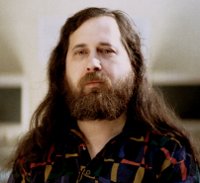 Dr. Richard Stallman: It’s a disaster. Well, except that it’s not secure boot that’s a disaster, it’s restricted boot. Those are not the same. When it’s front of the control of the user, secure boot is a security feature. It allows the user to control what programs can run on a machine and thus prevent — you might say — unexpected malware from running. We have to distinguish the unexpected malware such as viruses from the expected malware such as Windows or Mac OS or Flash Player and so on, which are also malware; they have features that hurt the user but users know what they are installing. In any case, what secure boot does is that it causes the machine to only work with (?) programs that are signed with a certain key, your keys. And as long as the user controls which keys they are, then it’s a security feature. However, it can be chained into a set of digital handcuffs when the user doesn’t control the keys. And this [is] happening.
Microsoft demands that ARM computers sold for Windows 8 be set up so that the user cannot change the keys; in other words, turn it into restricted boot. Now, this is not a security feature. This is abuse of the users. I think it ought to be illegal.
It’s a matter of control by the vendor of course, not control by the user himself
Exactly, and that’s why it’s wrong. That’s why non-free software is wrong. The users deserve to have control of their computers/
I think that not only Windows is going to be an issue in fact, if you consider the fact that even a modified kernel is going to be in a position where it’s perhaps not seen as verified for execution. Right, I’m saying, it might not only be a malicious feature in case of something like Windows running on it, it’s also for — let’s say — a user of the offered operating system but it’s free if the user wants to modify the operating system, for example…
The thing is, if the user doesn’t control the keys, then it’s a kind of shackle, and that would be true no matter what system it is. After all, why is GNU/Linux better than Windows? Not just ’cause it has a different name. The reason it’s better is because it’s freedom-respecting Free software that the users control. But if the machine has restricted boot and the users can’t control the system, then it would be just as bad as Windows. So, if the machine will only run a particular version of GNU/Linux, that is a restriction feature. And I haven’t heard anyone doing that yet with GNU/Linux, but that’s what Red Hat and Ubuntu are proposing to do things — somewhat like that — for future PCs that are shipped for Windows. But it’s not exactly that. And my reason is, the users will be able to change the keys. They will be able to boot their own modified version of the system of Fedora or Ubuntu if they want. So, what Fedora and Ubuntu were proposing doesn’t go all the way there. They’re proposing to do things to make it more convenient for users to install the standard version of those systems. But if things go as it has been announced, users will still be able to change the keys and boot their own versions. So, if all the restricted boot — but it will be something that goes sort of half-way there — it’s somewhat distasteful.
On the other hand, with Android, which is another mostly Free operating system which contains Linux but doesn’t contain GNU, it’s quite common for the product to have something equivalent to restricted boot, and people have to struggle to figure out how they can install a modified and more free version of Android. So, the presence of the kernel Linux in a system doesn’t guarantee it’s going to be better. And I’ve heard someone say — oh, it hasn’t been checked — that a particular or kind of Android device is actually using an Intel chip with restricted boot.
One of the concerns that I think is worth raising is the fact that, as far as I know, with many of the embedded devices, especially those based on ARM, I believe it’s not even possible to get into boot menu to disable so-called “secure”…
That’s where Microsoft is really going all out, because Microsoft has ordered essentially — demanded — that those shipping ARM devices for Windows 8 make it restricted boot with no way to get around it.
Yeah, which also means of course waste of… all sorts of impacts on the environment. Any time that hardware become obsolete with the operating system itself is not being used of course…
Well, it’s worse than that. It means basically that those devices, you have to throw them out if you want to escape to the free world. And this — in the past — we were able to install, to liberate a computer by installing Free software on it instead of its user-restricting operation system, and this of course was tremendously helpful to the spread of GNU/Linux because it meant that users could move to freedom. It would be much harder if they had to buy another computer to do so. So it’s a very damaging thing that Microsoft is doing and so we need to look for every possible way to stop them or tweak what they’re doing.
Well, I wanted to ask you, one of our readers — his name is Will — is asking me if you have seen any new good hardware that can take coreboot.
I’m sorry, what?
One of my readers — a guy called Will — he has asked me if you have seen any new good hardware that can take coreboot.
I don’t know. Basically, I don’t keep track of hardware models. I only remember their names anymore, except for the one I use, which is, the Lemote Yeelong and it doesn’t run coreboot but it will run timar [?] in GRUB, it has a Free BIOS. When it comes it has a Free BIOS, which is why I chose it. But in terms of running coreboot, well, the machine which you run coreboot on are Intel-type machines. Now, there are a couple of… there is a problem, and that is, a lot of the Intel — and also AMD — CPUs require a microcode blob, and coreboot has these microcode blobs, which is the same kind of problem as firmware blobs in Linux. So, what we really need to do is make coreboot libre, just as we make Linux libre (which doesn’t have the blobs), keep (?) the coreboot libre (which doesn’t have the blobs) and then we need to see which processors actually run adequately without any microcode blob. And we’re looking for somebody who wants to lead this project ’cause it takes work. Now, leading this project doesn’t mean that you personally get all these kinds of hardware; oh, no, it would be asking the whole community to test things, but somebody has got to ask the community to do it, spread the word, receive the responses, put them together, and publish the list. Would (?) he like to do that? If he is really interested in having the answer to this question, maybe he’d like to help get the answer, and that would help the whole community.
More from Stallman is to be published in coming days.
We hope you will join us for future shows and consider subscribing to the show via the RSS feed. You can also visit our archives for past shows. If you have an Identi.ca account, consider subscribing to TechBytes in order to keep up to date.
As embedded (HTML5):
Sunday, July 15th, 2012, 6:44 am
Summer News
 have begun picking up pace again, with most of the benefit being funneled into Techrights and TechBytes. Being summertime, this period will enable me to write more articles and also record more. The social life benefits also.
I recently recuperated from a shoulder injury, caused by weakened tendons, and my other half has just won the volleyball championship (her last game, the final, was last night).

I will try to blog in schestowitz.com more often than before.
Sunday, July 15th, 2012, 6:33 am
TechBytes Episode 68: Apple Bans War, Nokia’s Demise, and More

Direct download as Ogg (0:26:32, 13.0 MB) | High-quality MP3 (19.4 MB) | Low-quality MP3 (6.1 MB)
Summary: The first episode with one host and a warmup before an interview that’s planned with Richard Stallman
Tim has been busy, but he let me carry on in his absence until he gets back. I did not script or rehearse this episode; instead, I dived right in and improvised as usual. This episode covers Android sales, my Android development project plus experience, a tablet lacking basic features, and my observation that plugins/apps do not add so much more so to make Android usable for technical work as opposed to play and amusement. “Dreamhouse” by Steve Poltz is played as the first song and then I speak about Nokia’s cuts, MeeGo, failures with Microsoft, and shrinking cash piles. Microsoft’s losses are mentioned and then Apple-imposed Android ans (in the US), as well as lost patent cases around Europe. Oracle’s patent case and USPTO reform are mentioned in light of dissent from a prominent judge who makes the objective of software patents abolition seem reachable. “Get U Home” by Shwayze is the last song played in this short show.
We hope you will join us for future shows and consider subscribing to the show via the RSS feed. You can also visit our archives for past shows. If you have an Identi.ca account, consider subscribing to TechBytes in order to keep up to date.
As embedded (HTML5):