Introduction About Site Map

XML
RSS 2 Feed RSS 2 Feed
Navigation

Main Page | Blog Index

Tuesday, June 21st, 2011, 1:17 am

Ramble About GMDS and GPCA (Ongoing Research)


OVER the past few months I have been running many experiments and compiling about 200 pages of text and graphs to document this. Today I made a short explanatory video that was unplanned and totally unscripted (I tend to prefer spontaneity, I loathe staging or reading from outlines/talking points/scripts).

This video is a bit of a test intended to get the hang of the recording software. These are some preliminary thoughts on the approach taken by GMDS (generalised multidimensional scaling) and the one adopted by GPCA (generalised principal component analysis) proponents. Admittedly, I am only at the early stages of properly learning about both. However, the basic principles as they are applied to distances (in space, not within data instances embedded in the shown hyperspace) are analogous at some underlying level, i.e. they measure something which is theoretically a surrogate of one another. The premises are hinged upon unification or use of one method to complement another, perhaps just comparing the results of each one in isolation.

Wednesday, June 15th, 2011, 8:45 pm

TechBytes Episode 51: Patents and Trolls

TechBytes

Direct download as Ogg (1:16:40, 27.0 MB) | High-quality MP3 (37.1 MB) | Low-quality MP3 (8.8 MB)

Summary: This quick episode combines many topics ranging from the area of patents to Microsoft trolls

LAST NIGHT’S show covered some of the important issues from the past week or so. It wasn’t released until now because one of my monitors died and as a result my 2.5 months old KDE session needed to be restarted, then I needed to buy a new monitor. Thankfully it’s all back to normal now.

The closing tracks are “Caught in Your Freedom”, “Volcano” by Anti-Pop Consortium, and “The DJ” by DJ Revolution( language warning). 2 are taken from SXSW 2010 (get the torrents legally here).

We hope you will join us for future shows and consider subscribing to the show via the RSS feed. You can also visit our archives for past shows. If you have an Identi.ca account, consider subscribing to TechBytes in order to keep up to date.

As embedded (HTML5):

Download:

Ogg Theora
(There is also an MP3 version)

Sunday, June 5th, 2011, 7:43 am

Thunderbird: My Most Used Application

My most used and highly valuable applications are probably Kate, which I wrote about some days ago, and Thunderbird. KNode and Firefox used to be used a lot before I found ThunderBrowse.

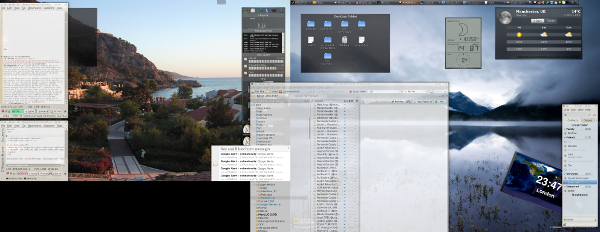
Here is a sort of overview of how I used Thunderbird, in case someone ever thought of it as a weak application. Click on the image below for an explanation of my workflow in desktop 2.

Thunderbird

Sunday, June 5th, 2011, 7:23 am

TechBytes Episode 50: ASUS Back With GNU/Linux, YouTube Likes Creative Commons

TechBytes

Direct download as Ogg (1:26:51, 19.0 MB) | High-quality MP3 (29.7 MB) | Low-quality MP3 (8.6 MB)

Summary: Rusty, Tim, and Roy return to a wide-ranging discussion

TODAY’S show covers YouTube’s embrace of Creative Commons, ASUS hardware’ embrace of Ubuntu, scepticism of Web statistics, and a lot more.

Today’s closing tracks are “invisible Boy” by John Smith and “Bell Tower Bass” by Eli Smith (same surname, very different styles). Both are taken from SXSW 2010 (get the torrents legally here). We have many more in the pipeline for future shows.

We hope you will join us for future shows and consider subscribing to the show via the RSS feed. You can also visit our archives for past shows. If you have an Identi.ca account, consider subscribing to TechBytes in order to keep up to date.

As embedded (HTML5):

Download:

Ogg Theora
(There is also an MP3 version)

Friday, June 3rd, 2011, 11:24 pm

TechBytes Episode 49: Linux Distributions in Middle of 2011

TechBytes

Direct download as Ogg (1:14:46, 15.9 MB) | High-quality MP3 (27.4 MB) | Low-quality MP3 (8.6 MB)

Summary: Tim and Roy talk about FOSS VOIP, several new GNU/Linux distributions, Nokia, and more

TODAY’S show starts by talking about news from Google and ends with some reviews of recently-released operating systems. Tim has the show notes in his site.

Today’s closing track is “Somebody Like Me” by Erica Nicole, taken from SXSW 2010 (get the torrents legally here). We have many more in the pipeline for future shows.

We hope you will join us for future shows and consider subscribing to the show via the RSS feed. You can also visit our archives for past shows. If you have an Identi.ca account, consider subscribing to TechBytes in order to keep up to date.

As embedded (HTML5):

Thursday, June 2nd, 2011, 11:15 pm

Efficiently Working With Text Files in KDE (or GNU/Linux in General)

Working with text

Several years ago in this Web site I explained how I work with KDE. It was so long ago that it was KDE 3.1 and I also worked with 4 or 8 dual-head workspaces (now I have 10 that are actively used). But today I would like to share some working tips that are based on adaptations I made over the years in order to increase efficiency in workflow. The short story is, just as activities should be divided conceptually based on some criteria of commonality (e.g. which window needs to be near which other windows), so should text files. It sounds very obvious, but let’s have a better, more detailed explanation.

My favourite text editor is Kate (I use xbindkeys to launch a new instance of it with CTRL+ALT+W). It is very powerful for both development and for writing. It has syntax highlighting for loads of languages/markup, on-the-fly spellchecker, indentation, etc. It also can manage sessions, where basically one can save program state with settings and then load everything from a profile. This includes plugin settings, e.g. tabbed interface for text files. I started using this feature extensively years ago, especially with tabs. Some months ago, however, I found that sometimes I needed text to be in other desktops where it can be adjacent to the windows that correspond to it. For example, development I do in workspace 8, monitoring work in desktops 5 and 6, and news/research mostly in desktops 1 and 2. So I basically broke down my editor into 4 separate sessions, each of which containing particular text files of relevance. In the picture above, shown are two text editors in tandem. One has an archive of my past posts for quick lookup that requires little browsing/navigation, just text search in an enormous text file (tens of megabytes). The top part has about 4 files open, ranging from posts in progress, links that are accumulated, quotes I commonly use, and also some templates of value. There tends to be more in there.

The bottom line is, if you work a lot with text, consider working with raw text and a powerful editor. Putting the whole thing through an HTML-based piece of software like WordPress or even LaTeX-powered software/front ends like LyX is always possible to do at the end. But the real power is in words; the lighter and faster, the better. To improve access to files and information of interest, divide the text editors/sessions into separate desktops. This reduces movement between desktops and enables focus on particular activities, leaving distractions aside. If you have to open the file manager a lot, then perhaps a better workflow is being missed. Shortcuts too can help.

By the way, my KDE session as shown above has run for over two months without even a second login. The desktop’s robustness sure is impressive! The tips above apply not only to KDE. Other editors can achieve something similar.

Tuesday, May 31st, 2011, 8:50 pm

YouTube Versus Television

TECHNOLOGY moves on and one must adapt to it. “Luddite” a word that is often used to discourage those who deviate from the norm, such as those who refuse to carry a mobile phone everywhere they go.The term Luddite in this case refers not necessarily to rejection of progress but to conformity of lack thereof.

Television is a generic term which refers to a device for remote viewing of something. Conventionally, however, we think of television as a set although some large bits of furniture or even projectors might nowadays qualify as televisions. What is common in almost all of them is that, with the exception of streaming or on-demand viewing, television is controlled by broadcasters, who have a lot of control over the viewer’s mind many hours of each day. The viewer can typically select the least undesirable channel among a finite number. Just because there are many channels these days does not mean one can watch a lot of them at once (simultaneously), so this limitation remains. The choice is elusive.

YouTube is different for several reasons as by its nature it allows anyone to broadcast and it also gives the viewer a lot more control over what is being watched. This is why I stopped watching television and eventually gave my set to a friend. The set was of no use anymore. It felt more like a device for passing commercials and clips that I did not wish to see. Sure, there were exceptions, but those were very rare. To choose a channel is still an illusion of choice as that hardly leaves much selection in the hands of the viewer. The choices are preselected by other people.

Recently I started to get more actively involved in YouTube not as a mere viewer. Back when YouTube presented statistics on how many videos a given account has watched the number 22,000 came up and since then I have watched probably about 50,000 videos on YouTube. So I pine to become part of those who contribute. In the coming weeks I will convert some older material and upload it to YouTube. It may be an interesting experience. Can a viewer engage in a two-way exchange of information? That certainly would be beneficial to society as it can weaken the power of media empires over people’s minds. It can also help promote the TechBytes show to people who never heard about it. At the very least as an experiment I shall see how it goes. This might be rethought.

Real-time Posts

Posts by @schestowitz

Retrieval statistics: 23 queries taking a total of 0.108 seconds • Please report low bandwidth using the feedback form
Original styles created by Ian Main (all acknowledgements) • PHP scripts and styles later modified by Roy Schestowitz • Help yourself to a GPL'd copy
|— Proudly powered by W o r d P r e s s — based on a heavily-hacked version 1.2.1 (Mingus) installation —|