Introduction About Site Map

XML
RSS 2 Feed RSS 2 Feed
Navigation

Main Page | Blog Index

Wednesday, November 10th, 2010, 3:07 pm

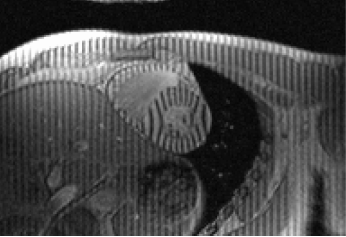
MRI Tagging

Tagged heart

Sudden change in plans and improvement of research direction leads me to the exploration of MRI tagging, which proves to be difficult when one tries to actually find raw data to work with, not information about it. In the coming days I plan to prepare a post explaining to people where they can obtain tagged data of the brain and the heart (trying to help others solve the problem which occupies many hours of my time). The Internet is extremely mature when it comes to sharing of text and sometimes even audio and film, copyright being an obvious barrier. When it comes to medical data, however, it is another story altogether, even if it’s totally anonymised. Personally, I’ve put 3-D scans of my brain on this Web site, hoping to provide people with the sort of data I sometimes struggle to get a hold of.

Wednesday, November 10th, 2010, 12:13 am

Fourth TechBytes Episodes: Fedora 14 Rave

TechBytes

Direct download as Ogg (1:18:09, 31.9 MB) | Direct download as MP3 (34.9 MB)

Summary: Tim and Roy discuss Fedora 14 (which Roy installed today), file sharing, DDOS attacks, and they also cover a variety of GNU/Linux distributions

THIS is the fourth episode, which is also the third episode released in 3 days. OpenBytes has some show notes and in the future the structure of the show will be as follows (as per Tim’s suggestion):
  1. News headlines summary
  2. One discussion point (or guest interview)
  3. Feedback
  4. Close on highlighted artist

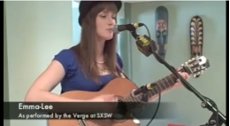
Emma Lee the singerThis show closes with a lovely song from the lovely Emma Lee (maybe not the same Emma Lee as the famous one). The song is called “That Sinking Feeling” and it was a free download in SXSW 2009 (Showcasing Artists).

RSS 64x64If you wish to be on the show or know someone who ought to be on the show, please let us know. As always, if you enjoy this show, please consider recommending it to others and consider subscribing to the show via the RSS feed. If you have an Identi.ca account, consider subscribing to TechBytes in order to keep up to date.
As embedded (HTML5):

Download:

Ogg Theora
(There is also an MP3 version)

Tuesday, November 9th, 2010, 12:14 am

TechBytes Episode 3: Focus on Games

TechBytes

Direct download as Ogg (1:14:09, 23.8 MB) | Direct download as MP3 (33.9 MB)

Summary: Tim and Roy discuss today’s news about games, graphics cards, and 3-D effects in GNU/Linux; towards the end of the show the discussion is focused on the competition

THIS is the third episode of our show, which now increases in terms of release pace and audience size. The show is neither scripted nor edited, but it strives to cover all the news that matters and delve into discussions which other Web sites seem to avoid. Show notes can usually be found at OpenBytes, which also posts links of relevance.

In a future show we may speak to “wallclimber”, who contributed a lot to Techrights and will hopefully be on TechBytes some time in January. She requires some preparation, which we too will be doing as the show matures. The interference of background noise has been reduced and the flow of the show will hopefully improve over time, even without any rehearsals.

RSS 64x64As always, if you enjoy this show, please consider recommending it to others and consider subscribing to the show via the RSS feed. If you have an Identi.ca account, consider subscribing to TechBytes in order to keep up to date.
As embedded (HTML5):

Download:

Ogg Theora
(There is also an MP3 version)

Sunday, November 7th, 2010, 6:51 pm

TechBytes Episode 2: Apple Fails in Servers, Microsoft Fails on the Web, and Everyone Heckles Ubuntu

TechBytes

Direct download as Ogg (1:29:46, 28.9 MB) | Direct download as MP3 (41.1 MB)

Summary: Tim and Roy discuss Apple, Microsoft, UK innovation, and of course a lot of GNU/Linux in this second episode of TechBytes, which is hopefully entertaining

TIM opens this show with an introduction which soon becomes a discussion about Ubuntu. Later on we speak about Silverlight, Moonlight, and WPF, which are seemingly a dead-end endeavour.

Roy corrects some remarks he made last week about Octave, a project he has not tried for years. He now testifies and talks about how impressed he is by Octave, which has made a lot of progress. Other issues that are covered towards the end are licence compliance matters and women in Ubuntu (now exceeding 5%).

In future shows we may speak about Steve Ballmer getting rid of a lot of Microsoft shares, possibly with Marti, Wayne, and several other guests who are sceptical about Microsoft’s claims. As a reminder, TechBytes does have a room for discussion about the competition, unlike some other shows.

RSS 64x64If you enjoy this show, please consider recommending it to others and consider subscribing to the show via RSS feeds or subscribing to TechBytes at Identi.ca.

As embedded (HTML5):

Download:

Ogg Theora
(There is also an MP3 version)

Friday, November 5th, 2010, 12:08 pm

Susanna Sorogon

Susanne Sorogon

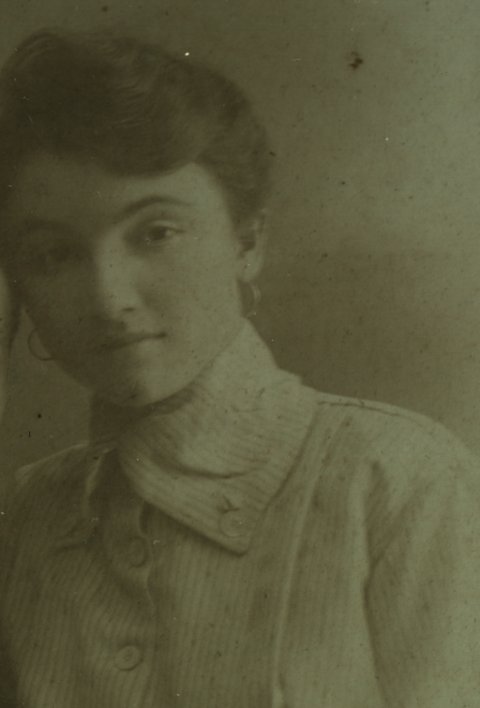
IT HAS BEEN many years since I last updated or maintained the family tree pages on this Web site (not public), but moments ago I expanded the collection and also found this old photo of my great grandmother, whom I never met in person. It is saddening that several generations down the line people are no longer remembered, neither by their photo/s (they are not tagged with names, so blurring and fading are not the main issue, which digitisation can slow) nor their name; often enough not even a date of birth is recorded, let alone a short biography. It will be interesting to see what the Internet generation can do to change this.
Wednesday, November 3rd, 2010, 6:32 pm

DICOM Viewers for GNU/Linux

DICOM in Octave

DICOM in viewer

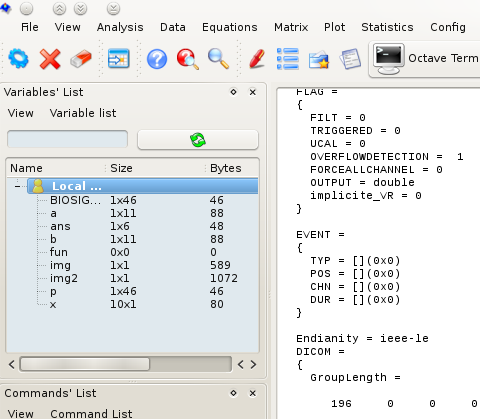
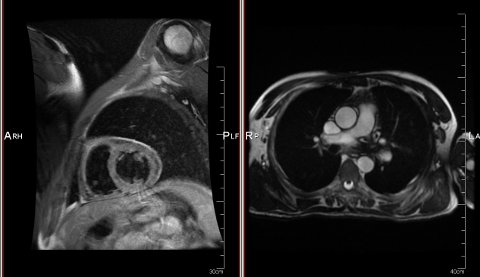
IT HAS been a while since I last did a comprehensive survey of DICOM-related software and since I am ditching MATLAB (in the quest for Free software-only research) I decided to review or at least check out what’s available at the end of 2010. Other people may find this handy.

DICOM is notorious for being the standard that’s not quite the standard and is actually somewhat proprietary and controlled by one entity. As someone pointed out the other day, DICOM is considered “extensible”, which implies that the usual type of format ‘bastardisation’ will always occur. It’s just an inconsistent data format as someone warned, so some software would cough at it and sometimes manage to salvage some data. According to Wikipedia, some tagging of the image/s is accompanied by data fields like:

Value Representation Description
AE Application Entity
AS Age String
AT Attribute Tag
CS Code String
DA Date
DS Decimal String
DT Date/Time
FL Floating Point Single (4 bytes)
FD Floating Point Double (8 bytes)
IS Integer String
LO Long String
LT Long Text
OB Other Byte
OF Other Float
OW Other Word
PN Person Name
SH Short String
SL Signed Long
SQ Sequence of Items
SS Signed Short
ST Short Text
TM Time
UI Unique Identifier
UL Unsigned Long
UN Unknown
US Unsigned Short
UT Unlimited Text

Let us say that we are more interested in the raw image data and not so much in the metadata. If that’s the case, batch conversion to a more manageable format is worthwhile. Here is the command-line converter that I use (some are for Windows only and they are proprietary) and some other options can be found on the Web through directories. There are also good software resources on scientific data formats and there is radiology CEU information regarding PACS and DICOM viewers. There is actually far more choice out there than there was a few years ago. For GNU/Linux and Free software proponents there is no lack or deficiency, either.

Wednesday, November 3rd, 2010, 4:11 pm

Octave Packages – The Free Software Candy Store

Octave packages

Octave packages - window

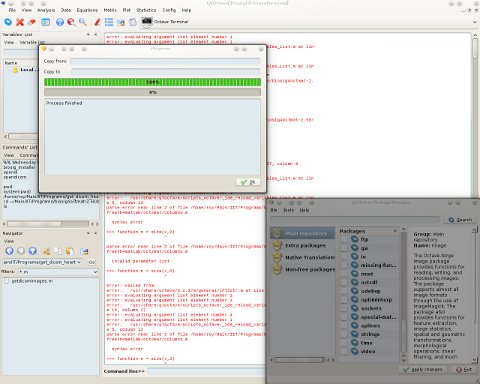
THIS POST is part of a series that I do about my incursions moving from MATLAB to Octave, which has so far been a pleasant experience. QtOctave looks better and is easier to install than MATLAB (on GNU/Linux with KDE at least). For those who experienced being a customer/user of MATLAB, it can really be a pain in the butt, licence-wise. The parent company, MathWorks, can be very aggressive when it comes to licensing (it pays the BSA after all), so people are kept tied to particular IP addresses and must renew something to remove artificial limitations. Moreover, the toolboxes that MATLAB sells separately are a case of artificial scarcity and they can be expensive. Octave resolves much of this by centralising a lot of software as shown in the screenshots above (also separating free/libre from proprietary). Rather than waste time with paperwork and bank transactions, any QtOctave user can simply and quickly click away to receive anything s/he desires. It’s truly like a candy store.

Why ever go through the trouble presented by MATLAB, Maple, Mathematica, or IDL? Some people may need these for collaboration and consistency (as in monoculture), but it is better to start without any proprietary software dependency.

I will report on more aspects of this comparison as I go along. At the moment I’m exploring the GPLv3-licensed BioSig project, which allows me to deal with DICOM datasets of the heart (images acquired just recently — ones that I picked up at the hospital yesterday). Speaking of which, I’ve learned that some scanning machines that traditionally used Windows are now moving to GNU/Linux. How exciting times are coming…

Real-time Posts

Posts by @schestowitz

Retrieval statistics: 23 queries taking a total of 0.102 seconds • Please report low bandwidth using the feedback form
Original styles created by Ian Main (all acknowledgements) • PHP scripts and styles later modified by Roy Schestowitz • Help yourself to a GPL'd copy
|— Proudly powered by W o r d P r e s s — based on a heavily-hacked version 1.2.1 (Mingus) installation —|