Summary: Tim and Roy speak about some recent news and discuss the world of GNU/Linux gaming
ODAY’S show was covering games for GNU/Linux and to some degree phones running Linux as well. We left our discussion about trolls and lobbying to tomorrow’s show and OpenBytes will have published the show notes by then (it’s late now in the UK).
Summary: A few hot topics from the past few days are debated and we also make a mention of Mono proponents
ODAY’S show was a short one as it was not scheduled and erratic work schedule harmed our regular pace. Gordon was absent, but he will be back in the next show. OpenBytes has published the show notes just now.
Summary: After almost a week (due to absence) we return to covering and debating recent stories of relevance within our scope
ODAY’S show covers many topics ranging from Google’s new operating system to Microsoft’s slow death in the mobile space. OpenBytes has published the show notes containing some of the topics we ran through.
oday I implemented circular arrangement of landmark points for the algorithm to identify something approximate/similar to the shape of the heart and then place a given number of points around there. In addition, a boundary is shown by sampling between those points, which gives a contour, with or without arrows on top of it. I will upload the code shortly (needs tidying up).
ather than use the line function in Octave I’ve created a function that can draw several types of arrow, either with colour gradients or uniform, thick or thin (these are parameterised). I’ll soon publish the code.
The shown above arrows are very tiny, but there is a small arrowhead that tells which direction the points move in. Additionally, I have been implementing some 3-D means of visualising what is being done, but it is too early to show the results of this, possibly with arrows in hyperspace too.
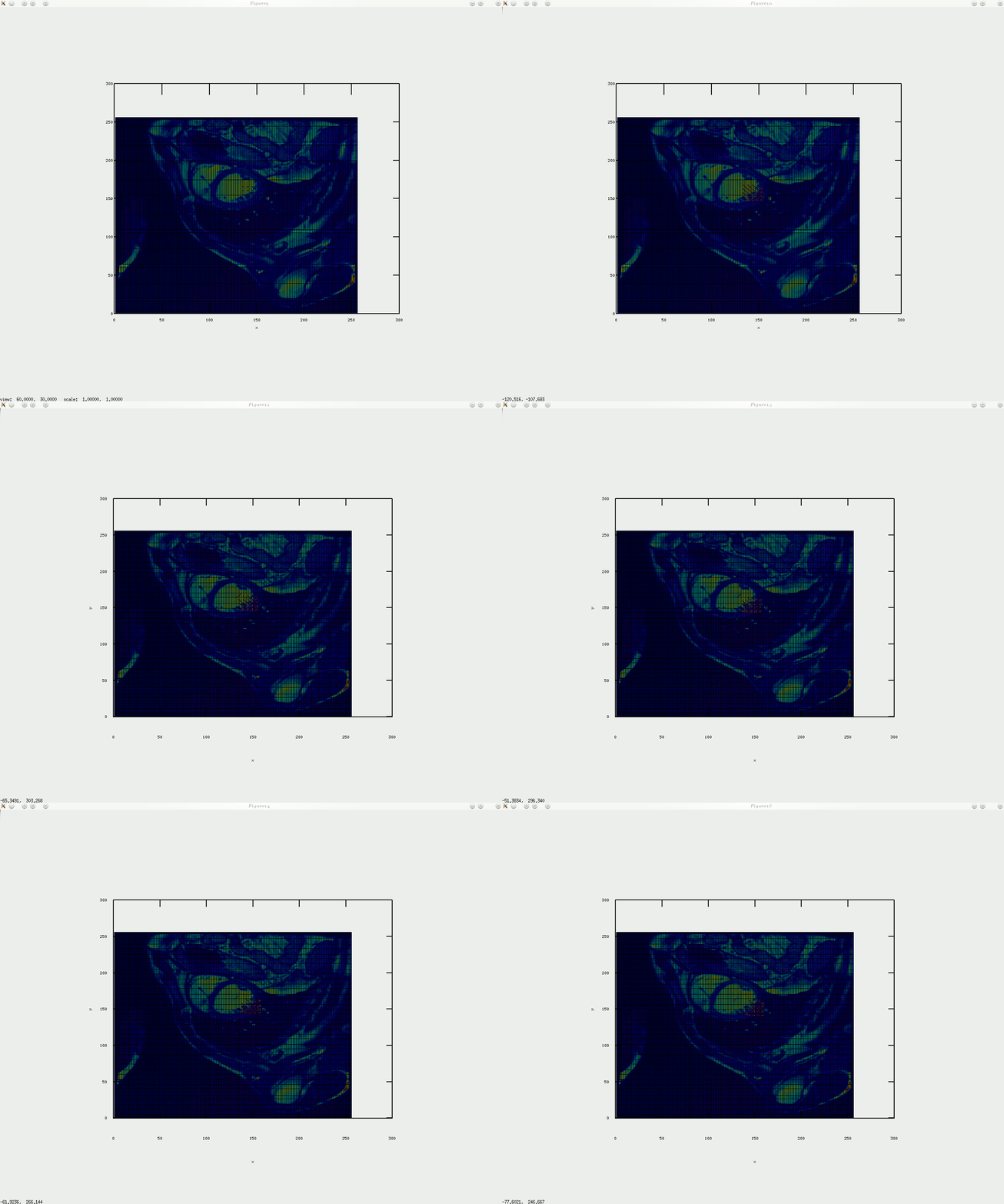
These new exemplary images show a surface yielded with ‘hot’ colours where I move landmark points in between frames. It’s still work in progress.
he GIMP is an extremely powerful program and animation in the GIMP can be achieved with layers. That’s why I can get so much work done just with Free software and GNU tools like gnuplot. This includes some of the following new examples, which are done by taking screenshots (from the GIMP), stacking them up as layers, and then saving them as a GIF file with the animation option enabled.
The following file, an animated GIF image which comprises 8 frames with 600ms setting them apart (click the image to zoom), shows my new algorithm tracking the heart’s boundaries in a sequence taken from the same slice, which prevents sudden, unregistered change in the intensity values near the point being probed. 16 points are initially fixed in a region, equally spaced although that is not a strict requirement because the program takes any list of points and handles each one in turn. The points are separated by a 5-pixel distance in the x and y axes although that too can vary independently based on parameter input that sets a grid (better initialisation would look for edges of interest). The shown arrows are narrow and crude although an option exists for making them thick (which then hides interesting parts of the image). The shuffle parameters in this case involve a frame size of 9×9 pixels, a shuffle radius of 5 pixels, and a summation of pixel-wise differences.
A colour representation of the same images sequence is shown below (click to zoom).
Another newly-implemented method looks at another measure for a window of pixels taken from consecutive frames. It considers a minimum of pixel-wise differences in a given range rather than take the average difference. The results obtained using each of these methods cannot be easily compared without a simplified synthetic set and a proper study would need to involve systematic experiments that look at how varying window size, radius, and calculation method affects overall performance. There is quite a project right there, but it only involves tracking, with or without tagging. Tags can help in identifying good landmark points to start with — points that define an anatomically-meaningful edge to start from and track as the sequence of frames progresses. Eventually, providing a formula for normalising a measure of similarity would be nice. Such a normalisation method — if properly applied — gives a new way of finding landmark points ‘on the move’. Doing so using non-rigid registration (NRR) is not possible for the heart as there is hardly a one-to-one correspondence between points (too much movement). The hope is that by employing a fast tracking algorithm with a good transform which adjusts itself for image intensity, size et cetera, it will be possible to identify edges and perform localised measurements, perhaps even do statistical analysis based on different sets of videos (long-term goal). These ideas are not far fetched and the body of work already done in this area ought to be explored. The novelty is the transform being used to quickly calculate similarity wrt neighbouring points, so existing work look at how to adjust parameters so as to get better results. In this particular problem domain, tracking the heart’s contours reliably and robustly enough is the objective, however it is not simple to do this ‘on he fly’ (speed of video playback for example).
EAKS are often just material which was supposed to be in the public domain all along. Copyright is not the issue. Since it was kept secret (often for no truly justifiable reason), input which was contained in it assumed no moderation would be needed. As such, secrecy resulted in mischief, rudeness, and often the perpetuation of misconduct, which relied on lack of wider awareness.
As I explained repeatedly over the years, I too was bullied for leaking documents which ought to have been out there all along. This is the main reason I am willing to dedicate so much time to defence of Wikileaks. I too may soon leak some more documents and I don’t want to get the “Assange treatment”. Nobody does. “EVERY attack now made on WikiLeaks and Julian Assange was made against me,” writes Daniel Ellsberg this week. For those who do not know, Ellsberg was partly responsible for ending the bloody Vietnam war.
Leaks hurt. Truth hurts, too. But always bother to check who it hurts the most. Therein lies the answer regarding the ethics of a leak.
The word “leak” — like “whistle-blower” — has a negative connotation. Let’s call leaks “enlightenment” and whistle-blowers “truth revealers”.
Retrieval statistics: 23 queries taking a total of 0.098 seconds • Please report low bandwidth using the feedback form
Original styles created by Ian Main (all acknowledgements) • PHP scripts and styles later modified by Roy Schestowitz • Help yourself to a GPL'd copy
|— Proudly powered by W o r d P r e s s — based on a heavily-hacked version 1.2.1 (Mingus) installation —|


 Filed under:
 ODAY’S show was covering games for GNU/Linux and to some degree phones running Linux as well. We left our discussion about trolls and lobbying to tomorrow’s show and OpenBytes will have published the show notes by then (it’s late now in the UK).
 Today’s show ends with “Paper Gown” by Caroline Herring (from SXSW 2009 Showcasing Artists). We hope you will join us for future shows and consider subscribing to the show via the RSS feed. You can also visit our archives for past shows. If you have an Identi.ca account, consider subscribing to TechBytes in order to keep up to date.


 ather than use the

 EAKS are often just material which was supposed to be in the public domain all along. Copyright is not the issue. Since it was kept secret (often for no truly justifiable reason), input which was contained in it assumed no moderation would be needed. As such, secrecy resulted in mischief, rudeness, and often the perpetuation of misconduct, which relied on lack of wider awareness.