ENNY, pictured above, has been with us since I was about 8 or 9. I have just received some terrible news. Due to her degrading condition, including poor sight and sense of hearing, she will put put to sleep within a couple of days. I will sorely miss her. My memories of her go as far back as I can remember. Like all golden retrievers, she was calm, obedient, and affectionate. Jenny was family.
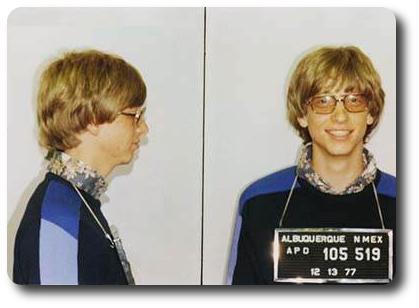
Bill Gates arrested in his younger days (photo in public domain)
would like to divert the readers’ attention to to my most recent post in another blog. Many of Microsoft’s dirty tricks are finally out for public viewing, indefinitely. I intended to put all of them on my external hard-drive, but gave up due to the enormous volume. Therefore, I’m glad they are online, saving me the storage burden. Which reminds me of a little joke:
[sarcasm]
500 GB. Now that’s a lot of space to accommodate with pr0n.
Files under /brunettes/2006/dec/29/3/volvume10/issue2/
OME time ago I was asked about my working habits in Netscape.com. My reply no appears in a friend’s blog. As I wrote my response in a rush, I have since then decided to tidy up the text a little bit. The slightly expanded explanation lies below.
In a nutshell, by concentrating on one topic at Netscape I know much better what was already submitted and I also know which bits in articles can connect, what gets repeated, and what’s considered major news. I used to be more diverse and I sometimes tried to break the news, but it was harder to keep track of. A lot of items were virtually ‘blocked’ because of duplicates, which I always try to avoid. I chose to be working on Open Source and Linux, for which I have real passion. This increases morale and motivation throughout work. It is merely a case of being amused while compensated, owing to formal role (and accompanying duties) of a Navigator.
I work in ‘batch made’, so over the course of the day I accumulate a list containing a title, a short description and a link. I assemble these in a simple text file. Because I don’t submit stuff immediately, however, it’s unlikely that I will be able to get the major news in. Duplicates are just out of the question. 2 or 3 times a day I just open many submit-type pages, allocating them to separate browser tabs, and then do the data entry from the text file I prepared. One monitor contains the Web browser and another contains the text file. As I scroll down the list I also separate some item which I wish to E-mail for use at Groklaw.
As for articles that I collect, I go through many hundreds of titles in the RSS feeds and follow about half the links. I try to extract the text that’s most eye-catching out of articles/blog items. Choice of RSS feeds is important because some tend to repeat the news (Slashdot, CNN, BBC), serving as slow and careful-to-corrobate-with-sources middlemen, whereas sites like Digg and C|Net have a lot of early scoops.
HE boundary between tags and channels, which are the means by which Netscape organises content, is becoming fuzzy. It seems like the former is likely to replace the latter, in due time.
Social news or meta-journalism appear to catch on as more and more large companies adopt them. Organisation of the user-contributed content, however, remains a tricky business. Categories, sections, and front pages no longer seem to work as there are better ways of delivering targetted content. The solution may be to personalise it all.
The use of tags is probably under-appreciated. When accommodated properly (e.g. not diluted through pluralisation), then assuming many submissions, a tag will appear in the tags cloud. Then, it will become available as an RSS feed or a vibrant Web page. Personally, I track tags of interest, rather than channels. Channels are a bit ‘old school’ because they mimic and inherit the limitations of traditional papers where one size fits all.
Categories are by nature static, so emerging hot topics will just expand or eliminate categories, leading to clutter or obsolesce, respectively. Even Digg constantly ignores the requests for new categories. But Digg has got word tracking (search as feeds), not tags, which is an inferior alternative. Unfortunately, at busy times of the day, Digg arbitrarily rejects requests for this type of feeds. They are resource hungry when generated. And that’s where Netscape is ahead.
One particular part of the article that caught my attention is this:
Air travel
“Green” travellers are boycotting air travel because of climate change. Campaigners have staged sit-ins at airports while hundreds of people have signed up to an online pledge set up by a veteran environmental campaigner. An estimated 3 per cent of people have stopped flying to help the environment, while 10 per cent are cutting back on flights.
Dead penguins, dead polar bears, larger oceans, and houses under water. Is this the future?
The world’s largest tropical glacier is in danger of disappearing within five years, according to international researchers meeting this week in San Francisco.
Take action and reduce waste. Every little helps.
Let us borrow this story and translate its impact to aspects of software development. In programming, greater reuse of code translates into fewer ‘seats’. Dependently, programmers require waste. Without waste and reproduction there is better utilisation of code replication capabilities. And then there’s commercial software that thrives in waste, leading to a morbid & spontaneous spasm in Mother Nature. Let’s work for Earth, not against it.
Retrieval statistics: 23 queries taking a total of 0.102 seconds • Please report low bandwidth using the feedback form
Original styles created by Ian Main (all acknowledgements) • PHP scripts and styles later modified by Roy Schestowitz • Help yourself to a GPL'd copy
|— Proudly powered by W o r d P r e s s — based on a heavily-hacked version 1.2.1 (Mingus) installation —|


 Filed under:
 ENNY, pictured above, has been with us since I was about 8 or 9. I have just received some terrible news. Due to her degrading condition, including poor sight and sense of hearing, she will put put to sleep within a couple of days. I will sorely miss her. My memories of her go as far back as I can remember. Like all golden retrievers, she was calm, obedient, and affectionate. Jenny was family.

 would like to divert the readers’ attention to to
  OME time ago I was asked about my working habits in
 HE boundary between tags and channels, which are the means by which Netscape organises content, is becoming fuzzy. It seems like the former is likely to replace the latter, in due time.
