Introduction About Site Map

XML
RSS 2 Feed RSS 2 Feed
Navigation

Main Page | Blog Index

Thursday, October 5th, 2006, 2:25 am

Wikipedia and Research Papers

WIKIS and research are a funny dou. As I recently pointed out, Wikis are an excellent tools for improving researched-on, peer-reviewed content. On the other hand, as this new article with some general background and criticism suggests, a Wiki is susceptible to abuse if it’s too open to a wide audience.

Brent Freccia, a social studies teacher at Newark High School in Delaware and a self-proclaimed “avid wiki-person,” created an entry for his school on Wikipedia, the oft-visited online encyclopedia and go-to source for students writing research papers.

An example where things can go terribly wrong:

When Cardinal Joseph Ratzinger was elected as pope last year, some Internet users who logged onto Wikipedia to see what he looked like found a rather different image: that of the evil emperor from “Star Wars.”

Tuesday, October 3rd, 2006, 5:00 pm

Monopolies Go Global

Out from afar I continue to observe an American domination that expands through integration, acquisitions, and a worrisome process of ‘innovation’ takeover. Here is an example from yesterday’s technology section.

Yahoo!’s shopping spree is showing no signs of letup. During the past 18 months, the online media and search giant has acquired photo sharing startup Flickr, social bookmarking site Del.icio.us, and Upcoming, a user-generated social events calendar. It has also tried to acquire social networking site Facebook for upwards of $1 billion.

Map of EuropeMicrosoft, Oracle, and Google (among a few others) are no exception. Microsoft in particular has been buying plenty of startups in order to penetrate the Web. Larry Ellison eliminated Open Source threats by buying them off (this includes an attempt to snatch MySQL, having led PeopleSoft to their demise). And while Oracle uses Linux very heavily and has seen a sharp rise in profits, it all makes you wonder where the global industry is headed. Technology is not the only sector affected. Giants such as MacDonald’s or Wal-Mart are there to remind us that they can go global and eliminate mom-and-pop stores in the process. Ultimately we may all find ourselves enslaved to few powerful players whose leaders accumulate billions.

This is made worse when large players liaise in order to squash any emerging threats (disruptive technologies such as Open Source software). Essentially, they promote their own agendas using seemingly-infinite powers and resources. As an example:

Why the world needs openness, not interoperability

This NAC/NAP lovefest would be laughable if it weren’t such a kick-in-the-teeth to the rest of the industry, enterprise IT, and all Internet users. A Cisco/Microsoft oligopoly stalls implementation, stifles innovation, and makes the network less secure. In this way, Cisco and Microsoft are standing in the way of progress.

Unless legistlation changes, only the universe is the limit. Corruption, lobbying, and shilling do not help either.

Monday, October 2nd, 2006, 11:22 am

Software Oligopoly and Impending Transition

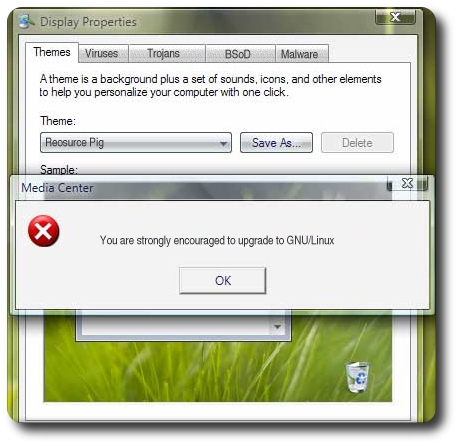
Vista error message

I shall continue to argue that Microsoft software (and Windows primarily) is slow and too cumbersome to work with. It discourages high productivity levels. Might this explain why that company from Redmond has produced so little in the past 5 years? Let us discuss.

I am shocked to see a software behemoth with so many employees still struggling to ship products on time. I can recall that rusty O/S called Windows XP, which was released when I was a teenager. It’s amazing that Microsoft has achieved so little in the past half a decade. All it has been able to get is just another ‘Service Pack’, to be ready some time next year. This one has a different name and a new theme, Aero Glass (see above). It also bears a hefty price tag.

Linux users may like to handle complexity, but meanwhile it seems as though their codebase is far more maintainable than that of Microsoft. In case you have not followed some key events, 60% of the codebase of Windows must be rewritten as it’s an utter pain to extend.

Let us take a step further and discuss the issues of security, diversity, and competition. Windows was not built with security or multiple users (network thereof) in mind, so it is merely ‘patched’ to bridge that crucial gap. A one-man election might work with Windows-based Diebold machine. Windows is, after all, a single-user O/S with some ‘hacks’ that make it possible to be used by multiple users in a network that involves more than a single user (e.g. Internet). And it’s worrisome. This has led to cyberstorms and makes the Internet a less pleasant place than ever before. Patches take long to issue because, in a codebase with ‘hacks’, there are just too many dependencies to consider. There is poor modularity. This monolithic approach leads to flakiness and unpredictable behaviours.

Is diversity the answer? Is a staged migration to more mature and reliable platforms the path to secure computing? I have little or no doubt about it. But this will not be easy. It is only natural to assert that Microsoft is doing illegal stuff to stifle its competition. Such a software industry vermin deliberately restricts ‘diversification’. There’s no parity in the industry that outmuscles any competitive threat before it matures to match the behemoth. It strives towards a state of mono/oligopoly and the law offers no barriers as it’s being tweaked by lobbyists.

Competition, you argue? I see none, but luckily people begin to see this and respond accordingly. It’s a false sense of competition when a startup needs and depends on vendor X in order to develop a product to compete with vendor X. That’s what Microsoft does through operating systems, distribution channels, licensing, and programming languages. A stronghold on the market may soon be broken, at least in Europe. The remainder of the world is secretly/quietly migrating to Linux, albeit the scale of this is not being blown out of proportion using advertisements. There is no marketing department in a Free software initiative.

Friday, September 29th, 2006, 10:17 pm

Updating One’s Resume

LAST month I discussed the need to generalise and open one’s own resume, as means of being fit for more jobs, as well as never be bound to one commercial product or vendor. This led me to have a quick look at my personal pages which I wrote several years ago. As the footers indicate, the introduction and CV page are well out-of-date. I have not bothered to get them updated for years, but I still maintain my real (full length) CV, which is not public anymore. It’s usually out-of-date as well, for the reasons I describe below.

I write down ‘patches’ on my PDA whenever an suitable addition is pending, for the CV or other documents that I maintain for some purpose (all written in LATEX). The extended CV, adjoined with a personal lift journal that I retain, is already approaching 100 pages in length. As my mind has a limited capacity for remembering past events and achievements (sometimes reusable, e.g. for other formal and much-required documents), over the years I decided to write them down whenever they cropped up in my mind. So that’s how the idea of accumulating ‘patches’ to documents (notably the CV) was born. Writing text can be assimilated to the model of writing code.

Monday, September 25th, 2006, 5:19 pm

Certifications Make All the Difference in the World

MIAS IRC presentation

ONLY a year ago, before ODF became the ISO standard, I had to engage in lengthy and complex arguments over formats. I was doing fine by my own, but the issue of exchange arises in wider public arenas. Not anymore though. The crowning of ODF gives all the protection that I require. Here is an anonymised E-mail that I have just sent.

>Dear Roy
>>
>> Please can you email a sample of your presentation file so
>> that the IT guys here can find the relevant software and
>> load it onto the equipment in the lecture room.
>>
>> Please send it by return

Hi [anonimised],

This file is in OpenDocument Presentation format, which
is the international standard for presentations (ODF). One
common applications that handles it is OpenOffice 2. I
understand that Microsoft intends to catch up with the standards
in Office 2007, essentially by supporting ODF through a plugin.

Many thanks in advance,

Roy

I will be presetning at Oxford University later this week.

Sunday, September 24th, 2006, 12:25 pm

Rough Life in Some Small Dive

Music shopThe title of this post is a bend of the lyrics “I’ll live a lush life in some small dive” from the song Lush Life, which is among my personal favourites. Why did I choose it? Because it radically contrasts what I’ll discuss here.

When I go out clubbing, I like to experience change. Going out is about breaking a routine. Sometimes I go to rougher places where I can get my mouth dirty rather than a posh bar or a so-called gentelemen’s club (or anything akin to it). The type of people whom I meet is fascinating and at times even inspiring. It gives a nice break from the ordinary and otherwise banal life.

When it comes to literature, on the other hand, I don’t fancy quite the same contrast. Frankly, I no longer follow sports and ‘celebrity’ news. I don’t read tabloid either. Some days ago I received another request for my address, for a free preview (prerelease) of a book. The last time I turned down the offer, but friends argued it was silly. In hindsight, I should have probably accepted the offer that was there. It was a book packed with sophistication. This time for a c change, the book appears to be tabloid-style, with sheer disdain for George Bush.

Friday, September 22nd, 2006, 5:34 pm

Identifying Personal E-mails and ‘Botmails’

Boxes

STUDIES which analyse large volumes of communication have always been interesting. For instance, most of the E-mail traffic nowadays is identified as SPAM; and over 80% of it is said to come from compromised Windows PC‘s. However, for a change, this is not what I wish to discuss today. I don’t want to have yet another bite at the effects Windows has on the WWW. It leaves me bitter.

Earlier today I read that only 37% of all E-mail at the ‘average’ office are personal E-mails. The rest are not. Some E-mails these days are invoked from a system rather than a human. Typically these are less interesting, less urgent, or can be altogether ignored. Some of that is mass mail, automated and despatched using address databases.

It is sometimes hard to discern between a personal message–one to which a response would be polite–and one which is targetted at a wide audience and whose content is carefully doctored to appear personal. I would like to recommend and promote a personal tip of mine. It is a little method I thought about for detecting and telling apart computer-generated from human-generated mail. When entering your name (e.g. at registration stage), for example, always append extra spaces that serve no purpose but preserve the integrity of the name. Having done so, you challenged the wisdom of the bot. Before punctuation, for example, you can see if a human inserted the name properly. A naive algorithm will not bother to crunch spaces, so the automation deems self-evident.

In other circumstances, having the recipient’s addresses within sight may help. Full headers can be very informative and various Thunderbird extensions even simplify text with representative figures (e.g. routing information as a series of flags, mail client name as an icon, signature as an icon, etc.). It makes the information easier to digest and it adds a wealth of knowledge that is often missed. Lastly, never discount the BCC tricks. A seemingly personal message can reach anyone ‘on the same wagon’.

Real-time Posts

Posts by @schestowitz

Retrieval statistics: 23 queries taking a total of 0.090 seconds • Please report low bandwidth using the feedback form
Original styles created by Ian Main (all acknowledgements) • PHP scripts and styles later modified by Roy Schestowitz • Help yourself to a GPL'd copy
|— Proudly powered by W o r d P r e s s — based on a heavily-hacked version 1.2.1 (Mingus) installation —|