Introduction About Site Map

XML
RSS 2 Feed RSS 2 Feed
Navigation

Main Page | Blog Index

Wednesday, July 26th, 2006, 12:19 pm

Downtime, Heat Waves, and Windows XP

Server room

SO, there I am at work again. By all means it’s an ordinary day, but the unusual heat makes me want to stay inside where it’s air conditioned. Just a minute ago I saw a follow Ph.D. student slamming his mouse and keyboard. I could see an empty Windows XP desktop, so I can only imagine that it froze on him (possibly after an important overnight experiment). That’s just something, isn’t it? No access to the results and a whole night gone in vain. I’d offer him Linux (it’s already installed on his secondary partition), but I don’t want to risk alienation or become his ‘support guy’.

My computer was running from April to July (SuSE Linux 8.1) without a single reboot, but we had three outages recently. These were due to the heat wave that evidently affects London datacentres, as well as California (notably the half-day MySpace downtime). I even heard about Utah too last week… downtime reported in news:alt.www.webmaster. I then found a news release and reproted it to Walt as a possible proof that the Web host was not lying. I guess we must all have to cope with the effect of the weather on our servers. Everyone suffers the same, so balance prevails.

Tuesday, July 25th, 2006, 5:37 pm

The Thunderbird Ideaology – Start Small, Grow Huge

CrossOver
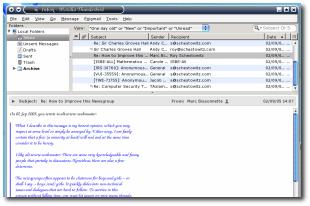
A screenshot of Thunderbird with the CrossOver theme

MOZILLA Thunderbird is, in my humble opinion, a very user-friendly mail client (as well as feeds reader or news reader) ‘out ot the box’.Like Firefox, it was built to suit merely anyone, even those who describe themselves as computing mediocres. Shall you wish to entend it, possibly making it more complex and harder to master, all you need to do is go to the official extensions page, click on the install button and make your application far more versatile. I have a dozen extensions installed at the moment and jointly they make Thunderbird more powerful than any other mail client I have come across.

Monday, July 24th, 2006, 12:14 pm

Reality Check: Getting a ‘Real’ Job

Computer lab
Another day, another dollar.
But is your workplace a dreadful place to be?

I quite enjoy my life in an arena which involves research, publications, public appearances, sharing of code that I produce, and technical writings that I rapidly accumulate. All of that, in fact, is something that reaches culmination through the Internet and Web sites, which are — to me at least — a gateway to a wider world. For long I have pondered (and even lost sleep over) a scenario where I find myself in a cubicle, coding for somebody else day, by day, by day…

Dreadful forecasts aside, there are other ways to make a living. Fortunately, a happy life is one where making ends meet should suffice, vacations are unnecessary, and help for those that surround us gets elevated. I seem to be getting worried prematurely. Here is one such article that speaks of self-employment and affordable independence.

It’s funny that when people reach a certain age, such as after graduating college, they assume it’s time to go out and get a job. But like many things the masses do, just because everyone does it doesn’t mean it’s a good idea. In fact, if you’re reasonably intelligent, getting a job is one of the worst things you can do to support yourself. There are far better ways to make a living than selling yourself into indentured servitude.

This reminded me of an older blog item (a speech actually) which I once read and boomarked. It moved me enormously.

I was a diligent Oriental in high school and college. I took college-level classes and earned college-level credits. I rushed through college in 3 1/2 years. I never traveled or took time off because I thought it wouldn’t prepare me for work and it would delay my graduation.

Frankly, I blew it.

You are going to work the rest of your lives, so don’t be in a rush to start. Stretch out your college education. Now is the time to suck life into your lungs-before you have a mortgage, kids, and car payments.

Another nice item from the first author (one which I commented on before) speaks of 10 ways to relaxify your workspace. Recommended reading!

Monday, July 24th, 2006, 7:17 am

Battle of Two Linux Titans

SuSE Linux beta, KDE

The older KDE-based version of SuSE Linux

ANOTHER short Linux comparison has taken my attention. It is by no means a professional or comprehensive review, but is does provide a ‘taste’ of two ends — Ubuntu and Novell’s SLED — both of which are GNOME-based GNU/Linux distributions. Below is just a fragment.

In conclusion, SLED 10 brings everything that Ubuntu does and feels slightly faster. But Ubuntu has bigger and nicer community and .deb is simply better than .rpm. Out of 10, I give both of them 10. Linux desktop has never been so good.

I quite like the author’s illustration of the increasingly-popularised Mac OS X look in Ubuntu. There have always been significant visual improvement in SLED, particularly since SUSE 10.1 was released with grey shades in GNOME.

Sunday, July 23rd, 2006, 8:56 pm

Misinformed Article About GNU/Linux

Season of the playful penguins
Season of the playful penguins from Oyonale

YESTERDAY I noticed an article which is due to go public on July 24th (that’s tomorrow). This article was titled “A Linux OS For All” [rel="nofollow"], but this title may be very deceiving, in my humble opinion. Its inference is not a very positive one. It led me to the thought of One Microsoft way (or Apple, for the sake of this argument’s completeness). To quote one part of the article that truly itched:

“Linux, on the other hand, does not have that excuse—the operating system should be popping up all over the place. From my experience, the features I like about Linux are probably also the biggest limiting factor to its widespread adoption on the desktop. Linux proves to be infinitely customizable and has a plethora of applications available, yet those excellent capabilities bring confusion to the product.”

I had to scratch that itch. Essentially, the author proposes robbing users from choice and diversity. Monoculture is what Linux is here to address/tackle. Isn’t that what SLED is for, after all? Why eliminate all others which are fine contenders? And why spread FUD about compiling packages when there are such huge Ubuntu repositories. Initially I thought that someone else should E-mail him (he explicitly invites feedback); even doing so before the article goes live! Eventually, I did this myself last night. I’m hoping to get a response on Monday. Patience is divinity, but the clock keeps ticking.

Update (24/07/2006): I received a reply suggesting that my words can be added as an appended Letter to the Editor.

Sunday, July 23rd, 2006, 12:28 pm

Digg’s Effect on Search Engines

The Digg front page

I must admit that I have fallen in love with the ‘Digg (sub)culture’. And primarily owing to Digg (and its saturation of dynamically-generated pages), the number of hits for my surname is growing at a wild pace across search engines. It is approaching one million in Google (Interesting fact: if I received a penny for every hit that is added to Google, for example, I would be able to make ends meet). This wasn’t intended; rather it’s a side effect that I have just become aware of. I tend to have a consistent username, which is always available due to the small size of my family.

I suspect that, at the moment, Digg boasts over 10 million subscribed members who are largely interested in information technology. Many will be exposed to the virtues of GNU/Linux and Open Source, which seems encouraging to me. At the time of writing, 4 of my submissions appear in the front page, among 15 submissions in total. That’s almost a third of a front page, whose domains’ Alexa traffic rank is among the top 100 sites on the Web. What an overwhelming experience.

Sunday, July 23rd, 2006, 9:11 am

Reliable Backup Mechanism

Data Recovery - presentation

T ODAY I would like to explain, in a relatively shallow level of depth, my most basic backup routines. I will concentrate on a somewhat simplified perspective and that which involves my current backup approach for local files, as opposed to the Web. The method is largely automated, owing to cron jobs (scheduler-driven). More details and method were described in older blog items. For example, have a cursory look at:

At present, I continue to seek and stick to a robust backup mechanism that is rather immune to human error, as well as hardware failures. I take the ‘stacked backup’ approach (keep several cumulative/progressive backups) and I always remain paranoid, as to be on the ‘safe side’ of things. I fear (and maybe even loathe) situations where I might lose data as this costs a lot of time and can even lead to considerable emotional pain, especially in the case of irreversible loss. As a result, I have scripted all my backup routines. I can just set it all up and thereafter forget about it, so frequency of backups can be increased without extra cost (time). I would like to share a few commands that I use in this blog post, for whatever it’s worth. Here are bits referenced from the crontab file, as well as some corresponding and related scripts.

First of all, here is a command which takes all the settings files (beginning with a dot) and puts them on the external storage media, datestamped. It’s possible to go further and compress (e.g. using gzip), but it makes the entire process much slower.

tar -cf /media/SEA_DISK/Home/Home-Settings/home-settings`date +%Y-%m-%d`.tar ~/.[0-z]*

Here is a simple way of preparing a datestamp-named directory.

mkdir /media/SEA_DISK/Home/`date +%Y-%m-%d`

I then take all files to be backed up, slicing them into volumes of 1 gigabyte (the filesystem will not accept files that exceed 4 gigabytes in size).

tar -cf - /home/roy/Main/BU|split -b 1000m - /media/SEA_DISK/Home/`date +%Y-%m-%d`/Baine-`date +%Y-%m-%d`.tar

Lastly, important files that change frequently are copied without any compression.

cp -r /home/roy/Desktop/ /home/roy/.kde/share/apps/kpilot /home/roy/Main/MyMemos
/home/roy/Main/kpilot-syslog.html /media/SEA_DISK/Home/Misc_local #local

I prefer to send copies of these files off-site as well, just for the sake of redundancy.

konsole -e rsync -r /home/roy/Desktop /home/roy/.kde/share/apps/kpilot
/home/roy/Main/MyMemos /home/roy/Main/kpilot-syslog.html
/home/roy/public_html roy@baine.smb.man.ac.uk:/windows/BU/Sites/SCG #and remote

In the above, Konsole is just a convenient graphic-textual wrapper for these operations that spew out status or flag errors, shall they ever emerge (a rarity).

I use tape archives to retain nightly stacks. Every night I use rsync to replicate my main hard-drive and to avoid the existence of deprecated files, I create a fresh copy twice a week, using rm -rf followed by scp (could be rsync as well, in principle) and a storage unit whose total capacity is 0.3 terabyte keeps stacks of the files before each rm -rf operation. Here are some bits of code which are hopefully self-explanatory.

konsole -e rsync -r roy@baine.smb.man.ac.uk:/home/roy/* /home/roy/Main/BU/ &

For a fresh copy of a remote home directory, begin by erasing the existing files.

rm -rf /home/roy/Main/BU/*

rm -rf /home/roy/Main/BU/.[0-z]*

Then, copy all files using a simple remote copy command.

konsole -e scp -r roy@baine.smb.man.ac.uk:/home/roy/* /home/roy/Main/BU/ &

The stacked backups that are dated get deleted manually; and quite selectively so! One should permit reversal to older states of the filestore by leaving sensible time gaps between retained backups. This prevents backups from being ‘contaminated’ too quickly. Important files are often replicate on file/Webspaces, so the most I can lose if often less than one day’s worth, due to hard-drive failures that are physical. The files are kept on 3 separate archives in 2 different sites in Manchester (home and the University; used to be three sites before I left one of my jobs). All in all, I hope this inspired someone. If not, at least it would serve as a page I can reference friends to in case they seek something similar.

More tips on *nix-oriented backup can be found in a recent article.

Real-time Posts

Posts by @schestowitz

Retrieval statistics: 23 queries taking a total of 0.090 seconds • Please report low bandwidth using the feedback form
Original styles created by Ian Main (all acknowledgements) • PHP scripts and styles later modified by Roy Schestowitz • Help yourself to a GPL'd copy
|— Proudly powered by W o r d P r e s s — based on a heavily-hacked version 1.2.1 (Mingus) installation —|