Monday, February 27th, 2006, 9:51 am

 HIS afternoon I will present Assessing the Accuracy of Non-Rigid Registration with and without Ground Truth (HTML version). The talk is part of a local symposium that involves all Ph.D. students in the Division. The presentation is a gross re-use of a previous presentation file and I was not using OpenOffice out of choice, I feel compelled to add.
I always attempt to use preparation time effectively. It seems most valuable to practice and rehearse on the day of the talk by getting familiar with the slides, remembering its flow, and having a clue about time constraints. I believe that, in order to stay fresh in one’s mind, this cannot be done days in advance; not effectively anyway. I will also stick to the habit of having a prominent-yet-discreet PDA unfolded with a timer in front of me while talking.
Sunday, February 26th, 2006, 5:56 am

 ESTERDAY I received an E-mail from a stranger. The message contained a much-sought-for answer to a question which I had asked several weeks ago. This came to show the advantages of asking questions in public forums (
news:alt.www.webmaster). What was my question then? Well, my intent was to merge multiple feeds and deliver them as just one aggregated feed. There were issues with implementation of such tools:
- Formats and versioning, e.g. Atom, RSS v. 1, RSS v. 2
- Tolerance for invalidity of feeds
- Sorting in merger based on category/time
I wound up finding RSS Merge, which enabled me to compose the following page. It combines various feeds from my main domain. Another Open Source package that is worth mentioning would be Planet. My only complaint (wishlist item rather) is that the tools do not deliver aggregated output in feed form. They are merely echoed as Web pages.
Saturday, February 25th, 2006, 5:39 pm

HIS item serves as a brief introduction and a pointer to a mailing list analysis tool. The tool in question is capable of producing statistics for mail that is stored in a standardised form, namely the MBOX format. The tool is called MailListStat, MLS being the memorable abbreviation.
I am currently generating statistics for mailing lists where I am most active, but there is a pitfall. Messages are not always RFC-compliant and, as a result, a certain number of messages gets discarded by MLS. Consequently, statistics do not reflect on the true figures and facts. I have changes the code and re-compiled it, but it was a “mend-and-break” situation. I could never get the desired results and only borked the package progressively. So, eventually I chickened out and aborted my initiative. The author of the tools admits there are some issues related to message headers interpretation. In the mean time, it seems as though I definitely gave up on this.
UPDATE: As of this morning, I am able to use the tool perfectly well. By saving mailing list archives in Horde/IMP, I am able to make the header both uniform and acceptable as input to MLS.
Related item: Newsgroups Statistics
Saturday, February 25th, 2006, 6:29 am

Can Origami become an iPod killer?
 E are all yet to hear about “Origami”. It is now at its ‘rumour stage’, but it is said to be a revolutionary piece of equipment from Microsoft. “Origami” could probably a miniature wearable (thus the name) hardware that is connected to a centralised network. CNET have some details.
Like Slashdot and other blogs and online forums, we, too, are getting tips about a new Microsoft concept gadget codenamed “Origami” that we understand is sort of a “Mini Me” PC.
Friday, February 24th, 2006, 4:41 pm
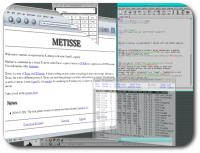
Screen-shot of Metisse for FVWM
 have just had a rare chance to become part of an exciting experiment. It took place at the The Manchester Visualisation Centre, which is near my office. This involved a new method for interaction with visual data.
A pen is being moved in 3-D space and its route gets traced in real time. Atop that, vibrations are as subtle feedback that indicates contact with items on the screen. It was only a week ago that I discussed the issue of 3-D desktops, i.e. ones with depth, where one can interact with items and be able to feel them. That notion of depth could become a good surrogate for virtual desktops. Another issue is the sensitivity of touch, realisation of depth without special displays and stereo-imagery glasses, and also the motion arms that move up and down, thereby leading to tiredness.
I must admit that got quite excited about the device and asked the lady how much it would cost to purchase one for my workstation. When I was told that the cost is 10,000 pounds per unit, I immediately gave up on the idea. Needless to mention!
Related items:
Friday, February 24th, 2006, 12:26 pm

 ILL Gates comes from a dynasty of businessmen and politicians. Over the years he was trying to commercialise software and nowadays he monopolises it. So what gives?
Commercial software companies liquify no assets into cash. They merely sell binaries (not even code) and offer little or no direct customer support. Accruing profits in such a matter is just lush, but is it acceptable at all? Is the final product doing what ‘it says on the tin’? Often it is not the case. Microsoft will soon sell a product to fix yet another broken product of theirs, which is absurd. Rather than offer refunds and benefits, which somehow compensate for a broken operating system, more money is extracted from the customer.
The above leads to serious questioning. Such marketing tactics do not appeal to anyone but the obedient Microsoft programmer whose understanding of hacking is flawed and often inexistent. That perhaps is why Windows fails to cope with that vital aspect which is security. That is why minor DDOS attacks pose a big threat to Windows servers, machines get hijacked and remote execution of code has become worryingly prevalent. Planting of programs and vandalism from afar is a face of evil that continues to take place. And yet, only few among us choose to blame the real culprit — Microsoft software.
Friday, February 24th, 2006, 6:07 am
The Wall Street Journal has taken an overview on per-for-use campaigns, which have become the norm among search engines.
Microsoft Corp. launched a campaign last week
offering $1 million in prizes…
…to users of its MSN search engine
…roughly a cent to a charity of the user’s
choice every time a search is conducted on
its Yahoo-based search engine…
…Amazon.com Inc. offers regular users of
its A9 search engine a 1.57% discount on
most Amazon.com purchases…
… Blingo.com, powered by Google, gives
away prizes like iPods and movie tickets
to lucky users who happen to search at
random times…
Users are getting paid to get served (and absorb advertisements in the process). In due time, this builds up loyalty and dependency. Yahoo offer many other benefits, which are not mentioned in this article. Google rewards people for using Firefox, which is a separate-yet-related matter altogether.


 Filed under:


