
Can Google and Microsoft ever walk hand-in-hand?
 UMEROUS notes have accumulated on my Palm, so I decided to publish them in a logical (not necessarily chronological) order. The notes are all associated with questionable practices and controversial moves, which have been embraced by the Internet’s largest forces, putting Yahoo aside for the most past.
We all wish to gaze into the crystal ball and see what Google comes up with. Moreover, Google remain the centre of attention to many of the media sources. This happened for a reason. Public opinion is rather negative when it comes to Microsoft, primarily due to their shady past and unethical paths, which involve misuse of their monopoly in desktop computing, including a customer lock-in strategy. Then come Google, which seem like a Luddite to Microsoft who perceive Google as their giant threat. Many eyes look at up Google as if it was the knight on the white horse — the one to save the world from a vicious ruler.
The reasons to dislike Microsoft do not only involve exploitation of their monopoly-like state-of-affairs. Microsoft’s CEO once made some derogatory statements about competing operating systems. In reference to Linux he once said “are you going to trust some guy from China?”. It is not just midleading, but also racist and disrespectful. It also comes to show lack of sportsmanship in this competition over the operating systems market. Steve Ballmer of Microsoft used similar types of FUD in reference to Google, saying it would disappear within 5 years. That was a couple of years ago and, ever since, Microsoft have only played catch-up on the Internet, merely copying everything from Google. If controversies ever arises (as in the case of book scanning), the will stipulates that Microsoft will embroil their counterparts into the very same mess, detracting them from victory. Aggressiveness and deep pockets remain in Microsoft’s valued arsenal.
Apart from Trojans, spyware and viruses, I see no real motion in Microsoft Windows. Neither do most existing Windows user, who begin to glance elsewhere. Even when properly protected, the platform has many critical flaws and suffers from the saturation of nagware (homonym of nagger), which we also know as shareware or freeware. Any alternative can be rather pricy. To make matters worse, large quantities (intentional storage room vocabulary) of computers are made captureable from afar. Zombie networks (or BotNets) are constantly being formed. Suddenly, a seemingly harmless and innocent existence of an O/S — one with hijacking vulnerabilities and viral complications — can attack and bring down large Web sites. The flaws are simply infectious. They hurt the entire Web, which is unacceptable.
Read the rest of this entry »


 Filed under:

 ALMSOURCE, former software makers of Palm (after fragmentation and before re-joining), have finally announced the inevitable transition to Linux. To be more specific, they intend to release a Linux-based mobile phone to the market. This exciting move will mark the death of Palm OS. It also explains the delayed Cobalt, as well as the relatively dormant state of Palm O/S.



 VER the past few years I have come to loathe telephones. At first, it was just plain disdain for cellular communication. That kind of disdain dates back to the day when it was first introduced to in the public sector (as opposed to prestigious businesses). More recently, I decided to disconnect my phone or refuse to answer, having already avoided giving out my numbers. Snail mail likewise, but it’s an entirely different topic, which I will attempt to steer away from.
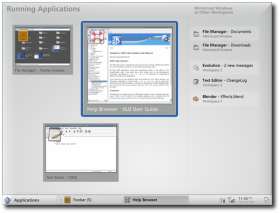
 widespread fallacy is that Linux remained command-line-based and customised to be used by geeks only. Those who have actually tried Linux throughout this century consider this presumption to be utter rubbish. Certain Linux distributions are as easy to use as Mac OS, let alone Windows, which requires security-related ‘skills’ and offers poor utilities at its base.

 ERELY everyone has come across corrective discrimination wherein gender/race quotas are specified, and in turn promote diversity. We should be taking similar principles to diversify computing. This would be an intersting experiment, from which all would benefit. The move has an increasingly-justified place in the avoidance of

