Introduction About Site Map

XML
RSS 2 Feed RSS 2 Feed
Navigation

Main Page | Blog Index

Friday, November 18th, 2005, 10:38 am

Is Google the Next Microsoft?

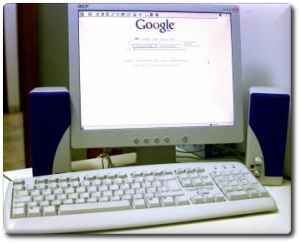
Google on a computer screen

KNOWLINGLY or unknowingly, whether deliberately or not, Google is striving to become a Web monopoly. As the Web is bound to become the centre of all, such monopoly can affect each and every aspect of our lives.

Google’s primary target appears to be Web services and their constant expansion, often superseding and replacing desktop equivalents in the process. What has Google implemented thus far? Below is nothing more than a partial list:

  • Statistics: notably Google analytics, which can now help study the roots of traffic, in-site PageRank distribution, crawling patterns and so forth. This requires Webmaster to sign up with yet another service: Google Sitemaps.
  • Web reading – e.g. Google Reader (for feeds), Google News, and Google Blog Search.
  • Image search – equivalent to a digital photography library, which neglects or discourages fair use
  • Desktop search
  • Google Wallet – potentially making on-line banking and highstreet banks obsolete
  • Mapping services
  • E-mail and broader communication (Google Mail, Google Talk)
  • Google Directories (DMOZ)/Google Base
  • Literature – Google Print (just been renamed for fairly valid reasons)

What have Google not implemented yet? Can we identify what Google set as potential revenue targets?

  • Games
  • Office suite
  • Music management (video gets closer)
  • Graphical toolkits
  • Web design facilities and/or hosting (Geocities) – Blogger and Blogspot make the exception
  • Photo album management
  • Bookmarks like del.icio.us (with the exception of Google Personalised that is only a step away)

Google can never replace very few elements:

  • Hardware
  • Operating system
  • Web browser, with the exception of Google’s Web Accelerator (proxy/cache)

[Note: The lists above are intentionally incomplete. They are intended to serve as support for an argument rather than be a comprehensive reference]

Google have already teamed up with Firefox (Mozilla), Sun Microsystems, and a variety of other cross-platform advocates. Google are also avid Linux users and supporters, so one wonders if Open Source or openness in general can take the place of Windows and give Google collateral control at the expense of Windows.

Bill Gates considers major losses to Google as an option. Google were portrayed as the main rival/threat and Gates urged his employees to focus on so-called ‘Live Software’ and on-line services. Mapping services, book scanning and the like have already been copied by Microsoft in what appears to be a catch-up game.

Google have seen enormous growth owing to constant innovation and superb recruiting. Meanwhile, Microsoft failed to evolve, refusing a move to the Net at the expense of their own shrink-wrapped software monopoly. Commercial software in general appears to be taking a slow dive, so the next 5 years will reveal a significant change. We are currently standing at the busy interchange.

Friday, November 18th, 2005, 5:58 am

Giving up a Laptop

Windows 98

Windows 98 screenshot from the 6-year-old Compaq Presario (click to enlarge)

THIS blog post is not concerned with giving away a laptop, but rather about my recent decision to give up laptops altogether. In this item I have collected some notes on my reasons for neglecting the world of mobile computers that are simply over-sized and are thus not contributory quite so often.

For increased productivity (e.g. dual-head, fast Ethernet), I find desktop machines to be an absolute necessity. I have learned this over time and I recently gave up the laptop which I had lugged for 6 years. It used to serve me fairly well while travelling, yet travel is the exception, which does correspond with daily requirements.

There are endless issues with laptops: hardware upgrades, components that become difficult to replace or even find (e.g. built-in speakers). These are just a few among the more prominent factors. One cannot ignore inflexibility with regards to hardware probing and peculiar vendor-specific drivers. I am not necessarily referring to Linux to Windows (or vice versa) migrations, but also to ‘intra-O/S’ migrations where drivers may be missing and so-called QuickRestore CD’s (factory defaults) can never resolve recurring incompatibilities.

I ultimately decided to stick to a PDA, preferably with folding keyboard. Along with desktop wordstation/s it works flawlessly unless one travels all the time. I have become accustomed to this over time. Synchronisation of memos with the desktop gives me the convenience I have probably sought all along.

Thursday, November 17th, 2005, 11:17 am

Decaffeinated Coffee and Heart Disease

Coffee grains

The following report was published yesterday:

DALLAS, Nov. 16 — Decaffeinated — not caffeinated — coffee may cause an increase in harmful LDL cholesterol by increasing a specific type of blood fat linked to the metabolic syndrome, hints a new study presented at the American Heart Association’s Scientific Sessions 2005.

Other items about coffee:

Thursday, November 17th, 2005, 5:06 am

Research Grid

A week back I became familiar with the World Community Grid. Described in their own words,

World Community Grid’s mission is to create the world’s largest public computing grid to tackle projects that benefit humanity.

Our work has developed the technical infrastructure that serves as the grid’s foundation for scientific research. Our success depends upon individuals collectively contributing their unused computer time to change the world for the better.

Servers lineI am hoping for my medical imaging research to become part of a localised research grid. Fortunately, this may actually happen sooner than I had anticipated. Yesterday I handed over C/C++ code to become a Web service.

I also have particular intersting in the way grid computing can assist the Web. My recent initiative called Iuron, once resumed, might rely on available, idle computer resources.

Wednesday, November 16th, 2005, 5:23 pm

ASCII Banner Generator

EVER wondered how quickly and trivially you could produce plain-text banners for a given word, name, or slogan? Using fixed-sized characters and common cross-platform fontsets, you can use an on-line tool to produce banners of choice. This obviates the need for manual and laborious composition or ‘off-the-shelf’ ASCII graphics (my long-standing favourite source). Below is some example output from the tool:


___ ___| |__ ___ ___| |_ _____ _(_) |_
/ __|/ __| '_ / _ / __| __/ _ / / / | __|_ /
__ (__| | | | __/__ || (_) V V /| | |_ / /
|___/___|_| |_|___||___/_____/ _/_/ |_|__/___|

The real issue is trying to fit the characters properly given fonts that are not the same as specified in the original site. This tool might be valuable, on occasions at least, for E-mail that is plain-text or even for UseNet/newsgroups.

Other Internet-based tools:

Wednesday, November 16th, 2005, 8:36 am

Google Finally Invade Sites

Google Cookie

Google Analytics will know
even more than the Google cookie

GOOGLE have introduced their site statistics service only a few days ago. They teamed up with Urchin who are among the best in their field, if not best in terms of the popularity and functionality of their software package, which analyses log files. With all the enthusiasm, concerns emerge as well, at least in my own mind.

Google continue to spread their wings, assigning innovative projects to their highly talented and Internet-savvy staff. This time, for a change, Google penetrate information that only sites can retain, i.e. in-house data. In that sense, they benefit from inside information, which perhaps leads to unfair, unbalanced competition which puts privacy in greater jeopardy.

Google’s quick expansion frighens me; it passively becomes a Web monopoly. First they stole the thunder from Alex King’s FeedLounge and now it may be Jeff Veen’s Measure Map (among others like Mint). I volunteered to help both projects, so I have seen or can foresee Google’s impact on ‘mom-and-pop’ sites. I have mentioned this implicitly in:

It all develops into a scary situation as you can never fight or resist scale, no matter how ambitious you might be. Services integration is yet another major factor which elevates the brand. Google can finally take a deeper look that transcends the level of SERP‘s and will be able to see what MSN, Yahoo and the others are up to. Moreover, expect abuse of reports, e.g. fabricated (i.e. spam) statistics that attempt to enhance a site’s image, at least in Google’s perception.

Is it just me who is slightly apprehensive? Are all bases belong (sic.) to Google? Google Base, which was officially launched just a few hours ago, crops to mind. I mentioned its possible impact among my Google pet peeves.

Google Analytics, by the way, is said to provide no statistics as yet. Many people suggest that its state is dormancy. I am not sure if the service is overwhelmed by demand or perhaps it is still in beta, much like most services from Google.

Wednesday, November 16th, 2005, 12:57 am

Mathematical Equations in HTML

Equation in German

As an arbitrary set of useful links:

Nice examples like the following equations have been put together:

∆u  =  Δu  =  n
∑
i = 1
∂2u/∂xi2
 +∞
∫
−∞ 
exp(−x2) dx   =  √π

The above is valid HTML, but as expected, it makes heavy use of tables although data is not truly tabular. From a standards perspective, this may be frowned upon.

While on the issue of rarely-used symbols, below lie my related ‘pocket links’:

Real-time Posts

Posts by @schestowitz

Retrieval statistics: 23 queries taking a total of 0.346 seconds • Please report low bandwidth using the feedback form
Original styles created by Ian Main (all acknowledgements) • PHP scripts and styles later modified by Roy Schestowitz • Help yourself to a GPL'd copy
|— Proudly powered by W o r d P r e s s — based on a heavily-hacked version 1.2.1 (Mingus) installation —|