Introduction About Site Map

XML
RSS 2 Feed RSS 2 Feed
Navigation

Main Page | Blog Index

Monday, October 10th, 2005, 1:53 pm

Knowledge Engine

Iuron

EARLY this morning I bought iuron.com. The host was admirably rapid in its automated response and setup. Subsequently, after just minutes since the purchase I was able to access the domain (DNS was up-to-date already) and initialise things, e.g. content, passwords, customised error pages, siteinfo.xml, robots.txt, favicon.ico, etc.

In the intermin I created a site/project logo using The GIMP. It took me roughly 10 minutes to produce the compact GIF version, of which I keep a non-lossy version (bitmap) as often required.

A detailed but not yet comprehensive proposal is bound to go public in the brand-new domain soon. The specifications are not public and are password-protected for the time being. Let the title and excerpt give you a rough indication of where the project is headed. I am yet to seek funding opportunities so many more details are (hopefully) soon to follow.

Sunday, October 9th, 2005, 4:47 pm

Bowling and Spinning

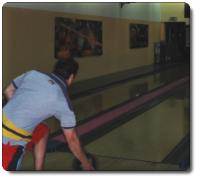
Roy bowls

The least hideous photo snatched by my sister
(against my will, I am urged to point out)

SINCE I rarely post items about my personal life, I decided to make an exception today. On my very recent vacation, I taught myself a valuable lesson in bowling — a lesson that cost me an entire game that was filled with gutter balls and oddities. It was a game of exploration and experimentation.

I decided that I wanted to master ball curling, thus hitting the pins much like the pros while spinning the ball elegantly. This ended up far more successfully than I had imagined and I would like to share tips based on my amateur experience.

  • Firstly, I count my steps (approximately 4) as I walk backwards to identify a good starting position, ensuring that I throw as my left foot stomps forward
  • I approach the track by treading across the left side rather close to the gutter. This turns out to be helpful as I am right-handed, hence I must spin to the left
  • Bending of the wrist gives the ball its spin. The grip with the ball is rather steady when the wrist is perpendicular with respect to the forearm. I was once told that by a childhood friend who played in the leagues.
  • The ball must be thrown in a sharp angle so that it nearly collapses onto the right gutter. Otherwise, it may spin to the left too early.
  • To give the ball little time to travel before it changes direction, the throw must be fast. The speed also gives extra power, which is crucial.

My main problems were often too much of a spin or reluctance to let the ball approach the gutters. It is simply adverse to instincts. Ultimately, I managed to consistently hit the pins at almost 30 degrees (towards the end of the track) and I had almost no gutter balls. As bowling is very repetitive, I need more experience. Nonetheless, I hit a few admirable strikes and spares that day, all of which involved a sharp spin and very powerful impact.

Up until a week ago I hit the pins by chucking the ball straight down the middle. At the age of 16 or thereabouts I hit 140+ at my best. Without hitting the pins diagonally it is rather hard to achieve high scores. I look at my transition to the spin as a form of long-term ‘investment’. I also find it much more rewarding to practice and for others to observe.

Sunday, October 9th, 2005, 3:44 pm

Linux Tablet

Nokia 770

As a sequel to my previous reference to Linux-powered tablets, it is worth mentioning the Nokia 770.

When the Nokia 770 Internet Tablet hits the streets in the coming weeks, it will mark a technological milestone for the world’s largest mobile phone manufacturer. The tablet not only is Nokia’s first non-voice Wi-Fi device, but it also runs on the Linux operating system (OS).

To me, this seems like an excellent (yet more expensive) replacement to Palm handhelds. Palm have recently lost their direction and their commitment to Linux appears to have been crippled.

Saturday, October 8th, 2005, 5:49 pm

Feed Readers Everywhere

Man and his dogMany on-line services incorporate RSS feeds these days. Briefly observe, for instance, the vendor-specific feeds management for this Web log.

It turns out that Google have joined that game with what they call Google Reader. GReader is bound to deliver quite a lot given what we know about Google engineers and their love-affair with Web applications (more latterly videos).

For feeds, I am still using RSSOwl (JRE, hence inter-operable), of which I am a tester. I am also a tester of the Web-based, AJAX-rich Feedlounge (screenshot below), but admittedly I never contribute immensely as a tester. I use RSSOwl (screenshot below) almost exclusively. I am rather loyal to RSSOwl though I occasionally take Feedlounge for a short spin. Feedlounge is somewhat irresponsive, is still in its testing phases, facing an uncertain future and boasts commercial aspirations.

Feedlounge

Feedlounge in action

RSSOwl screenshot

RSSOwl back in April (click to enlarge)

Thursday, October 6th, 2005, 7:42 am

Sun-Google Pact

Open officeSun Microsystems, makers of the Linux-related Solaris, have formed a pact with the Linux-oriented Google. The exchange between the two is that of search technologies (i.e. search bar) and Java Desktop, most notably OpenOffice, which is treading strongly and becomes among the main dangers to Microsoft alongside Web-based Office.

Sun Microsystems Inc. and Google Inc. on Tuesday said they agreed to a multiyear pact for Google to promote Sun’s software technologies in what amounts to a direct challenge of Microsoft Corp.’s dominance of business users’ desktops.

Wednesday, October 5th, 2005, 7:44 am

Windows Dies Again

Broken CRT

THIS morning I received a flash reminder of how disasterous Windows can be. I tend to forget this as my professional life is Microsoft-free. My mother’s computer refuses to boot as the hard-drive cannot be mounted by Windows XP. Not even safe mode can do the trick.

This comes at a time when I strongly urge my mother to switch to Linux (probably Ubuntu), which perhaps would be a blessing as the computer reached a halt (over 5 minutes to boot) due to Registry bloat. Perhaps this O/S crash will wind up serving us well, but the amount of distress and required restoration work is enormous. This all comes at a time when we are reminded how mature Linux has truly become.

“Why choose Ubuntu for the parents?”, one might ask. I have 3 Linux machines at Manchester and 2 of them (the more recently set up) run Ubuntu while the main one (repository or so-called ‘mother ship’) runs SuSE, which is my favourite.

While I’m here at home I occasionally the Ubuntu Live CD because, let us face it, it can be a pain working under Windows as you cannot (trivially) SSH with X forwarding. Only the bandwidth is somewhat of a barrier at the moment (ADSL as opposed to proper LAN).

Tuesday, October 4th, 2005, 7:59 am

Forking Applications

Double-headed arrow

DEVIATING from the a development branch, thus staying away from the regular updates cycle, is a step which is bound to have its problems, e.g. security and missed out extensions. I am fully aware of these issues and I made mistakes in the past nonetheless, particularly with Web applications. I am rather confident and comfortable with my choices to extend applications, but one must remember the pitfalls, as well as the very few advantages.

Rather than simply downloading pre-installed and/or pre-configured packages like Gallery, WordPress, a VPN client or PHP-Nuke, one can add a wee bit of ‘individuality’ to them. For example, with actual words and vocabularies that do not suit your way of speaking, you can instill some personality within the software — a beauty to be found most commonly in Open Source software. It gives a feeling of ownership, a sense of personal contribution.

Linux users are often inclined to hack software and customise it, maybe because they can. With some Linux distributions like Gentoo, people struggle to compile individual components and some have the odd habit of re-compiling the Linux kernel. Again, it gives an utterly unnecessary sense of achievement. That free platform, however, unlike other platforms, can be claimed to be one where very little intervention should be involved. With 5-CD installations, for instance, all the necessary software is in place, is well-integrated and simply works without any apparent conflicts. Somebody else took care of all the nasty installations and then burned some ISO to be distributed and put as-is on other people’s computers. So, we perceive a situation where there is a great deal of freedom, but at the same time that freedom is unneeded or even discouraged.

Change to existing packages is risky. It can bring an application to a fragile state. Attempts to exploit vulnerable (usually non-existent if the owner is fortunate) components are being re-directed to an unpleasant page at server level on this domain. I hope these can successfully deter a determined hacker. The only ones to come across such a page would be those attempting to sabotage (hence the rel="nofollow" in the link above).

When forking and choosing to no longer follow a development cycle, there is always some possibility of ‘flushing’ self-made components and starting fresh with similar, even identical data and an application belonging to the current generation, hence incorporating state-of-the-art technologies. Upgrades usually mean some loss of personal changes which are better off never lost. This may lead to feelings of regret due to waste. It also means hours of conversions, not to mention the laborious process that is involved in updates and getting accustomed to new interfaces. As it stands, I continue to fork, but do so cautiously.

Real-time Posts

Posts by @schestowitz

Retrieval statistics: 23 queries taking a total of 0.095 seconds • Please report low bandwidth using the feedback form
Original styles created by Ian Main (all acknowledgements) • PHP scripts and styles later modified by Roy Schestowitz • Help yourself to a GPL'd copy
|— Proudly powered by W o r d P r e s s — based on a heavily-hacked version 1.2.1 (Mingus) installation —|