Wednesday, June 29th, 2005, 4:15 pm
 There is a true advantage to having audio stored locally, as in the case of off-line podcasting. There is full control, in general, over the audio data in question. This means that podcasts can be sped up to fit the preferences of the listener. There is an XMMS plug-in called SndStretch (shown to the left) which I absolutely adore. It can speed up audio to be up to twice as fast, without change in pitch. No more squeaky voice due to change in pace. An half-hour show can be listened to it in only 15 minutes. This also works for music, which makes it more entertaining and variable.
Wednesday, June 29th, 2005, 4:05 am
 Video formats are among the most complicated formats to handle. Decoding and encoding of a frame sequence is an intricate process that different manufacturers take a different approach to solving. One solution is to settle down for no compression, the other being imposition of standards. There is one body, namely Microsoft among a few more, that embeds elements which are never agreed upon in the IT community. This corruption of inter-operable formats includes documents, spreadsheets, mail and even Web pages. Norway has had enough of that.
I would argue that there is no reason to get bitter. No open format, no view. I was never a huge TV/video anyway. When Microsoft change the encoding of text or textual formats, that descends to an entire new level though.
Tuesday, June 28th, 2005, 2:29 pm
Click to enlarge the image
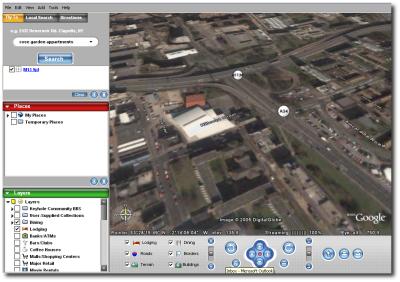
 oogle Earth is a project which strongly impresses me. I got hold of a Windows machine where Google Earth had been installed and grabbed a few screenshots of streets around Manchester, UK.
Given the satellite data, this technology is not overly innovative. All that is required are mappings of existing satellite images onto a sphere, then relying on OpenGL acceleration. The real issues to be faced are bandwidth and Google’s progress on 3-D geographical data acquisition.
What screenshots cannot show is the excellent real-time interaction with the scene. Roads, street names and other details can be toggled on/off. There is also some highly continuous motion when hovering from one place to another. To get a better impression, you may wish to view this gallery with more sample images.
Tuesday, June 28th, 2005, 9:27 am
 hen I first registered schestowitz.com, I registered it for 10 years — until 2014 — that is. At the time, I could not imagine that search engines would favour sites that are committed to a long-term future. But guess what? It turns out they do.
Paying your host for domain renewal annually is a poorer choice; furthermore, it is undesirable if your site has real potential. As unfair as it may seem, Google definitely favour sites which are registered for many years and will position these higher in the SERP‘s. This helps in identifying sites that are serious about their vocation and might rule out spam sites or scrapers (site that steal content for fast, artificial growth).
There are important factors when selecting a domain name, which is a very influential choice. A domain name needs to be:
- Short
- Memorable (to distinguish from “short”. For example,
m3d4n8sm.com versus feedsync.com)
- Decent and trustworthy
If you struggle to think of a good name that is also available, have a quick look at the enormous list of deleted (i.e. registered, then neglected) domains in the ICANN-inclined whois.net.
Changing of a domain is far more problematic than people imagine. Change of bookmarks, loss of SE ranks, update of links (where still possible) and loss of identity are all involved in such transition. A domain change can be a bitter, cruel and highly effort-consuming process, which makes the initial choice of a name very crucial.

schestowitz.com: rising from ~20 to ~1,000 daily visits in less than one year
Tuesday, June 28th, 2005, 4:08 am

Getting just the valuable data from pages
 eeds have definitely revolutionised the way we use the Internet. We can efficiently seek and exploit content without having to undertake laborious navigations in sites. The content is delivered to the user so there is no need to actively obtain it or ever spend time re-reading segments of text.
I have just finished brushing up the script I developed for syndicating static pages that do not offer feeds. Windows users can use it under Cygwin; Mac and Linux user can use it at much great ease. All details and code are contained in the more comprehensive page.
Monday, June 27th, 2005, 5:00 pm

Bill Gates arrested in his younger days (photo in public domain)
 n item I have just come across (hat tip Justin Moore) speaks about excluding MSNBot based on poor performance. MSNBot (and Yahoo! likewise) consume a great deal of bandwidth, but are barely used as search engines by the Internet audience.
From Justin:
- Exhibit A – MSNbot Crawl hits = 9561
- Bandwidth used = 124.43 MB
- Visits to wantmoore.com as a results from searches @ Google = 683* [sic.*]
- Exhibit B – Googlebot Crawl hits = 3415
- Bandwidth used = 51.74 MB
- Visits to wantmoore.com as a results from searches @ MSN = 41 [sic.*]
…
So, effective immediately:
User-agent: MSNBot
Disallow: /
* Order of the visits is wrong and should be reversed.
I spotted similar statistics on my domain, with Google as the top referrer at almost 20,000 visits/month. MSN remain at a miserable 200 and take almost as much bandwidth as Googlebot. I have plenty of bandwidth to spare; So, I might as well let Microsoft spend crawling time in vain.
Monday, June 27th, 2005, 1:37 pm
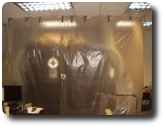
A cheaper method has been suggested for cooling down servers: warpping them in bubbles.
Is it just my imagination or is the wrapping going to warm up the server due to the ‘blanket effect’? If one of these temprature-controlling containers (like the ones astronauts use in space) gets used, does it really save energy?It turns out that air conditioners work on pumping the excess heat from the servers out so that they needn’t cool down the entire room. It makes no difference how warm the room gets outside of the bubbles, but how will the engineers feel about it? I am ‘privileged’ to have experienced the unpleasant feeling one gets in a room with hundreds of racks, namely in Manchester Computing where I work.


 Filed under:


