Thursday, March 31st, 2005, 2:33 am
 y relative passed me a message concerning Internet policies. It discussed the loss of privacy among sites with the
 .us suffix. The message came from GoDaddy, who apparently sent all their clients a self-promoting E-mail — one example among many of mail that that is uncalled for. Other organisations exhibit similar, let us call it, “aggressive behaviour”.
Bob parson, the man in charge of GoDaddy ‘broadcasted’ in this mass-E-mail:
…On my personal Blog, www.BobParsons.com there are a number of articles where you can learn more about the NTIA’s unfortunate decision and what you can do to help get it reversed.
I also will be talking about our right to privacy on Radio Go Daddy, our weekly radio show that debuts today, March 30, at 7 PM PST. To find out how to listen in, please visit the Web site dedicated to the show, www.RadioGoDaddy.com…
The above is shameless self-promotion. GoDaddy, the very large and successful domain registrar, have demonstrated tactless behaviour.
Wednesday, March 30th, 2005, 6:10 am
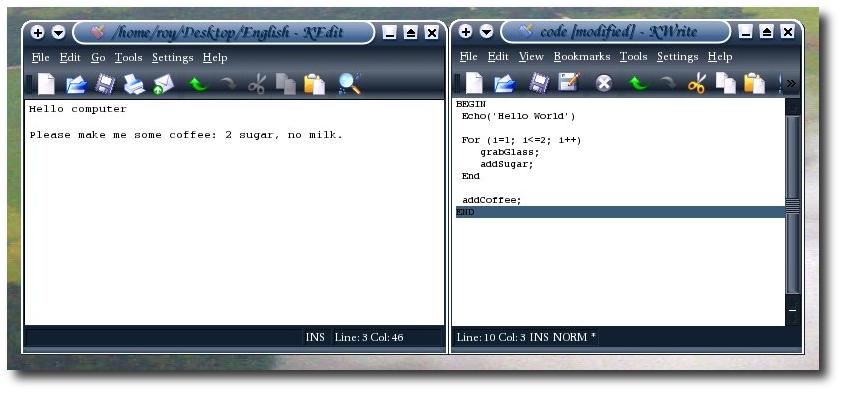
 n relation to the previous item, research in MIT has produced a small application which turns English into computer code.
This small milestone can have an effect on the entry bar for programmers. However, one would argue that this the strand of work is pointless. Ambiguous languages can now (supposedly) turn into (ambiguous) code, which cannot be trusted. Will one be able to rely on translated ‘code’ of this kind? It’s the equivalent of sending E-mail from speech-to-text recognition without prior proof-reading.
 A little sarcasm of mine; click image to view
Tuesday, March 29th, 2005, 6:46 am
 Dragon NaturallySpeaking is voice-recognition software that’s cutting-edge. It is not yet another speech-to-text application; it is high-performing as it exploits the entire power of a modern Pentium 3 (better or equivalents) machine and it involves a training phase where an individual’s voice is learned.
Dragon NaturallySpeaking is now available for the Palm Tungsten. The recorded data will be synchronised with the desktop and then interpreted automatically. This makes a vision come true — the vision of composing E-mail by talking to a PDA. See the Web site for details.
Cited by: PalmAddict
Monday, March 28th, 2005, 9:53 am

 here came a time when I stopped shutting down machines, let alone restarting them. The waiting is unnecessary and re-opening of programs is avoidable. Today’s computer architecture is sophisticated enough to deprive monitors from power and stop the rotation of hard-drives after a specified time-out. What’s more, modern programming languages, standards and fast-growing operating systems make memory leaks rare, while in fact, perhaps needless to mention, memory becomes cheaper.
My personal experience has shown that Windows XP is stable, but it slows down considerably after hours of work. Similarly, the Registry gets bloated after months of regular use. Linux (and branches like Mac OS X) suffers from none of these issues. I typically reboot after 50-100 hours of persistent work. Windows CE suffers from similar problems and needs to be reset quite often (provided it has not already crashed). My Palm gets reboot every 3 weeks or so.
The bottom line: if you tolerate system crashes or reboot too often, consider alternative platforms.
Sunday, March 27th, 2005, 1:29 pm
Fun stuff with transparent screens has recently hit the Web. Go view the full gallery.
This beats the hell out of the previous item, which briefly mentioned transparency in KDE.
Sunday, March 27th, 2005, 3:50 am
Linux Desktop
Slashdot have spotted a demonstration of Luminocity [sic.] — an experimental OpenGL-intensive window manager for GNOME. For the hi-tech savvy, the site includes stunning videos of Luminocity in action.
Sneak Peek at Microsoft’s Longhorn
For the curious, there are recent Longhorn screenshots at Paul Thurrott’s SuperSite for Windows.
Saturday, March 26th, 2005, 12:29 pm
A few hours ago I was listening to BBC Radio 1. I heard a conversation which made me smile:
Radio Host: “Here is the tie-breaker question: In the year 2000, how many people lived in Miami? Not the whole of Florida, just Miami.â€
Caller: “Ummm… 42 million?â€.
Radio Host: “Well, according to you, Miami is just a little smaller than Englandâ€.


 Filed under: