Introduction About Site Map

XML
RSS 2 Feed RSS 2 Feed
Navigation

Main Page | Blog Index

Archive for the ‘Rant’ Category

MSN Strategic Deceit Conceals Truth

The magnitude of mind games has reached detrimental level. Microsoft have become overly obsessed with Google and they come up with deceiving public statements. Here’s one:

Ballmer said Thursday he doesn’t think the company is lagging its competitors, noting that Microsoft has strong technical expertise and a loyal online user base with products like its MSN Messenger.

Here’s another one (from Gates):

Bill Gates has promised to keep Google “honest” by pushing the internet rival to “to better” despite coming late to the internet services market with an unfinished offering.

And yet, most recent figures show:

MSN’s search market share dropped from 14 percent to 11 percent

Google and Yahoo increased their market share in the online search arena as Microsoft’s MSN slipped, according to Web research firm Nielsen//NetRatings.

Moreover, on a separate and important Web services front:

But Microsoft is shying away from the 10-year-old name and hoping to freshen up its image as services such as Google’s Gmail creep up on its market share.

In short, Google mail’s annual growth stands at 114%; Hotmail, despite expansion of the Net, only grew by 16% in the same period.

Intellectual Property and its Negative Effects

Orange pillsPatents, copyrights and trademarks serve an important role. They prevent theft of one’s methods and reputations, which often require heavy investment (not necessarily financial). But what about intellectual property which is fuzzy and not concrete? I will use a case study to exemplify this.

Think about the case where Xerox patented the one-stroke Graffiti input, which Palm devices later used for stylus-based input. It is the method by which drawing on a screen is translated into discrete, atomic signals such as letters and numbers. Jotting a line from top to bottom to render a “1″ should not warrant anyone property of such an idea, right? Yet, that’s what Xerox achieved. They ‘invented’ the chalkboard interpretation language and took ownership. Ultimately, as to abstain from paying royalties perhaps, Palm invented “Graffiti 2″, which is a cumbersome method of achieving the very same thing. People’s habits were broken and input made slower just because Xerox ‘owned’ a more efficient input method that involved a single, unambiguous stroke. A common language was actually possessed by one master.

Let that teach us why patents in software are evil and are not accepted in Europe. The case would of course be different in fields like medicine and especially drug discovery.

Quick Reboots

Reload

A couple of months back, Vista engineers ere bragging about Intel systems architecture which would enable quick startups from memory. This sounded like “hibernation mode” rather than standby, but it was still used as Windows Vista selling point, alongside updates without reboot. So here we shall address two issues.

Why should one bother rebooting? Linux rarely ever requires it. Frequency of updates is low and the severity of bugs is relatively low. And again, what is there to be gained from quick reboots or even the avoidance of bootstrapping? Saving a minute a couple of times a year? It would probably take longer to just set up such quick startup facilities. The whole scheme is unnecessary with energy saving modes, so again, why ever reboot in the first place? And why bother reducing booting duration?

A Monoculture that Could Never Survive

Windows XP
Yet another day in La-La Land®

FILLED with frustration over some recent rotten conducts, I once assembled a few streams of consciousness to compose a bitter essay. It was saturated with citations on the way Microsoft continues to exploit its desktop monopoly-like state-of-affairs. I titled the essay On Operating Systems Monoculture and it spanned 4 pages. Today I would like to elaborate on that matter, whilst venting some anger (rant alert) and pointing out facts that Microsoft prefer to hide from their users, owing to Vista’s prematurity.

In a world where a desktop monopoly prevails, there is also mental manipulation of minds. Innocent people are (mis-)led to believe they are IT-proficient when they manage to change font size in Word. Skills are not sufficiently generalised and MSCE qualifications are a glaringly-obvious example of this. Advice must be taken from people who live in a broader reality and are neither delusional nor biased.

To take an overview, as well as a look into the future, Microsoft continue to use dirty tactics to push away any type of rivalry. They also propagate some hackney myths. Microsoft cried “Wolf” whenever someone criticised Windows Vista. Yet, based on some recent screenshots, Vista Starter Edition will allow only 3 processes to run at any one time. It is one among the numerous ‘penalties’ that will force a paid-for upgrade.

Then comes the issue of desktop environment visualisation. Graphics in Vista are unimpressive, assuming Aero cannot be run. Aero is the glass-like component in Vista’s window rendering, which enables translucency (as in Linux and Mac OSX). Aero is estimated to be properly-supported by 50% of today’s hardware. So, is Microsoft taking a step backwards, both in terms of hardware support and functionality? Even when Aero is enabled, it offers nothing out of the ordinary. LiteStep can already enrich the looks of Windows, so Vista offers nothing innovative. Aero only suffocates the CPU. The 3-D effects make the system choke. Vista is the same product which is known as XP Service Pack II (or Windows Server 2003), but it was put in a new dress. It is no surprise given the recent major fallback in terms of the codebase.

Microsoft employ a famous composer to work on sounds in Vista. Judging by what the O/S has to offer and rave about, Microsoft could take the easier route and just go with Mozart’s Requiem. It may soon be “Hasta la Vista“.

Will the Internet Ever Be Privatised?

Money on keyboard

Backed by an ambitious contention, one Web site calls for the halt of Web privatisation.

You think the Internet will always be the great freewheeling information superhighway you’ve grown to love? Well, think again. Media giants want to privatize our Internet.

As one among several threats, consider Google Groups. Under the magnifying glass is accumulation of over 20 years worth of forums conversations (full names included). To make matters worse, consider the practice of appending “Copyright Google Groups” to each of these pages. Then comes the contribution (or lack therefore) from those who post from Google Groups without quoting, which merely leads to clutter in UseNet. It sometimes seems as though UseNet has evolved into ‘Google Chat’, which is worrisome.

Another matter to consider is charging for E-mail traffic, as means of crippling spam. It comes to show that corporations can instate and manipulate ‘Net politics’.

Beyond these facts, rumours are formed and echoed as regards a Google Web or even the newly-proposed ‘Chinese Web’. Then, of course, there is the issue of censorship, aimed to better suit the interest of governments– either through blocking of sites or filtering of search results.

The future of the Web looks not bright. Given present trends, the outlook is rather grim.

Why I Gave up on Scoble

Bill Gates
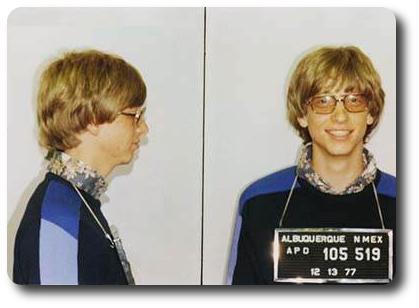
Bill Gates arrested in his younger days (photo in public domain)

Foreword: I syndicated Robert Scoble’s blog for a few months in the past, mainly in order to keep an eye on Microsoft’s ‘software politics’ and developments. I thought I would see the nicer face of an aggressive corporation, but I soon dropped it like a hot plate.

I consider very few things to be “shocking”. There are very few things as adverse-to-logic and even shocking as Robert Scoble using Firefox and running his blog on WordPress (LAMP technology). This has been the case ever since his so-called ‘Net dad’ had weblogs.com sold out to VeriSign — a rather evil company. Scoble is a Microsoft evangelist, but he decided to practically infiltrate a world of Open Source. At some stage, it ended up badly.
Before Scoble became Dave Winer’s ‘surrogate child’, he wasn’t doing anything too admirable, but he was among the first people to blog. Then, years later, he would rave about ‘RSS this and RSS that’. It was Winer’s technology. Scoble only understands computers as a user, rarely realising the underlying issues in depth. He is no developer and no great writer either, yet his reputation and momentum, as well as being outspoken and critical of Microsoft while being paid by them is what makes him somewhat exceptional. His reputation is overrated.

When it comes to technology, I found that Scoble cannot tell his ass from his face. Microsoft employed him only because of his Web statistics. It is a public relations trick — companies buying readership (through popular voices) and promote propaganda to improve the Windows brand name and image. Microsoft had plans of employing many freelance bloggers to promote evangelism, using money. Scoble now runs on Linux and when I mailed him about it, he could only come up with a lame excuse about this choice.

If you seek a popular blog to aggregate, skip Scoble. It is an utter waste of time. Grossly overrated.

The Misjudged Security Model

Bill Gates

BILL Gates comes from a dynasty of businessmen and politicians. Over the years he was trying to commercialise software and nowadays he monopolises it. So what gives?

Commercial software companies liquify no assets into cash. They merely sell binaries (not even code) and offer little or no direct customer support. Accruing profits in such a matter is just lush, but is it acceptable at all? Is the final product doing what ‘it says on the tin’? Often it is not the case. Microsoft will soon sell a product to fix yet another broken product of theirs, which is absurd. Rather than offer refunds and benefits, which somehow compensate for a broken operating system, more money is extracted from the customer.

The above leads to serious questioning. Such marketing tactics do not appeal to anyone but the obedient Microsoft programmer whose understanding of hacking is flawed and often inexistent. That perhaps is why Windows fails to cope with that vital aspect which is security. That is why minor DDOS attacks pose a big threat to Windows servers, machines get hijacked and remote execution of code has become worryingly prevalent. Planting of programs and vandalism from afar is a face of evil that continues to take place. And yet, only few among us choose to blame the real culprit — Microsoft software.

Retrieval statistics: 21 queries taking a total of 0.099 seconds • Please report low bandwidth using the feedback form
Original styles created by Ian Main (all acknowledgements) • PHP scripts and styles later modified by Roy Schestowitz • Help yourself to a GPL'd copy
|— Proudly powered by W o r d P r e s s — based on a heavily-hacked version 1.2.1 (Mingus) installation —|