Introduction About Site Map

XML
RSS 2 Feed RSS 2 Feed
Navigation

Main Page | Blog Index

Sunday, March 20th, 2011, 12:45 am

TechBytes Episode 35: ASUS returning to Linux and Other News

TechBytes

Direct download as Ogg (1:55:10, 33.6 MB) | Direct download as MP3 (52.7 MB)

Summary: Tim and Roy talk about GNU/Linux for senior people, ASUS returning to Linux, and Microsoft’s struggle to evolve

THIS episode was probably the last one to be recorded over a mobile network and it is also the first one to have two music tracks in it.

RSS 64x64The show ends with “Zombie Baby” and “Endsequence”. We hope you will join us for future shows and consider subscribing to the show via the RSS feed. You can also visit our archives for past shows. If you have an Identi.ca account, consider subscribing to TechBytes in order to keep up to date. ?

As embedded (HTML5):

Download:

Ogg Theora
(There is also an MP3 version)

Our past shows:

November 2010

Show overview Show title Date recorded
Episode 1: Brandon from Fedora [cref 41364] 1/11/2010
Episode 2: No guests [cref 41585] 7/11/2010
Episode 3: No guests [cref 41669] 8/11/2010
Episode 4: No guests [cref 41695] 9/11/2010
Episode 5: No guests [cref 41843] 12/11/2010
Episode 6: No guests [cref 41854] 13/11/2010
Episode 7: No guests [cref 41885] 14/11/2010
Episode 8: Gordon Sinclair on Linux Mint [cref 41924] 15/11/2010
Episode 9: Gordon Sinclair returns [cref 42019] 17/11/2010
Episode 10: Special show format [cref 42089] 19/11/2010
Episode 11: Part 2 of special show [cref 42186] 21/11/2010
Episode 12: Novell special [cref 42317] 23/11/2010
Episode 13: No guests [cref 42520] 28/11/2010
Episode 14: Patents special [cref 42577] 29/11/2010
Episode 15: No guests [cref 42605] 30/11/2010

December 2010

Show overview Show title Date recorded
Episode 16: No guests [cref 42693] 3/12/2010
Episode 17: No guests [cref 42788] 5/12/2010
Episode 18: No guests [cref 42949] 11/12/2010
Episode 19: No guests [cref 43118] 16/12/2010
Episode 20: No guests [cref 43164] 18/12/2010
Episode 21: No guests [cref 43265] 20/12/2010
Episode 22: No special guests [cref 43501] 27/12/2010

January 2011

Show overview Show title Date recorded
Episode 23: Tim, Gordon, and Roy [cref 43673] 2/1/2011
Episode 24: Tim, Gordon, and Roy [cref 44053] 10/1/2011
Episode 25: Tim and Roy [cref 44327] 14/1/2011
Episode 26: Tim and Roy [cref 44507] 18/1/2011
Episode 27: Tim, Gordon, and Roy [cref 44772] 22/1/2011
Episode 28: Tim, Gordon, and Roy [cref 45179] 30/1/2011
Episode 29: Tim, Gordon, and Roy [cref 45235] 31/1/2011

February 2011

Show overview Show title Date recorded
Episode 30: Tim, Gordon, and Roy [cref 45557] 7/2/2011
Episode 31: Tim and Roy [cref 45777] 13/2/2011
Episode 32: Tim and Roy [cref 46108] 22/2/2011

March 2011

Show overview Show title Date recorded
Episode 33: Tim, Gordon, and Roy [cref 46504] 6/3/2011
Episode 34: Tim, Gordon, and Roy [cref 46566] 13/3/2011

Friday, March 18th, 2011, 5:38 pm

Fedora, Importance of GNU/Linux Competition, and Technological Freedom

FEDORA 11 is a fine distribution of GNU/Linux, but my session got stuck (frozen) today. Generally, scheduling on the desktop in this out-of-date operating system is somewhat deficient. Windows sometimes do not respond for a period of several seconds. The bug where a text selection cursor is made permanently visible and allows no real interaction with any applications kicked in… again… today. It happens quite rarely with other distributions and there’s an escape route out of it, e.g. if the terminate signal can be sent to the application causing it, assuming it can be identified. But not this time though. Bearing in mind that it’s not the very latest version of Fedora and having used the fourteenth release since it was made available (even installed it for others), it does seem fair to say that for a smooth experience on the desktop, one is still better off going with the Debian family. Mandriva (predominantly but not strictly RPM-based) has been very good too, probably a lot better than Fedora.
The problems with Fedora are not really caused by adherence to freedom. Some creases and bugs, however, might not be addressed early enough because Fedora’s adherence to freedom (not strict adherence, but better than Ubuntu’s for example) limits the extent of its userbase, which in turn reduces the incentive Red Hat has to concentrate on the desktop side of things.

I have been working with Fedora 11 since last Friday (just waiting for my home computers to get back online with the new line activated) and as much as I try to love Fedora, I cannot help feeling that Kubuntu and Ubuntu have been giving me less hassle. Deep inside I wanted to declare that Fedora was better, but the experiences simply suggest that any such claim would be wishful thinking, even deceptive. The problem is that Canonical was made quite arrogant (hello Hubris!), which harms Ubuntu on technical and communal grounds alike. Canonical could use more competition.

It may be true that Linux in the mainstream is all about Android, Google, Ubuntu, mainframes, and Red Hat Enterprise Linux these days. That’s fine. As long as Fedora uses and reuses the same pertinent packages, there is no risk of Fedora truly falling behind. The wonder of Free software is, as long as one is allowed to copy the competition or branch out of it, unfair advantage is harder to gain. Canonical and Google have both attempted to produce “added value” (or enhancement) which is hard to emulate, replicate, or even get involved in. They are using some very vendor-specific code, which changes the balance of control not just with copyright assignment. It’s not progress and it is usually counter-productive.

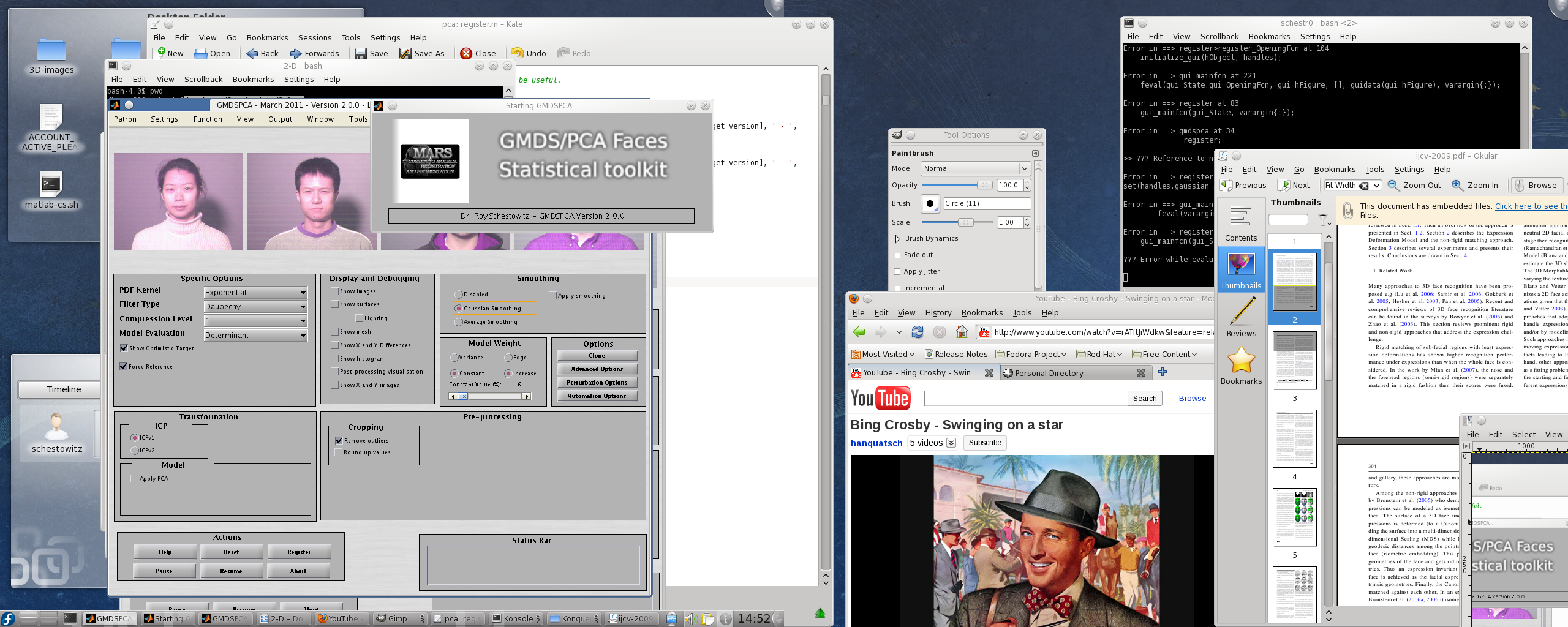
Next week I will resume GNU/Linux advocacy and do a lot less programming (below is a new screenshot of the application I have been developing, but it’s unfortunate and regrettable that the code depends on a proprietary framework) and there is a lot of thinking to be done regarding strategy. Generally speaking, the world’s population loses control over technology at a very rapid pace* and software freedom is no longer the only freedom worth pursuing by a developer with passion for humanism. The head of the Free Software Foundation (FSF) has just stepped down and it is hard to blame him; maybe he too reached similar dilemmas and came to realisations that software freedom is not enough. Collaboration too is crucial (GPL encourages it), not to mention education in general.

Expressions GUI
____
* I spent half an hour this morning chatting with a lady in her 70s. She too — not too surprisingly — feels as though mobile phones are a burden rather than a blessing. In general, she is also concerned about today’s society which lacks face-to-face interaction and intimidates her generation that’s not at all accustomed to a technological control grid. Free/libre software is being used a lot in this context (primarily for companies to bring their user-hostile proprietary layer to market immediately), not as much is being produced though. If technology is not built to provide the user some more control, then it usually tries to control the user. But people are not made sufficiently aware of it, unless the FSF speaks out, as it recently did against Android.

Thursday, March 17th, 2011, 3:22 pm

Developing With Fedora 11

GMDS/PCA

FEDORA 14 was a bit of a mixed bag, but it was definitely an improvement compared to previous versions. I’ve used it since it was released (and blogged quite a lot about it). At the moment I use an older version:

bash-4.0$ uname -a
Linux [XXXXX] 2.6.30.10-105.2.23.fc11.i686.PAE #1 SMP
Thu Feb 11 07:05:37 UTC 2010 i686 i686 i386 GNU/Linux

Not to worry, it’s up to date and it runs the latest KDE. The general impression has been positive, having worked on this operating system for the past week or so (still awaiting my Ethernet’s return, so working from a lab, not via SSH). A few remarks about the weak spots:

  • X (org/server) blows up under particular circumstances where a newer version of X might be expected. If an attempt is made to invoke it from a remote host (SSH with X forwarding), the whole of Fedora blows up and the session must be restarted. If run locally, the same type of X issue simply raises a hardware-based exception and produces a major warning, then gives the option to gracefully shut down the affected program. It’s not good, but it’s definitely better than the former scenario, which is reproducible by the way.
  • Dual-screen handling is fantastic. It is still a plug-and-play experience, even with Fedora 11 in place.
  • There are far too many visual artefacts and drawing bugs (direct rendering is lacking). Again, this may just be the fault of old X and nothing whatsoever to do with the drivers of this GPU (Fedora seems to favour free drivers).

Aside from X rants, this platform is fantastic for development. Everything has worked well so far, except Firefox with occasional crashes (occurring at least once a day).

Is Fedora ready to become the most widespread GNU/Linux desktop? Probably not yet. But for development? Sure, why not? Fedora 14 is more mature, but that too has some wrinkles which I covered here before.

By the way, the screenshot at the top (click to zoom) shows the application I’ve been developing recently. More details will be published shortly as blogging distracts from persistent coding, and vice versa.

Tuesday, March 15th, 2011, 10:12 pm

Bizarre Week, More Predictable One Ahead

[Or in general, what has been going on]

Once a year I take a break from the Internet, usually for about a week. This need not mean being absent from the Net altogether, just a lot less omnipresent (if present at all). Last year I took my longest break ever (well, since the 90s) from the Internet, lasting about 5 days of zero access to the Net. It was an interesting experience. Usually I take these breaks in summer, but due to problems with the Internet connection (although I do work to have it restored in the new house as quickly as is feasible) this time it happens in spring. Anyway, for those who might be interested, here are my experiences when stepping offline after virtually ‘living’ on the grid on a daily basis for 51 weeks.

First of all, despite initial expectations, there is not much of a yearning to get back online. When the train of thought is interrupted and online activity slips out of mind, so is the desire to get back in there. Typically, there is a feedback loop such as conversations with people and it’s this type of cycle that make it disruptive upon departure. Productivity-wise, being offline is not more productive, but it depends on the definition of productive; activities merely change a bit. It is probably a lot harder taking 7 single days off throughout the year than it is to take one week off. It’s something to do with workflow. Similarly, when it comes to coding, it often works better if a week is set aside and dedicated just to code; transitions that are too frequent lead to mental baggage and distraction; separation between home and work computer sometimes helps eliminate the temptation to mix the two.

Anyway, as I digress, hopefully (if BT keeps its promise) I will be properly back online next week. The ISP is a very bad deal (more expensive than the rivals), but it’s supposed to be unlimited without restrictions, although BT loves to embed antifeatures like throttling and Phorm (spying on packets). Until then I am focused on getting research and development done; in addition, when time permits, I re-plan the operation of Techrights which once a year requires a rethink because technology changes and means of disseminating information (e.g. IRC, microblogging, audiocasting) make delivery a constantly-changing turf. Those who stick to “traditional” paradigms like “old media” did (e.g. newspapers) are doomed to become extinct because everything evolves.

I currently have three jobs, one of which is the business I start with some friends and people whom I know can offer me contracts. This oughtn’t interfere with my operation of this site as well as Techrights (I own about 6 domains at the moment, but these two are by far the most major ones), in fact in some ways these are complementary. There has been a lot of social life recently; now, that — unlike the jobs — can really come to the expense of hobby Web sites. Maybe sleep can give way.

Monday, March 14th, 2011, 6:41 am

TechBytes Episode 34: Patents and Phones

TechBytes

Direct download as Ogg (0:44:31, 13.7 MB) | Direct download as MP3 (20.4 MB)

Summary: Tim, Gordon, and Roy catch up with news about phones and patents

THIS episode was recorded in a rush and is short because it was recorded over a mobile broadband network (it took a whole night to upload). We touch some important subjects and prepare for possible changes in shows to come.

RSS 64x64The show ends with “Skydiving” by Jonay and Jasmine Kara. We hope you will join us for future shows and consider subscribing to the show via the RSS feed. You can also visit our archives for past shows. If you have an Identi.ca account, consider subscribing to TechBytes in order to keep up to date.

As embedded (HTML5):

Download:

Ogg Theora
(There is also an MP3 version)

Sunday, March 13th, 2011, 6:48 pm

Contracting for Scientific Betterment

Tourists checking a map

Helping hand for Free software entrants in science

Earlier this month I wrote about a new ‘umbrella’ under which I’ll be able to accept contracts, as I’ve been doing for about a decade now. The banner chosen for it is “Scientific Freedom” and the official site for it is still not finished even though I’m reasonably happy with the state that it’s in, so it’s now public. I’m fortunate enough to have met skilled people around the Web — people with whom I can share work in case it’s geographically suitable or in cases where workload is high. So even though there’s nothing too new here, the site is new and it makes it abundantly clear that I only ever code for freedom (preferably GPLv3) because it’s beneficial to everyone, the client included.

Sunday, March 6th, 2011, 11:08 pm

TechBytes Episode 33: Monopoly, Patents, Monsanto, and More

TechBytes

Direct download as Ogg (1:16:04, 22.9 MB) | Direct download as MP3 (34.8 MB)

Summary: Tim, Gordon, and Roy meet after a long time and catch up with interesting news

IN THIS relatively short episode we finally have Tim back online (ISP issue) and we have discussions about GNU/Linux, desktop environments, patents, Monsanto, copyrights, and even British media (including criticism of the BBC and Rupert Murdoch).

RSS 64x64The show ends with “tears” (the song). We hope you will join us for future shows and consider subscribing to the show via the RSS feed. You can also visit our archives for past shows. If you have an Identi.ca account, consider subscribing to TechBytes in order to keep up to date.

As embedded (HTML5):

Download:

Ogg Theora
(There is also an MP3 version)

Real-time Posts

Posts by @schestowitz

Retrieval statistics: 23 queries taking a total of 0.372 seconds • Please report low bandwidth using the feedback form
Original styles created by Ian Main (all acknowledgements) • PHP scripts and styles later modified by Roy Schestowitz • Help yourself to a GPL'd copy
|— Proudly powered by W o r d P r e s s — based on a heavily-hacked version 1.2.1 (Mingus) installation —|