Massive dataset explored
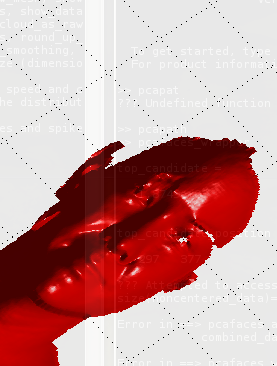
Example face with holes remaining in the data

Another example

Same as above, different angle
Summary: Notes, tips, code samples, and pointers relating to FRGC (an ongoing series of posts)
 HIS post provides some information of interest to those who may find themselves working with 70 GB of data and some programs [1, 2]. The latter is a FRGC Web site. The package comes with associated applications and scripts written in Java, C++, Perl, etc. The previous post about the dataset (FRGC ver2.0) offers a bit of background that is research-specific (relating to Dr. Ajmal Mian and his Ph.D. student Faisal R. Al-Osaimi), whereas the notes below are a bit more generic. This series of posts is not about statistical models of faces but only about the dataset. This recent message from Face Recognition Research Community contains MATLAB/Octave loader code for a data instance from the dataset, where each 3-D face weighs about 13 MB (compressed):
function [x, y, z, fl] = absload(fname)
%ABSLOAD Read a UND database range image from file.
%   [X,Y,Z,FL] = ABSLOAD(FILENAME) reads the range image in FILENAME
%   into the variables X,Y,Z,FL.
%   FILENAME is a string that specifies the name of the file
%            to be openned
%   X,Y,Z are matrices representing the 3D co-ords of each point
%   FL    is the flags vector specifying if a point is valid

% open the file
fid = fopen(fname);

% read number of rows
r = fgetl(fid);
r = sscanf(r, '%d');

% read number of columns
c = fgetl(fid);
c = sscanf(c, '%d');

% read junk line
t = fgetl(fid); clear t;

% get flags
fl = fscanf(fid,'%d',[c r])';

% get x
x = fscanf(fid,'%f',[c r])';
% get y
y = fscanf(fid,'%f',[c r])';
% get z
z = fscanf(fid,'%f',[c r])';

% close the file
fclose(fid);
This just handles one single image. There are many in the current collection:
find | grep .abs | wc
   4950    4950  257215
All of which are compressed:
find | grep .abs.gz | wc
   4950    4950  257215
To get a list of the 3-D faces:
find | grep .abs.gz | awk '/{print $1}' 1>~/files_list.txt
It yields something like the following:
Read the rest of this entry »


 Filed under:
 The show ends with “tears” (the song). We hope you will join us for future shows and consider subscribing to the show via the RSS feed. You can also visit our archives for past shows. If you have an Identi.ca account, consider subscribing to TechBytes in order to keep up to date.