Introduction About Site Map

XML
RSS 2 Feed RSS 2 Feed
Navigation

Main Page | Blog Index

Monday, February 7th, 2011, 11:57 pm

TechBytes Episode 30, Starting with FOSDEM 2011

TechBytes

Direct download as Ogg (2:02:52 37.3 MB) | Direct download as MP3 (56.2 MB)

Summary: Tim, Gordon, and Roy catch up with GNU/Linux vs Microsoft (or vice versa) news and then drift further away into some other topics

TONIGHT’S scheduled-not-so-planned-but-spontaneous show covered mostly GNU/Linux-related issues like Microsoft sponsorship of Linux and FOSS events, the situation at Nokia, Microsoft MVPs, Windows versus GNU/Linux at work, Debian’s new release, Linux Mint, uniformity across GNU/Linux environments, filesharing-based business models, Anonymous, and a few more issues. Corresponding articles will be linked very shortly in OpenBytes‘ show notes.

RSS 64x64The show ends with our default track. We hope you will join us for future shows and consider subscribing to the show via the RSS feed. You can also visit our archives for past shows. If you have an Identi.ca account, consider subscribing to TechBytes in order to keep up to date.

As embedded (HTML5):

Download:

Ogg Theora
(There is also an MP3 version)

Sunday, February 6th, 2011, 3:40 pm

GNOME From KDE vs KDE From GNOME

Today I set up my alternative machine in a way which enables me to get the best of GNOME and KDE. It was set up in a way that I never tried before. Back in 2001 or thereabouts I would have gnome-panel imported into my desktop session (from another computer) and I repeated this type of practice locally around 2005-2007 when I wanted my KDE desktop to also have gnome-panel and therefore allow easy access to GNOME-side administration tools or applications. Today I tried something different altogether by installing KDE alongside GNOME and then running plasma-desktop in GNOME, which obviously imported panels and the background utilities, including 2 folderview plasmoids that import directories over SSH (the remote server on which I run workloads).

The bottom line is, there need not be a strict choice between GNOME and KDE. Both are compatible with one another and can run alongside one another in the very same session. In this case, it’s a dual-head machine with free graphics drivers and I might post some screenshots soon. This helps debunk the myth of incompatible desktop environments.

Tuesday, February 1st, 2011, 2:28 pm

3-D Face Recognition

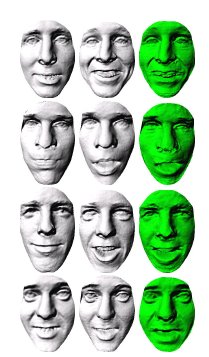
Al-Osaimi paper

From Al-Osaimi et al., IJCV 2008

Summary: My attempt to reproduce some of the results of F. Al-Osaimi et al. and furthermore improve them using other methods and different datasets (with a 3-D scanner at our disposal)

THIS post provides some background about my next (current) research project, which deals with non-medical applications. The previous project dealt with cardiac imaging and I’ve packaged that code and published it along with other data that may be useful.

The group of A. Mian has done some fantastic work recently on 3-D face recognition and I shall attempt to reproduce some results with a NIST database. In their paper “An Expression Deformation Approach to Non-rigid 3D Face Recognition,” F. Al-Osaimi, M. Bennamoun, and A. Mian explain some good results from experiements that apply PCA to face images (paper published online in September 2008 by a leading computer vision journal, but access is restricted, so there is no link, either… unless one uses this copy).

Since I have extensive experience with NRR, PCA, and statistical models in general, this project suits me better than some previous ones. I have done limited work on analysis applied to sets of face images that are only rigidly or affinely registered.

The paper from the group in question is 22 pages long in the raw form and about 15 in IJCV. The abstract describes an idea and quantifies some results using known benchmarks and the “FRGC v2.0 dataset”. Then, the method is alluded to vaguely and not formalised until later. The phrasing could be improved somewhat to avoid repetition, e.g. in the following paragraph containing parts like: “2D face recognition has been extensively researched in the last two decades. However, unlike 3D face recognition its accuracy is adversely affected by many factors such as illumination and scale variations. In addition, 2D images undergoes affine transformations during acquisition. Moreover, handling pose variations in 3D scans is more feasible than 2D images. It is believed that 3D face recognition has the potential for more accuracy than 2D face recognition (Bowyer et al. 2006). On the other hand, the acquisition of 2D images is less intrusive than 3D acquisition. However, 3D acquisition technologies are continuously becoming cheaper and less intrusive (The International Conference on 3D Digital Imaging and Modeling, 1997–2007).”

“Most of the approaches in the literature are rigid,” says the text in page 2, just before the overview which states: “The main contribution of this paper is a non-rigid 3D face recognition approach. This approach robustly models the expression patterns of the human face and applies the model to morph out facial expressions from a 3D scan of a probe face before matching. Robust expression modeling and subsequent morphing gives our approach a better ability in differentiating between expression deformations and interpersonal disparities. Consequently, more interpersonal disparities are preserved for the matching stage leading to better recognition performance.”

The background section is followed by some classification of existing work, concluding with: “Our approach also falls into this category i.e. non-rigid 3D face recognition.”

1.1 presents a very good summary of related work and 1.2 a clear overview of the method and the ideas behind it, accompanied by a helpful diagram at the bottom of page 3 (Figure 1). The strategy is to use pairs of image of the same individuals, normalising them a bit, and then applying PCA to reduce the dimensionality that characterises expression variation.

Section 2 in page 4 starts by describing pre-processing steps that are essential yet specific to the limitation of the FRGC v.20 dataset. Page 5 starts presenting some visual examples of the approach, with some equations relating to PCA (along with more visual examples) in pages 6 and 7.

Section 3 begins to deal with some other experiments that are not just dealing with models in synthesis mode. The same dataset is being used (with about 5,000 3-D faces), but more data gets added to it. To quote, “The dataset is composed of two partitions: the training partition (943 scans) and the evaluation partition (4007 scans). [..] The FRGC dataset was augmented by 3006 scans that were acquired using a Minolta vivid scanner in our laboratory.”

Parameters and set sizes (those which are included) get tested in very large-scale experiments that yield ROC curves. These curves help show how to set the different parameters and enable one to measure advantages of one algorithm over another. Page 13 has some comparisons to other methods from the literature, with numbers summarised in a chart.

This is truly inspiring work and I shall spend the next few weeks learning from it as well as implementing something similar.

Tuesday, February 1st, 2011, 1:59 pm

Linux Mint 10, Ubuntu 10.10, and Kubuntu 10.10

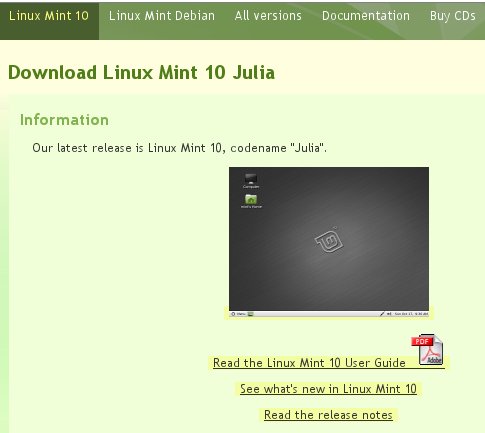
Linux Mint 10 Julia

TODAY I moved on to my next research project, which I will mention very briefly in the next post. As part of this move I’ve also made some distro changes. The servers are running Ubuntu, so for the sake of consistency I wanted to explore the latest and greatest of Ubuntu and its flavours/derivatives. I gave a go to 3 and spent some time working from them (not long enough an experience as yet).

Will it be 10 out of 10 for the 10.10 releases? What about Mint 10 (codename “Julia”)? I decided to try today, hopefully seeing how it all compares to Fedora 14, which I have used since it was released around the end of October. The change is motivated by needs of consistency; I also like to try different distributions and see what they are all about over time, for the sake of comparison. I might stop using Fedora for a while. It is still installed on a PC, but I moved all my important work files out of there, which means they’ll go out of sync over time.

A report about use will be posted at a later date (this is not a review but a post with quick impressions). The important points are that today I tried Linux Mint (very latest version, which is GNOME based) and latest Ubuntu+Kubuntu shortly afterwards. Linux Mint has this nice new feature (to me at least) that has it start the installation while the user enters installation options such as user details, location, etc. The menus and graphics (including icons and window decorators) are stunning. Setting up dual-head in Ubuntu without proprietary drivers was easy, in Kubuntu it’s still not as easy (getting twinview). Overall, since both share the very same base (even same packages for the most part, except those which are preinstalled), comparison in this case ought to rely on what’s above the hood, mostly user experience.

Monday, January 31st, 2011, 9:00 pm

TechBytes Episode 29 Discusses Desktop Environments and Coding

TechBytes

Direct download as Ogg (1:39:34 30.8 MB) | Direct download as MP3 (45.6 MB)

Summary: Tim and Roy catch up with some news about GNU/Linux and enter discussions regarding these areas

TONIGHT’S unplanned show covered mostly GNU/Linux-related issues. Corresponding articles will be linked very shortly in OpenBytes‘ show notes. (Update: the notes have just been published)

RSS 64x64The show ends with our default track. We hope you will join us for future shows and consider subscribing to the show via the RSS feed. You can also visit our archives for past shows. If you have an Identi.ca account, consider subscribing to TechBytes in order to keep up to date.

As embedded (HTML5):

Download:

Ogg Theora
(There is also an MP3 version)

Monday, January 31st, 2011, 5:39 am

TechBytes Episode 28: The Past Week in Review

TechBytes

Direct download as Ogg (1:37:31 29.8 MB) | Direct download as MP3 (44.6 MB)

Summary: Tim, Gordon, and Roy talk about Microsoft’s results, LCA, ACS:Law, Google’s ‘censorship’, and more

LAST NIGHT’S show covered the above topics and so much more. Corresponding articles will be linked very shortly in OpenBytes‘ show notes.

RSS 64x64The show ends with “Chur” from Countdown, which is a track Tim selected. We hope you will join us for future shows and consider subscribing to the show via the RSS feed. You can also visit our archives for past shows. If you have an Identi.ca account, consider subscribing to TechBytes in order to keep up to date.

As embedded (HTML5):

Download:

Ogg Theora
(There is also an MP3 version)

Sunday, January 30th, 2011, 2:41 pm

Cardiomat Version 1.0 is Released

TODAY I AM releasing the final code from my current project. The following is the accompanying README file:


Homepage: http://schestowitz.com/Research/Cardiac/Cardiomat
Index of related documents: http://schestowitz.com/Research/Progress/2010-2011.htm

INTRODUCTION

Cardiomat is the name given to an Octave/MATLAB program whose intended use is heart tracking, with various different bits that help probe cardiac structure and perform basic measurements.

FILES

Contained in the package are the following M-files and sub-directories:

./Experiments
./Experiments/fiesta_simulation-old-experiments.m
./create_synthetic_set.m
./GUI
./GUI/cardiomat.png
./GUI/splash.m
./GUI/splash.fig
./GUI/get_parameters_from_user.m
./GUI/getoptionsgui.m
./GUI/cardiomat-title.jpg
./GUI/cardiomat.m
./GUI/cardiomat.jpg
./getdicomimages.m
./loadtaggedsequence.m
./README (this file)
./Imported
./Imported/findit
./Imported/findit/findit.m
./Imported/arrow
./Imported/arrow/arrow.m
./Imported/gradient
./Imported/gradient/gaussgradient.zip
./Imported/gradient/gaussgradient
./Imported/gradient/gaussgradient/gaussgradient.m
./Imported/gradient/gaussgradient/README.txt.txt
./Imported/gradient/gaussgradient/testgaussgradient.m
./Hybrid
./Hybrid/cardsim_frame_shortaxis.m
./Hybrid/shuffle_transform.m
./fiesta_simulation.m

In addition, the program depends on at least one function from biosig4octmat-2.50, whose homepage is located at http://biosig.sourceforge.net. That function helps find the centre and the radius of a best fit circle/sphere for a group of points.

The directory named “Hybrid” contains functions that were written jointly and “Imported” contains functions which were brought from the outside. The core functions in the package are GPLv3-licensed and the rest are most likely to be BSD-licensed (check the sources to verify). Some of the imported functions may work only in MATLAB and not in GNU Octave, which is a free/libre substitute for MATLAB that lacks some graphical features for the most part.

HOW TO RUN THE PROGRAM

The program was written to be compatible with both Octave and MATLAB. There are some features in it that may require a UNIX/Linux system (e.g. animated videos) and some that may require MATLAB. Additionally, in order to reduce dependency on MATLAB’s GUI utilities, the program can be run in GUI and CLI modes separately, with only the use of figures being the exception to this (figures are output rather than means of interaction).

Key functions reside in the main directory of the program (one function, getdicomimages.m, is deprecated) and a directory named “GUI” contains some of the newer parts that add a GUI.

An important interface function is called fiesta_simulation.m. The first line of code in this function is a boolean flag that says whether the program should be run in GUI mode or not. If use_gui is 0, then the program will simply run the list of tasks specified below. It is possible to give several jobs for the program to complete this way, e.g. in order to run many experiments overnight. If use_gui is non-zero (probably 1 but not necessarily), then the function is assumed to have been called from the file GUI/cardiomat.m, which is a wrapper that invokes a splash screen and some dialogues that serve as a graphical interface. In turn, parameters fed to these dialogues will be passed to fiesta_simulation.m. It might be necessary to modify some paths inside the files in case the functions and the files are located in different places than the ones specified in parameters. Such paths are named in fiesta_simulation.m, loadtaggedsequence.m (specifies output directories onto which to save figures), and splash.m (looks for program images). For a new user, the only things require modifications are likely to be directory paths and maybe the use_gui boolean, depending on this user’s preference.

To run the program in GUI mode, MATLAB is needed. There is also a parameter to specify in fiesta_simulation.m in order to inform loadtaggedsequence.m whether MATLAB or Octave gets used. It is the boolean which is also the last argument in the function call, being 0 for MATLAB and 1 for Octave. The GUI front end will always pass 0 under the assumption that it is run under MATLAB.

DATASETS

The specified directories include a path from which to open images, optionally with a wildcard to filter bits contained within a given directory, e.g. selecting a subset of images that are a range of numbers. Due to privacy/data anonymity constraints, no raw data accompanies this program, even though it can definitely be obtained from many places (see for example https://schestowitz.com/Weblog/archives/2010/11/14/segmented-and-tagged-datasets/).

COMPATIBILITY

There are separate levels of compatibility dilemmas. One is the program level and another is the operating system level. Although the program has been tested in both MATLAB and Octave, on both GNU/Linux and Windows, there may be trivial code changes to make in case errors show up. Most will be path related, so it is abundantly clear that emphasis should be put on making all functions reachable from within paths definition (e.g. “addpath(genpath(YOUR_PROGRAM_ROOT_DIR_HERE))”) and booleans should be set to do the right thing (GUI/CLI and MATLAB/Octave). The goal is to ensure the program can be run under as many platforms as possible, with either free/libre or proprietary software.

IN CASE OF DIFFICULTIES

If issues running the program are experienced, please contact the author (address above). Bugs are expected to exist (it is a research purposes program, so polish is not a priority) and input is not validated or sanitised to provide virtual ‘rails’ on which the user operates the program (sane values need to be given). Sample function calls are given in fiesta_simulation.m and /Experiments/fiesta_simulation-old-experiments.m. Some of them may use the old interface and thus lack some input arguments, but most of them show the type of experiments which were run using the program.

Real-time Posts

Posts by @schestowitz

Retrieval statistics: 23 queries taking a total of 0.411 seconds • Please report low bandwidth using the feedback form
Original styles created by Ian Main (all acknowledgements) • PHP scripts and styles later modified by Roy Schestowitz • Help yourself to a GPL'd copy
|— Proudly powered by W o r d P r e s s — based on a heavily-hacked version 1.2.1 (Mingus) installation —|