Introduction About Site Map

XML
RSS 2 Feed RSS 2 Feed
Navigation

Main Page | Blog Index

Thursday, December 28th, 2006, 2:00 pm

Time to Rethink ‘Waste Culture’ Amid Global Warming?

BBC News
Sri Lanka shoreline, before and after the earthquake
Never underestimate the forces of nature, geology, and climate. Picture from the BBC (2004).

THE article “Disappearing world: Global warming claims tropical island” caught my eye during Christmas (or “holiday period”, if you prefer). As a reminder, there are/were serious floods that cost lives over Christmas—a trend that seems repeatable, especially around Christmas time. This year was no exception. But what happens when a once-vibrant island becomes an underwater site for diver historians? What will the impact of refuge be? Can man battle climate? Does the world intend to take action at all? Or, as my father would say, is it just “busy making money”?

Rising seas, caused by global warming, have for the first time washed an inhabited island off the face of the Earth. The obliteration of Lohachara island, in India’s part of the Sundarbans where the Ganges and the Brahmaputra rivers empty into the Bay of Bengal, marks the moment when one of the most apocalyptic predictions of environmentalists and climate scientists has started coming true.

Wednesday, December 27th, 2006, 12:21 pm

Open Source and Scientific Analogies

Season of the playful penguins
Season of the playful penguins from Oyonale

Sidling with Open Source software development is sidling with science. To use a parable, people in conferences don’t just show the end products. They often have papers explaining methods, without being restricited by patents, and increasingly some source code is available too. They want to make a difference, not (necessarily just) money.

Linux (and Open Source software) protects its users, which it does not perceive as customer, from technology that only benefits greedy companies. Avoidance of brainwash, abuse and abomination is not only an important factor to so-called technocrats. As more people grasp the value of liberty, accentuated by corporate-centirc products such as Vista, the stampede to vendor-neutral solutions will begin.

Sunday, December 24th, 2006, 12:24 am

‘Bling Factor’ versus Linux

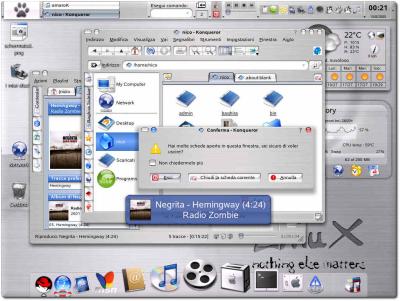
Tiger in KDE
Linux with KDE in its Baghira glory

Increasingly, people choose to customise their GNU/Linux installation so that it mimics Mac OS X. Just have a look at this screenshot to get a taste of one recent example. But is that what it all comes down to? Are looks all that matters? Can it steal customers?

Businesses need brains for productivity, not eye candy for play. This applies not only to the server room and the office. Package management in, e.g. Ubuntu GNU/Linux, is simpler than that which is found in Mac OS X. Cost and endless hardware support is yet another matter. Linux supports merely every architecture and, provided you do not buy Windows-only/exclusive peripherals (or Winmodems), Linux will handle everything without a hardware refresh cycle.

The notion of “appealing” is not synonymous with merits. It’s more related to superficial instincts which will not ensure and excitement that won’t last for long. I personally disable all shadows, translucency and I have no interest in eye candy (e.g. Compiz/Beryl with XGL/AIGLX) that detracts and distracts. Show-ware for the show room; but it’s not long-lasting.

Friday, December 22nd, 2006, 7:10 pm

Open Source Software in British Education

Macs cluster

A short essay of mine has been published over at newassignment.net. It is a short writeup which, at least at the time, contained ‘inside information’ from a project that I am involved with. The unedited version lies below:

By its very nature, learning involves exploration. Exploration requires transparency, versatility, and openness. Therefore, one of the areas that benefits education the most is the Open Source paradigm for development, collaboration, as well the widespread use of Open Source software.

There is an ongoing debate in the United Kingdom. The Open School Alliance recognised the fact that an Open Source approach to education would benefit the students not only by providing necessary skills, but also by reducing costs. There is an absurdity which took many observers’ attention. While recommendations are made by a government body called BECTA to acquire Open Source software in schools, facts on the ground suggest that these recommendations are completely ignored. Instead, pricey proprietary software is being acquired. It restricts the scale of knowledge offered to students, as well as leads them to depending on companies.

Members of the parliament have entered this vibrant discussion. They are presently working to reverse the worrisome trend. They wish to introduce more schools Open Source software rather than retain a state of ‘neutrality’ wherein vendors use incentives to promote their closed systems. To date, eighty-six members of parliament have questioned the exclusion of open source software from UK schools. They respond to an early day motion (EDM) tabled by John Pugh.

John Pugh MP has recently said: “In my experience a school is a key part of the community and as such has a role to play in the economy of that community — the emphasis on somethings seems to be local supply but not for information technology.”

In journalism, just like in school and academia, one needs to find a state of independence from industry. This rationalises a symbiotic relationship that exists between the community-oriented approach — that which replaces reliance on products and their vendors — and its appraisal. This culls out the tendency to incorporate bias, whether deliberately or not.

We sent the word out to the press/wires the other morning. We have approached the 100-MP milstone with 97 signatures by now.

Related links:

Related articles for some context:

Thursday, December 21st, 2006, 6:45 pm

Oracle Cannot Steal Linux from the Community

Let us suppose that Red Hat was right all along. RHEL is Unfakeable, not Unbreakable. Despite the predatory betrayal and the decreased support costs, Oracle can only attract 300 downloads per day.

In the first 30 days, we had 9,000 downloads of Unbreakable Linux from our website and hundreds of customers connecting their servers to our network.

This brings us to Novell’s GPL ripoff/sellout. Novell may suffer from the same PR backlash. It can never use organic surveys to attract informed customers, let alone a few optimistic minds, whose mind is disconnected from that of the beyrayed developers and peers.

Related articles:

Unbreakable Linux still unproven, analyst warns

IT managers running Red Hat Linux should think carefully before making the switch to Unbreakable Linux, the new Linux distribution that Oracle Corp. announced last month.

Our View: Don’t Fear Oracle’s Linux

Opinion: Oracle’s move will actually help Red Hat by boosting Linux’s already-growing presence in the enterprise.

Red Hat Dismisses Threat Posed by Oracle and Microsoft

Red Hat Inc’s executive vice president of worldwide sales, Alex Pinchev, has dismissed the impact that Oracle Corp’s entry into the Linux support business could have on Red Hat, insisting Oracle does not really know what it is doing.

Oracle up to bat: Red Hat bashing possible

The wild-card in all this is Oracle’s take on its Linux support initiative and what that means for Red Hat. Now it is possible Oracle won’t mention Linux, but typically Larry Ellison slaps some rival around and talking trash against SAP has got to be getting old.

Addendum: for the sake of comparison, Novell sees roughly 5,600 downloads a day; RHEL (not Fedora) is donwloaded about 12,500 per day. The moral of the story is that those who play fair certainly appeal to the customer. In fact, based on the latest from MarketWatch, “Red Hat is expected to report earnings per share of 12 cents for the third quarter, according to analysts polled by Thomson First Call.“

Sunday, December 17th, 2006, 12:58 pm

How Open Source Software Prevents Lockins & Data Loss

Iron links

Break the shackles.Don’t let your data get
locked and the vendor have the key

MUCH has been said on the topic, but here is the gist. Open source, standards-based applications are much safer to choose. You know you will be able to access your data in the future.

Example: Can one truly open and recover, let us say, an Outlook 3 profile? Can one analyse its data once identified and recovered from an old computer? The matter of fact is that commercial vendors seek to make old versions obsolete. This leads to (frequently forced) upgrades which bring in revenue.

Open source programs don’t have the same interests and motives. They use standard data formats. If not properly documented (a rarity) the source code is available, in order for the data to be imported or parsed for subsequent use. Proprietary software does not have this merit. It is based on the lockin principle/stategy, which benefits the vendor, not the customer.

Saturday, December 16th, 2006, 12:06 pm

Alexa Versus Netcraft Ranks

Wikipedia statistics

I will start with a proposition that I repeat rather often: Alexa ranks are flawed. Usually, for most sites, they are utterly meaningless.

It is difficult to argue this when faced with Alexa-happy people, but the figures cannot be trusted. It is a toolbar that acts in a similar way to spyware which drives these ranks. The A9 toolbar for Firefox used to have the same effect. Recently however, Microsoft grabbed A9 by the balls and forced them to drop the toolbar. No more Alexa manipulation on Macs and Linux boxes. So where do we end up?

Alexa aligns with Webmasters’ surfing habits. Netcraft figures, on the other hand, align better with system administrators’ surfing habits. The two can intersect. The shown figures are, by default, calculated from a three-month average of pageviews. One can view daily reach though to see how it goes willy-nilly when a few regular visitors use the toolbar. The exception to this might be the very top sites, although the definition of traffic still matters.

Manipulation gets harder at that stage where top sites get ranked. Many people game Alexa as well. Do not trust Alexa ranks. Ever. Use Netcraft if you want something that’s not just an alternative, but is also better in the sense that fewer people game it. Here are some example statistics from two top site.

  • Netcraft rank for Netscape: 341st
  • Netcraft rank for Digg: 867th
  • Alexa rank for Netscape: 479th
  • Alexa rank for Digg: 79th

See? No alignment between Netcraft and Alexa figures at all. Not even for top sites. These so-called ‘realistic’ figures collide and contradict one another. Alexa has become one these “everybody steals, so I can as well” sort of thing… grossly biased. While people continue to game Alexa it remains a strange animal.

Real-time Posts

Posts by @schestowitz

Retrieval statistics: 23 queries taking a total of 0.092 seconds • Please report low bandwidth using the feedback form
Original styles created by Ian Main (all acknowledgements) • PHP scripts and styles later modified by Roy Schestowitz • Help yourself to a GPL'd copy
|— Proudly powered by W o r d P r e s s — based on a heavily-hacked version 1.2.1 (Mingus) installation —|