


Tuesday, October 24th, 2006, 3:25 pm
Alexa Ranks – Only Make Belief
 Filed under:
Alexa ranks can be fun. But can they ever be trusted?
What does a high Alexa rating mean to a web master? It shouldn’t mean that much as it’s not accurate. Alexa is a website that tracks a website’s traffic history, and gives a ranking based upon the number of visitors. However the fact that it requires a tool bar to work flaws it in many ways.
[...]
Apparently the folks at Alexa have never heard of any other browser besides Internet Explorer and FireFox. This seems quite unprofessional coming from a company owned by Amazon.com.
My main site peaked at ~17,000th for Alexa (with Netscraft rank currently at 18,608th for schestowitz.com). In the latter case, however, the figures are grossly biased because I have the toolbar installed. Ranks very much depend on the audience the site attracts. System administrators , for example, fancy the Netscraft toolbar. Its primary service addresses a niche.
Alexa traffic ranks prove to be a real problem (as well as a perpetual pain) to Webmasters. This remains the only number which can conveniently be assigned to a Web site. It is a silly label that should be disregarded, but the average user does not know this. Luckily, not every average user will have such ranks displayed. Alexa as a comparator is a misleading assessor. Even top sites cannot be compared, unless one judges by orders of magnitude (and takes these with a grain of salt). In fact, PageRank and the likes of it weigh more factors other than traffic, so they ought to surpass Alexa in terms of validity.
As a timely rant, I was temporarily able to influence Alexa rank with a local installation of the A9 toolbar, but then Microsoft took over A9′s operations and forced them to shut down some competing services, the toolbar included. Yet another example of acquisitions or mergers that are practically death knells (and a penalty to Mac/Linux/BSD users in this case). That is just why I took it personally.
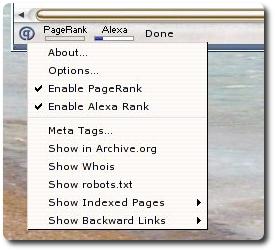
SearchStatus in action
Related item: Firefox Toolbars


 HE way knowledge is shared among and between people keeps changing–or put positively–evolving . Take for example stories and personal journals that are released under a Creative Commons (e.g. Attrib-NonCommerical-No Derivs 2.5) license. These come to show that content becomes a very ‘fluid’ thing where information is increasingly reused to improve existing knowledgebases. But it goes beyond that.
 Many people are openly sharing information about themselves. They make it searchable online. Keywords and unique identifiers definitely help as well. Indexing makes streams of written consciousness easier to locate. Passively perhaps, I am among people who can organise personal data owing to searching technologies in a vast pool of informational context–the World Wide Web. I did not choose the path of anonymity. It was either a wise or a dumb choice, depending on who’s to judge. By collecting and piecing together over 20,000 UseNet posts of mine (a screenshot of my newsreader is shown on the right hand side), one could reproduce some of my life’s history and, potentially, highlight more controversial opinions, too.
 The CNN ran an article on some mind-boggling research. It addresses the
 According to an article that I recently read, the Internet could one day be broken down into

 OMPUTER skills and competence with them is a subjective thing. It very much depends on the area of expertise which is judged, as well as the way it is judged (e.g. average level of skill versus number of gurus). Regardless, I have found

 HE KDE project celebrated its 10th anniversary last night. The wonderful work done by its contributers and volunteers has greatly enriched my life in the past few years, so I would really like to thank them.
