Thursday, May 4th, 2006, 3:37 am

The front page of Slashdot on April 1st, 2006
 FTER Slashdot’s transition to proper CSS-based layout (it used to be heavily based on tables), a contest is run to select the new, permanent site design. Here are some of the latest design contenders. Some of these designs are included as actual Web pages, whereas others are appended as PNG-formatted screenshots. Shown above is the Slashdot front page as of April 1st this year.
Wednesday, May 3rd, 2006, 4:10 pm
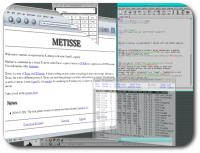
Screen-shot of Metisse for FVWM
 MAGINE to yourself a world (or a desktop environment rather) where everything lies in 3-D space. Imagine interaction with objects, which takes into account the ‘depth’
 Z of one’s arm, rather than just the (X,Y) coordinates — those that are delivered from the conventional mouse.
Croquet is an intersting project that provides an SDK for 3-D environment. It could potentially make it all a reality. Pseudo-3d (stereo imaging) displays exist already.
Wednesday, May 3rd, 2006, 7:44 am

proposal for Google: This is probably a very long shot, but since Microsoft have invested so much money in the fight for Web services space (Google is a notable sufferer as a recent example shows) and even incorporated egocentric search bars in Windows Vista applications, would it not be sensible for Google to promote GNU/Linux in their SERP‘s, much as they already do with Mozilla Firefox? Google even financially reward for Firefox downloads, among other things, so why not Linux?
While Windows users can download and use Firefox, this will not eradicate search bars altogether. The only way to weaken Microsoft is to cut them off at the main plug, making Windows (and Office at al.) obsolete. The missing step is that of porting all of Google’s applications to GNU/Linux. This appears to be work in progress. They released a Windows distribution in the past, but they still have Goobuntu ‘in house’.
If this ever becomes a reality, it will be a great contribution from a company that has exploited Linux for a long while and owes much of its success to its power, scalability, portability, and affordability. At present, Google are essentially bribed to deliver the adverse message by putting microsoft.com as a sponsored link at the top of the search results for ‘linux’ (more details here).
Wednesday, May 3rd, 2006, 6:58 am

The little ‘object’ on the left has the most responsibility. The laptop may act as merely a relic, a host.
The title says it all. It is
Booting Linux on a Mac from an iPod”>yet another story which illustrates the versatility of GNU/Linux.
Think about this scenario for a moment: Using an iPod to boot Linux on a Mac. No, we’re not kidding. This is exactly what writer Dave Taylor describes in a new online article at LinuxJournal.com entitled “Yellow Dog Linux Installs Neatly on an iPod.”
Tuesday, May 2nd, 2006, 8:41 pm

 AVE you ever thought of an (electronic) article that you once saw or read? Could you find it easily after a few weeks, months, or years? How about if you bookmarked it? Would it always allow the article to be found again? And if so, how quickly can it be found?
Mozilla Firefox offers some good facilities for previously-browsed pages to be found. Both History and Bookmarks in Firefox have a ‘find as you type’ widget. However, this only contains and uses page titles.
What would make a better feature that is able to perform a more fuzzy and full-body search? The first option is to permit a search engine to spy on you and retain a record of pages that you follow. In turn, it will index these in isolation and allow your pages of choice to be searched cohesively. It is as though the knowledge conveyed in the index partly corresponds to what you already know. So, it is somewhat of a brain search, which makes the assumption that you carefully read every Web page you visited.
The option which exposes the user to a lesser privacy invasions is this: allow the Web browser to index a page whenever one is visited or only once at the end of the day. The index is of course cumulative and it permits the user to search just a ‘subnet’ — that which he/she has already explored.
Tuesday, May 2nd, 2006, 7:29 am
 Zettair is a light and compact search engine. It is supposedly suitable for indexing one’s personal files and then searching them. This tends to remind me of Google Desktop and some weaker equivalents that are bolted onto the operating system. On the contrary, Zettair is both free and Open Source. Is it also available for a large variety of platforms, namely:
- Linux
- FreeBSD
- Mac OS X
- Solaris
- Windows
- Cygwin
I have not had the chance to try it, but it sounds fascinating as a free tool that can be modified and extended. Once I complete my Ph.D., there is a good chance that I will resume work on Iuron, which is an Open Source knowledge engine. I wrote a couple of proposals for it last year. Time limitation don’t permit further progress, at least for the time being.
Monday, May 1st, 2006, 7:14 pm

What happens when every time you receive a product and it breaks, time after time? You lose confidence, right? Here is the story of a rather stubborn guy.
Apparently, Szarek has had not one faulty Xbox 360, not two, not even three. No, he’s had four, count ‘em, four malfunctioning Xboxes, and he’s pissed, especially since he read that the console’s maker, Microsoft, feels customers who complain about faulty Xboxes should take their gripes elsewhere.
Older item: Xbox 360 Off to a Slow Start in Japan


 Filed under:

