Introduction About Site Map

XML
RSS 2 Feed RSS 2 Feed
Navigation

Main Page | Blog Index

Friday, April 21st, 2006, 6:45 am

Back Online, Re-gaining Pace

I returned from a long vacation yesterday morning. It will take me a while to catch up with the workload and then resume a stable blogging pace. For the mean time, here are a couple photos from my stay at my cousin’s house in North Miami Beach.

Garden view
A view on the yacht at sunset, taken from the garden

Family and Miami
I am the person at the bottom. Not a good
photo, but I hadn’t much choice.

The conference in Virginia, by the way, turned out very well (for me, at least). Our work was overwhelmed by attention and, as it turned out a couple of days ago, it is likely to reach the world’s most formidable (in the good sense of the word) journal on medical imaging. It is work in progress, which joined two other in-progress submissions. Prospects are positive and the future seems bright.

Tuesday, April 4th, 2006, 10:25 pm

Away for a Fortnight

Roy as a baby
Like many others, I prefer using my baby
picture as a personal blog/site identity

AHEM….

This will be my last blog post for a while, the reason being absence. I am leaving for Easter later tonight (yes, well ahead of the holiday itself). Frankly, I am filled with anticipation. I am off to America where I shall present our medical imaging research in an international scenery for the first time. I will be back within a couple of weeks and I expect little or no ‘on-line time’ in the interim.

I dread the impact of spam whenever I’m oblivious to cyberspace and am almost aloof. Nevertheless, experience shows this to be beyond manageable. I suppose could, as a matter of principle, post some blogs items whilst I’m away. It would be slow and cumbersome though, so it beats the purpose.

I would like to wish a joyous holiday to all the regular and errand readers!

Tuesday, April 4th, 2006, 10:16 pm

Free Software is the Best Software

Money on keyboard

COMMERCIAL software advocates will often have you fooled. Industrial leaders (and their employees) will have you believe that “you always get what you paid for”. Poor products deliver bad results is the subtle implication. It is a fallacy, however, which keeps brainwashing the older generation more than anybody else. It ignores context, which in this case is software. It also relies on a gross generalisation of popular-yet-trite tidbits.

Many things are free nowadays. Even music is finally distributed for free, given generous bands that seek exposure and fame. “You get what you paid for”, you see, is an old proverbial saying, which treads back to an era that predates technology. It was conceived before software came into existence; before R&D investments were a principal factor of cost, let alone bandwidth or distribution through CD‘s.

Software is not physical. You need never manufacture 10 million ‘Apaches’ for all the different active Web sites. You need only make the code available for download, at which point it duplicates itself. This is why Unisys and Apache (among others like Oracle and IBM) falsify and shatter the long-term potential of commercial software. As a famous film once suggested (slanted quote), “when people have already built it, it will come”.

The Internet makes programs readily avaliable, which has lad to the gradual demise of shrink-wrapped software. Similarly, the Internet has had a negative/positive impact on journalism, depending on which side you are on. Small sites and independent ‘journalists’ (often bloggers) continue to obviate the need for the daily paper. Fear looms not only over Microsoft and The Wall Street Journal. Quieter, lower-profile vendors like Cisco are under threat too. Open Source communication protocols and routes, as well as VoIP and IPTV are in the making or already ‘in the wild’. In due time, they will expand and kill the industrial state-of-affair as we presently know it.

The notion of cost and independence from manufacturing extends further. Analogously, intellectual property has had value which was never truly physical. Software represents a different case altogether. When open, intellectual property or patents are out of the question (at least in the EU). Software can be duplicated and people realise that the prevalence of the Internet only gives a boost to a world-wide openness/freedom (freedom of choice, freedom to change, and free of charge): information-wise (let Wikipedia inspire you) and software-wise. Nobody can stop the customer’s demand, not even with DRM, which to many vendors was a last resort.

“You get what you paid for”, one says? Precisely so. For nothing at all you can get the world in our modern age.

Tuesday, April 4th, 2006, 10:08 am

WordPress Bug and Trac Repellency

WordPress 2.0 nightly

I have this sick habit, which is my tendency to keep track of bug reports I have submitted to projects. As uninteresting as it may be, here is my latest report to WordPress:

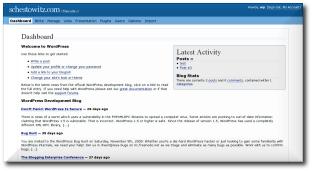
Leak’ Outside Bounding Border

[Latest nightly in use]

The appearance of the dashboard is inarguably impressive, so call it a pet peeve perhaps: I find the following box spillover somewhat of an eye sore, which should be trivial to fix. The “Write post” box is extended when the items on the left are expanded, but what about those the reside on the right-hand-side?

Local Screenshots

I sometimes feel like a bug report which is not recognised or awarded for (if not financially, then at least on a personal level), there is little or no incentive to intervene and assist further.

I must admit that I lost a fair bit of passion for WordPress development. I have been less willing to help once it began to drift onto a commercial agenda (Automattic). But as I digress, I may continue to contribute to a project whose code is GPL‘d; a project that has impact on many sites and enriches people’s on-line experience. I still feel discouraged to do more debugging when somebody else out there gets paid for it. The forum mavens have expressed similar sentiments before.

Monday, April 3rd, 2006, 11:03 pm

How to Fix Windows

Windows in CSS

I thought that the following was very blog post-worthy…

How to fix your Windows Application when it doesn’t work:

  (1) Stop and start the program
   (2) Log in and log out again
    (3) Reboot the machine
     (4) Reinstall the application again
      (5) Reinstall the operating system
       (6) Dance naked around the machine, waving a rubber chicken
        (7) “Take your machine back for servicing”
            – Chris Wedgwood

Monday, April 3rd, 2006, 4:58 pm

Spellchecking Everything

SPELLCHECKERS have been a very fundamental tool for quite some time. However, they tend to be bundled to particular applications and the whimsical Windows XP does not even include one, unless/until Office gets installed. Below are a few observations and personal tricks, which enable the task known as spellchecking to ‘escape’ the relams of individual packages.

Firstly, let us consider Web browsers. The latest of Konqueror comes with in-line spellchecker ‘out of the box’; Firefox has plugins (notably SpellBound); I am not too sure about Opera because it contains nothing as such ‘out of the box’. Then again, I may have missed it because I use Opera no more than once a week. Internet Explorer may rely on applications like Word or Outlook (Express) for peripheral spellchecking, yet this is far from convenient.

How can the user check inserted text in merely any application? What happens when the spelling facility is out of sight? I can only present my own method, which is the use of a lightweight external program: the text editor. Copying to external editors is easy and generalisable, just as a last resort. In my case, this involves a sequence of keystrokes: [Ctrl]+A (highlight all), [Ctrl]+C (copy), [Ctrl]+E (for editor invocation), [Ctrl]+V (paste in editor), [Ctrl]+T+S (spellchecking), then [Ctrl]+A (highlight all again), [Ctrl]+C, [Ctrl]+V (paste back). It takes only a few seconds and works effectively in any application.

All in all, familiarity with keyboard accelerators is the key (pun intended), as well as setup of new accelerators, hand positioning (arms as adjacent as possible to all peripherals) and so forth. A few others could possibly attest to a similar experience.

Yahoo News
The ‘big boys’ have some typos as well, one of which I captured

Monday, April 3rd, 2006, 1:55 pm

Fighting Microsoft, IBM Spend 300 Million Dollars

Season of the playful penguins
Season of the playful penguins from Oyonale

IBM have gradually become a close ally of Linux, as well as Open Source in general. Among the exciting news for Linux, heaps of which have flooded the mainstream in recent weeks/month:

IBM Challenges Microsoft With $300 Million Ad Campaign

At the center of the new migration initiative under Move2Lotus is “Migrate to the Penguin.” IBM is introducing a limited time only rebate program for eligible IBM Software Resellers who move customers from Microsoft Exchange to Lotus Notes and Domino on Linux collaboration offerings.

Source: technewsworld.com

Real-time Posts

Posts by @schestowitz

Retrieval statistics: 23 queries taking a total of 0.095 seconds • Please report low bandwidth using the feedback form
Original styles created by Ian Main (all acknowledgements) • PHP scripts and styles later modified by Roy Schestowitz • Help yourself to a GPL'd copy
|— Proudly powered by W o r d P r e s s — based on a heavily-hacked version 1.2.1 (Mingus) installation —|