Tuesday, April 25th, 2006, 2:24 am

 HERE is a growing interest in snatching of Web traffic from search engines. A notorious method for achieving this is by large mass of useless and re-used content. This is backed by many inbound links, which are most commonly accumulated by spamming of other Web sites. The overall outcome of this is degradation in the quality of publication on the Web. Likewise in science (sometimes at least!).
There are real technical papers and fake ones as well. SCIGen was at one point utilised to output randomly-generated publications, one of which was actually accepted to be presented at a conference.
Finally, there is a new tool,which claims to be able to discern real technical papers from fake ones.
Authors of bogus technical articles beware. A team of researchers at the Indiana University School of Informatics has designed a tool that distinguishes between real and fake papers.
It’s called the Inauthentic Paper Detector — one of the first of its kind anywhere — and it uses compression to determine whether technical texts are generated by man or machine.
Monday, April 24th, 2006, 6:05 am
 finally caught up with work. Having returned from this long Easter vacation overwhelmed by workload, I was rather restless for days. I am still feeling sore due to lack of exercise. This comes at a very bad time as a contest is commencing rather soon and I must be in a better shape.
I can finally take the time to post a photo which I was sent a couple of days ago. The photo shows myself, my cousin Rachelle, and my cousin Michael at their house in Davie, FL.

Monday, April 24th, 2006, 1:43 am

Season of the playful penguins from Oyonale
 HILE absent, I did not have the opportunity to comment on Oracle’s desire to buy a Linux distribution. This started a whole chain reaction, which had people think about the exploitation of Linux by giants. This also resulted in the exchange of some insults.
More latterly, Red Hat, who were rumoured to be in Oracle’s acquisition agenda, have been responding. Below are some among the softer words, which have come out from the months of their executives.
Success May Threaten Open Source Ethic
“His conclusion is contrary to virtually everything I’ve seen in my 17 year history of commercial free/open source solutions,” Michael Tiemann, vice president of Red Hat said about Goulde’s report. “I believe that the effect of open source on the proprietary vendors is a force 1,000 times more powerful than the force of proprietary principles on the open source community.”
Sunday, April 23rd, 2006, 11:18 am
 A rare and important story such as this cannot and should not be ignored. An intersting scientific discovery has just come to my attention.
It turns out that nature’s own chemicals are more able to fight bacteria than one of man’s most significant developments: the invention of penicillin. And get this: a compound in wallaby milk is said to be 100 time more effective. Will humans start breeding wallabies? Or is the statement made in the article an exaggeration that will sooner or later be balanced?
Scientists have discovered a bacteria-fighting compound 100 times more effective than penicillin – in wallaby milk.
Researchers found the highly-potent compound, tagged AGG01, was active against a wide variety of fungi and bacteria including antibiotic-resistant superbugs.
Saturday, April 22nd, 2006, 2:09 pm

Probably the most ubiquitous wallpaper nowadays
 ACH platform (including its distribution and/or version) can often be characterised by its default wallpaper (background picture), among other visual signatures such as the login screen and icons set. Here is a nice and fairly complete gallery of default wallpapers . It contains wallpapers many of us have seen in Mac OS, Windows, and Linux.
Saturday, April 22nd, 2006, 6:03 am
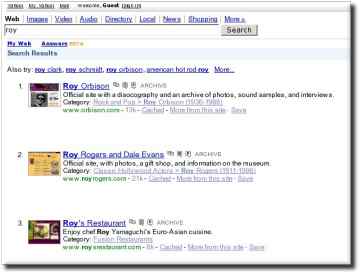
Yahoo search results for “roy” with
thumbnails (previews) added ‘on the fly’
 AST year (July 2005 to be precise), I conceived a hypermedia system/Web browser wherein page previews get put adjacent to incoming/outgoing links. Such previews should serve as somewhat of a screenshot that rids the need to explore deeper. They give the surfer a shallow preview, making arrival at pages more rhetoric or unneeded. The surfer can become selective based on the appearance of the destination page.
Screenshot-type extensions turn out to exist in Opera and even in Mozilla Firefox. In fact, there are several such extensions for Firefox. One of these extensions is BetterSearch, which manipulates search engine results pages directly. Thumbnail zooming is possible too and thumbnails rely on Alexa’s thumbnails database with the caveat that only front pages are displayed, rather than the actual pages delivered to the SERP. In BetterSearch, almost a dozen search engines are supported. One has to remember and constantly bear in mind that a fast connection is required for pragmatic use. It can otherwise become an obstruction — a time-consuming obstacle
Friday, April 21st, 2006, 11:39 am

More spam from more remote countries
nevitably, with higher bandwidth, more connected nodes, and little supervision (other than endless censorship), Chinese spam is gaining steam. That said, 80% of all spam was recently said to be despatched from compromised Windows computers, which makes this crime passive. As the BBC reports:
The US is close to losing its place as the top spam sending nation on Earth.
Statistics from security firm Sophos show that China is fast catching up the US as a source of junk e-mail.
The amount of spam on my sites has become too overwhelming recently. Certain accounts I will just filter blindly, without bothering to check any spam boxes for false positives. When it takes nearly an hour going through spam, it becomes both unacceptable and impractical.
My Wikis are repeatedly falling victims to Chinese spam and that’s just the beginning of the story, which involves much beyond E-mail. The Web becomes a scary place when much of its traffic is malignant. It becomes hostile, as opposed to user-friendly. It deters the use of E-mail, much as hacking forces some sites to go offline, due to high maintenance costs (time/money).


 Filed under:

