Introduction About Site Map

XML
RSS 2 Feed RSS 2 Feed
Navigation

Main Page | Blog Index

Saturday, July 15th, 2006, 11:42 am

Blogging Pace Minset

The Web Developer extension in action

WE often face the need to compromise and rearrange priorities. We do so in order make better use of our time, but there are trade-offs involved. A few months ago I said I would give up on blogging pace, which stood at about 3 posts per day. According to one blogger, this deems quite reasonable. At present, neglect of pace appears like the right strategy, for a wide plethora of reasons.

Daily posts are a legacy of a Web 1.0 mindset and early Web 2.0 days (meaning 12 months ago!). The pressure around posting frequency will ultimately become a significant barrier to the maturity of blogging. Here are 10 reasons why.

Friday, July 14th, 2006, 7:59 am

Blocking Ads – An Example for Digg.com

I already addressed ad blocking controversies several times in the past, the context being slightly different each time, e.g.:

With blocking often comes some guilt, as it is resistance to the developer’s intent (much like modification of source code). But to me, the bottom line has always been that I am never (or rarely) interested in the content of the ads, all of which are promotional and often urge the visitor to expend money (if not merely get exposed to and absorb some brand name). Thus, any click that I am ever likely to make would probably verge the line of click fraud (assuming pay-per-click programs) and this revenue money goes towards many sides. It will most likely pay off authorities through taxation, the advertiser (or mediator, e.g. Google, Yahoo/Overture), and the Webmaster. So, everybody is essentially gaining at the expense of the client of these ads. If you are not genuinely interested in ads, never follow the link. It is probably as unethical (if not more) than the exclusion of ads altogether.

Digg.com is no exception to all of this. It recently seems to have adopted Google ads that are rather stubborn in the sense that most plug-ins or rules cannot hide them well away from sight. When Digg version 3 launched (only a few weeks ago) it took only minutes for me to get irritated by the waste of space at the top — that which is assigned purely for contextual ads from Google. None of my 3 blocking mechanisms in Mozilla Firefox was enough to wipe it off the page, much to my misfortune as I use Digg very heavily and my Web browser is small in terms of its height dimensions (due to kpager at the bottom of the screen). Either way, there was a simple way to suppress those ads, merely by excluding the div in question. This can be done using a simple selector in Firefox, which makes that top banner ad disappear, never to be thought of again.

Find your chrome directory under your main installation:

  • /Applications/Firefox.app/Contents/MacOS/chrome in Mac OS X
  • C:Program FilesMozilla Firefoxhrome in Windows
  • firefox/hrome in your Linux local installation directory

You might also find it convenient to do this on a per-user basis, by locating your chrome settings under individual profiles, e.g. ~/.mozilla/firefox/1ixj9tdk.default/chrome on my SuSE Linux box.

Edit (if already existent) or create a file named userContent.css and add the following selector:

*[src*="banner_ads"] , div[id="top_ad"] { display: none !important;}

This was inspired by Firefox AdBlock, which is far more comprehensive, but appears to be no longer available (it older URI is now broken). You can always append new rules by looking at the source code of pages and add selectors for exclusions, even using simple wildcards.

Thursday, July 13th, 2006, 4:30 am

IRC Meeting at UCL

Bourbon

I will be in London all day today, which is why I am up so early in the morning/night. A Structure and Function meeting will take place and encourage discussion about some recent research among our inter-site collaboration (Manchester, Imperial College, University College London, Oxford).
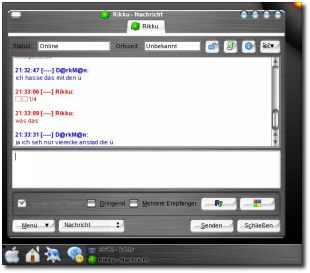

The journey to London will be roughly as long as the stay, which is somewhat disappointing, if not a real pain. It is also quite disruptive to the normal daytime activities, so I will go to sleep late at night. It is definitely going to be a heck of a long day!

Wednesday, July 12th, 2006, 3:41 am

Linux/KDE Mockups Drive Increased Productivity

Black Halloween
KDE with a theme that I am particularly fond of

As KDE gears up towards the release of version 4, users continue to contribute innovative ideas. Below are a few examples, all of which are mockups and brainstorms.

  1. Show Progress in Title Bar. This one shows the pragmatic effect one can achieve by embedding extra information in the title bar of a shaded window.
  2. System Notification. Here we see an illustration of system and task status centralised under a single widget.
  3. Tasks Info in Less Windows. Lastly we have yet another similar example where information gets condensed, which saves some screen ‘real estate’.

Related items: KDE: User-Driven Innovation, KDE Receives Praises for Innovative Features

Tuesday, July 11th, 2006, 11:39 pm

Users Are Efficient; Neither Stupid, Nor Lazy

WHY is it that so many user interfaces simply fail to work? It’s because users are permitted to take shortcuts and ignore the instructions. This is in fact the message which is delivered by Jeff Veen, whose opinion was inspired by another’s.

Veen concludes: “They’re not stupid. They’re not lazy. Don’t treat them that way.” Users are efficient. They want to get the job done with the least effort. It just doesn’t bode well as far as the intent of the developer is concerned.

Yanoff
New Yanoff for Palm – an example of
poor UI design

Tuesday, July 11th, 2006, 1:23 pm

I Have Become a Top Digger

The Digg front page

I have just reached page one of Digg’s top users! This puts me at an excellent position in two separate Web sites: MATLAB Central and Digg, with 20th and 30th position, respectively.

With MATLAB I have been for 2 years, but with Digg this was achieved within just 2 months, which seems rather amazing to me. Two months to get there translates to more than one story at the front page, per day, on average. The pace on weekdays stands at approximately 3-4 front page (promoted) items per day, which makes my first rave seem almost insignificant and utterly irrelevant.

Tuesday, July 11th, 2006, 4:12 am

Getting Started with Linux

Season of the playful penguins
Season of the playful penguins from Oyonale

Some days ago I found advice and general information for Linux beginners. It seems rather decent, so I’ll quote a slight bit as a teaster.

1. Read, read, read and study what’s available out there before choosing a distribution to install. Unlike Windows there is more than one choice. A good place to start is distrowatch, a sort of “news of what’s new in Linux” site. You’ll find a paragraph of discussion of many older releases as well as new ones.

Real-time Posts

Posts by @schestowitz

Retrieval statistics: 23 queries taking a total of 0.082 seconds • Please report low bandwidth using the feedback form
Original styles created by Ian Main (all acknowledgements) • PHP scripts and styles later modified by Roy Schestowitz • Help yourself to a GPL'd copy
|— Proudly powered by W o r d P r e s s — based on a heavily-hacked version 1.2.1 (Mingus) installation —|