Introduction About Site Map

XML
RSS 2 Feed RSS 2 Feed
Navigation

Main Page | Blog Index

Friday, March 10th, 2006, 11:56 am

Google and the Optimisation Trap

Google Cookie
How does the notorious Google cookie affecting your search results?

II is no secret that Webmasters sometimes subvert (or “optimise” as they would call it) Google results pages, which in turn weakens the relevance of Google’s search results. This manipulation is done by insertion/injection of particular keywords, as well as navigation hacks, ‘organic’ inbound links and so forth.

While artificial changes to site content have an effect on other search engines, changes are done primarily with Google in mind. This urges Google to make their strategy (algorithms) more dynamic and permit results to ‘dance’ every now and then, sometimes owing to large updates (c/f Bourbon). In such circumstances, ‘re-shuffle’ reached the extent that resembles a complete overhaul of indices. The main purpose it to weed out spam, yet the borderline between “ham” and “spam” becomes rather vague, so genuine siteget affected and often penalised. Many lose vital revenue as a consequence.

The Internet is becoming a brutal battelground. There are many cases of black-hat SEO, which have become worryingly prevalent. Even id search engines can annul the effect of ‘noise’, this does not account for the issue of relevance, spam aside. This is possibly a case of becoming a victim of one’s own success. Google have become the main target to many harmful practices, including the rumour mill.

In my humble opinion, Google remain the best engine bar none, but new challenges are being posed every day. Black-hat practices accumulate more and more tricks, which can be ‘pulled off the sleeve’ and then shared, soon to become a Web epidemic. Like a virus which quickly exploits flaws in servers and desktops, SEO hacks rely on flaws in search engines algorithms. The question remains: will Google be able to adapt to changes as soon as they occur, thereby annihilating the impact of Google-targetted site/page optimisations? I will illustrate using a very timely and true example.

This morning I wanted to know the precise definition and difference between single-breasted and double-breasted garments. Putting “single breasted double breasted” in Wikipedia (I tend to use it for knowledge queries, as opposed to URL search), I got the perfect answers with clarifications, pictures included. In Google, one gets promotional stuff. Shops are trying to sell suits, so results 1 to 4 are purely irrelevant for my query (at least the one I had in mind). I had no intention of seeking a guide or a purchase. In other words, the finanical incentive beat the informative source, which is sad. I did, however, find Wikipedia’s page at number on Google for the phrase “single breasted double breasted”. To me, this was not good enough. As a whole, it wasn’t a specific and satisfactory outcome as the first 4 places attempted to sell me something. Knowledge references should surpass any individual store — one among the many which exist.

Friday, March 10th, 2006, 4:53 am

Google Office in the Making?

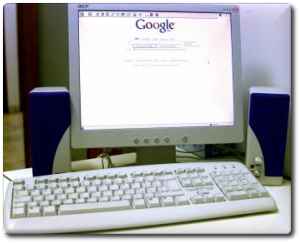
Google on a computer screen

SEVERAL months ago, Google’s co-founder denied rumours and shattered hopes of a so-called ‘Google Office’. It was by all means rumoured to be ‘in the works’. This story was alluded to in the context of Web-based Office. This was the time of Web 2.0 and AJAX hype. Many Web 2.0 startups laboured hard on Web-based, Office-like productivity tools, which were (still are) in the making, as well as began to penetrate the commercial market.

As it now turns out, Google indeed enter a territory that could potentially lead to a Web-based Office, directly challenging Microsoft’s Live Office, as well as the existing desktop-bound Office. ‘Live software’, as it has been called, has the intent of complying with Gates’ Web-ward migration memos. This move by Google will urge Microsoft to take their Office tools on-line, thereby making the Web a primary batteground, not out of choice. OpenOffice is yet another threat to Office, yet Microsoft already fight it with dirtier tactics.

Also in the news on Google: GDrive – the upcoming on-line service for storage and backup. It has already become highly controversial due to privacy concerns. The latest of Google Desktop raised similar concerns as Google may hold copies of people’s hard-drives on their servers, making it more susceptible to exposure.

Thursday, March 9th, 2006, 7:44 pm

IBM: Linux Migration, Vista Reluctance

Season of the playful penguins
Season of the playful penguins from Oyonale

MERELY anyone who follows the news will have come across this by now. A an intersting rumour, if not an announcement, gree legs and began running wildly. It came from IBM in Germany. It suggested that IBM would be moving to Linux rather than upgrade to Windows Vista. This initiated a storm in a teacup, but finally, IBM make a formal denial. Many questions still hang in the air.

Andreas Pleschek, IBM’s head of open source and Linux technical sales in Northern Europe, was widely misquoted this week as saying that IBM had cancelled its Windows contract with Microsoft as of October.

Thursday, March 9th, 2006, 2:42 pm

Front Page Feeds and Technology Feeds

Man and his dog

ABOUT a year ago, I agreed upon a rule for myself: Read more of the technology sections in Web sites; feeds likewise. Front pages and doorway pages tend to concentrate on celebrities (sports included), sex, and death.

This disposition is a matter of personal preference, of course, but the general advice is for each person to choose feeds that intersect with and correspond to main interests. Good feeds encourage reading. Reading re-enforces knowledge and in the lack of distracting detail, the mind is better stimulated, as well as focused on consistent information.

Related item: Greedy Feeds and Generous Feeds

Thursday, March 9th, 2006, 4:24 am

Sneak Peek into Google Calendar

Horde

Calendaring in the Open Source Horde project

SHOWN above is a screenshot of the Web calender which is closely integrated to my mail. As it turns out, as well as speculated years ago, Google are working on their own implementation. Their Web-based software will actually be called CL2 on the face it. Some screenshots are revolving around the Web nowadays. They depict what could potentially kill many other Web-based calendars.

Related item: Managing To-Do Lists On-Line

Wednesday, March 8th, 2006, 4:58 pm

Coffee and the Impact of Genetics

Coffee grains

I am not too happy to have read the following:

Caffeine boosts risk of heart attacks in the genetically susceptible.

People carrying a common variation in a certain gene could be worsening their risk of a heart attack simply by drinking several cups of coffee per day.

Daily count of coffee mugs: 6 so far.

More ‘coffee items’:

Wednesday, March 8th, 2006, 10:50 am

Things That Microsoft Will Have You Believe

Bill Gates
Will such folks ever lie to you???

DIVERSION from the truth has been one of Microsoft’s greatest strengths and marketing techniques for decades. Here are the most recent examples, accumulated over the past couple of days alone:

  • Microsoft “re-launch” or “unveil” a shiny, brand-new search engine, to reside on a new domain. This hype-driven drivel (e.g. “MSN is twice as good as Google”) sounds better than “we have improved our rusty search engine slightly”, right? Microsoft pulled the same trick a few years back, arguing that MSN had been re-invented to incorporate major innovation (all in vain of course). Such overstated facts are intended to attract curious Web surfer, nothing more. It is an enticement, which is sometimes backed by financial rewards too.
  • Arguably, the following was alluded to by Windows advocates: Do not attempt to take Linux Live CD’s for a spin as they can destroy your computer. Such calls for ejection were deterring Windows users from seeing something else and carry on with an installation and progressive platform migration. Fortunately, some ‘penguins’ (not ones with a beak and a tuxedo) have taken matters into their own hands.
  • OpenOffice 2 is 10 years behind, according to Mr. Yates of Microsoft. Lo and behold: another FUD campaign which indicates that Microsoft’s revenue suffers. Similar dirty tactics were embraced as means of halting the momentum of Linux servers sales. Merely everyone knows the false and controversial campaign that followed. A Google search for ‘linux’ still puts microsoft.com at the top, owing to a sponsored link paid for by the Dark Forces. Such conflicting search results have led to lawsuits in the recent past. I still await Google’s rectification of such shameful fiascos. Lastly, let us remember paid forum members that advocated Windows.

Microsoft can try hard to conceal their past lies, but a few journalists, observers and professionals will never forget.

Real-time Posts

Posts by @schestowitz

Retrieval statistics: 23 queries taking a total of 0.088 seconds • Please report low bandwidth using the feedback form
Original styles created by Ian Main (all acknowledgements) • PHP scripts and styles later modified by Roy Schestowitz • Help yourself to a GPL'd copy
|— Proudly powered by W o r d P r e s s — based on a heavily-hacked version 1.2.1 (Mingus) installation —|