Thursday, January 19th, 2006, 5:23 am

Two recent articles, which are definitely worth reading, are listed below.
Search engines extract too much of the Web’s value, leaving too little for the websites that actually create the content. Liberation from search dependency is a strategic imperative for both websites and software vendors.
To you who are toiling over an AJAX- and Ruby-powered social software product, good luck, God bless, and have fun. Remember that 20 other people are working on the same idea. So keep it simple, and ship it before they do, and maintain your sense of humor whether you get rich or go broke. Especially if you get rich. Nothing is more unsightly than a solemn multi-millionaire.
This reminded me of a fun blog which is purely dedicated to Web 2.0 bashing.
Wednesday, January 18th, 2006, 12:10 pm

 recently volunteered to take browser compatibility more seriously. I never truly believed there was a place for platform discrimination. However, refusal to upgrade from Internet Explorer to Firefox is not quite so excusable. Web standards should be fundamental enough to be supported at the very core of a browser and behave reliably. And yet, I realise that my attitude must change.
The context of this post is WordPress, a blogging platform whose development and community I have been a part of for over a year. In fact, I have put my name down among the Roles in WordPress Wiki page. To quote:
Testing / QA
Browser Testing – Testing Firefox, IE, Opera, and Safari against major WP functionality; documenting bugs; coding workarounds.
- I have a large variety of browsers which are built for Linux (including old versions), so I will continue to test nightlies and report inconsistencies and incompatibilities whenever time permits. I can use emulation to test under Safari and IE, but I have WinXP and an iMac at work. –[[User:schestowitz|schestowitz]] 3:38, 13 Jan 2006 (GMT)
The idea of roles in WordPress was introduced less than a fortnight ago. While editing the Wiki, I also decided to bind a vague personal description to an empty placeholder page which carries my name. I chose:
An ordinary guy who is overly fascinated by ‘anything Linux’ and ‘anything PHP/MySQL’.
My role involves using a large variety of browsers, especially exploring the Administration Panel (/Dashboard) side. Due to Safari and Internet Explorer, I will have to work on alternative platforms, too. Mac OS X is powerful, but rarely has the ‘expessivability’ of GNU/Linux. Also, it has commercial strings attached to it. Many of its applications bear a cost. To test cross-Web browser compatibility, I can disengage from the 3 Linux that I regularly use and take advantage of the iMac and Windows XP machines at the office. These operating system definitely have a place; just not in my house [smile]! They have not been switched on for months, but now there is a reason for a small change. I love WordPress! As matter of face, it was love at first sight and the affair carries on.
I have reported a few bugs already and some have been resolved:
Tuesday, January 17th, 2006, 3:28 pm

Refusal to accept deceit
 EN, just like women, tend to show their strengths while hiding the weaknesses. It is a rational choice. Be smart and you will wish to boast about it. Chess clubs and advanced literature and among the destined venues, attractions or vocation. Be strong and you will probably wind up spending a lot of time at the gym. Social people (or extroverts) are more talkative, so they are inclined to go out more.
The same principles apply to one’s appearace. Guys can opt for long sleeves, short sleeves or no sleeves. Shorts, jeans and even baggy pants are all acceptable. Girls endowed with nice legs will go out in skirts. Girls with an attractive figure expose their torso nowadays, or even their arms. Those with large breasts often use their cleavage as a ‘weapon’.
The conclusion of the matter is that one’s exposed side — that which we are most aware of — hides the downsides and boasts glory. Never be misled by the cover or even be demoralised by impression made by peers. The neighbour’s lawn looks greener for a reason.
Tuesday, January 17th, 2006, 6:25 am
 EARCH engines are constantly finding new ways to improve their performance. While there are many methods involved, some of them are less ethical than others. Think of the following perplexing scenario: Refinement of one’s results by means of crawling and utilising the opponents’ data, which is ‘exposed’ to everyone. In legitimate cases this is known as “harvesting” or — put negatively — ascribe to it the connotation of “scraping”. The root of the idea is use of search engines to improve and refine results of another. Scroogle and Webcrawler, for instance, are dependent purely on this concept. There is a cyclic trap here, too. Search engine ‘poisoning’ comes to mind.
 Think of MSN using Google Directories or Google using
 del.icio.us, which is a social linkage database that is now owned by Yahoo. Moreover, directories like DMOZ are non-profit, yet they are often open for use (or misuse) by profit-making companies. Link bases like deli.ci.us (owned by Yahoo) have the potential of refining results. As they are publicly available, could anyone truly restrict rivals from accessing and using the potentially valuable data? These links are contributed and managed by the public and have no prescribed copyrights. The depth of exploration for search engines does not seem to be limited, which is worrying.
There seems to be a certain ethical and legal border where image crawling and serving them within frames (Google Images) become questionable, let alone public forums, UseNet included (Google Groups). This by all means refers to Google Images and Google Groups, quite exclusively even. How deep should one be allowed to crawl the data in existence and how should it be attributed to the source? To dare is to win, but often this leads to demise which is catalysed by public opinion. There is no doubt as to whether company acquitions are intended for more extensive data collection, assuming that information, if obtained even in the form of spying, is available. Information can become powerful, but it has a cost which is often the death of privacy.
As I carry on with my drivel on the infiltration of search engines, I also discover the belated arrival of a European search engine.
In his New Year’s address outlining his administration’s plans for 2006, French President Jacques Chirac focused on plans for a European search engine to rival US internet companies such as Yahoo and Google. Some of the top tech labs in France and Germany are reportedly working on the ‘Quaero’ (Latin for ‘to search’) search engine.
Monday, January 16th, 2006, 11:59 am
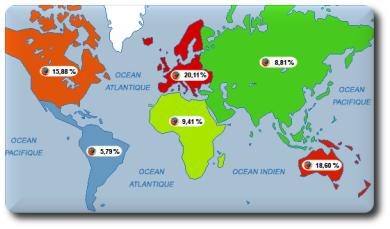 Picture from
 xitimonitor.com (click to confer the source)
A diagram is worth a thousand words.
Related news: Dell bundle Firefox with Windows in the United Kingdom.
Monday, January 16th, 2006, 7:50 am

Mainsoft and IBM will one day unveil their long-anticipated port of .NET Applications to Linux and J2EE. Finally, this important milestone which enables Windows-centric applications to be ‘opened’, becomes a reality.
Mainsoft Corp. and IBM Wednesday announced an effort to work together to extend the Linux ecosystem by helping Microsoft customers move to Linux.
Meanwhile, the word through the grapevine is that another pact will deliver many low-cost Linux workstations.
Computer maker Mirus Innovations LLC and software vendor Linspire Inc. have teamed to offer a line of Linux-based desktop PCs starting at $299.
The pace at which good news for Linux get delivered is encouraging. Later today, an official announcement will be made with regards to Hewlett Packard’s top executive departing from her duty to join Penguin Computing. Keep an eye on the business/technology news.
Sunday, January 15th, 2006, 4:58 pm

T was only a few days ago that I came to ponder an interesting fact: I have never,ever in my life paid for a piece of software. I have never paid for a Web service either. I had some computer games bought for me as a gift while I was a teenager, or even younger than that. I was primary using freeware as a child and I do not think it ended up quite so miserably, despite my habit of relying on free and/or Open Source solutions.
The are a few exceptions to the above statement. Admittedly, I may have bought computers that had Windows pre-installed and thus a licence paid for. Anything commercial that I ever use nowadays, the University pays for (MATLAB which runs on Linux, for example). My Web host pays for cPanel too, I presume. Palm handhelds which I have owned have some programs bundled, but I never purchased any softwere for this platform where so much is already free.
Is it all something to take pride in? I do not believe so, but the observation is an interesting one nonetheless. Frankly, I can never recall pulling out a credit card for software purchase or a paid service on Web. On the Internet, if I ever pull out the CC numbers, it is for groceries, various items (primarily gadgets) and Web hosting bills. Never have I paid for a licence key or a binary file.
Bottom line: expensive proprietary software is not a necessity. That, however, is not what commercial software vendors would have you believe. Freeware and Open Source software are their greatest enemies and, given experience and orientation, they can achieve anything. They also have the merit of being transferable and readily available in abundant numbers.


 Filed under:
