Wednesday, January 4th, 2006, 5:22 am

 HREE figures which I tend to quote quite often are John Dvorak, Joel Spolsky, and Jeffrey Veen. There is a lot of discussion these days about the impact of the Internet on mainstream media and all of them address the issue regularly. Veen’s latest item is certainly worthy of special attention.
What we couldn’t have seen back then, and what is so obvious today, is that you can very effectively cut out the middleman. What happens when the entire audience is on the network and has access to the databases? And what happens when they have the tools to publish what they uncover? Some call it chaos, others call it the blogosphere. But you can’t deny that it is transforming media faster than we ever thought it would.
Previous items on the same topic:
Tuesday, January 3rd, 2006, 12:42 pm
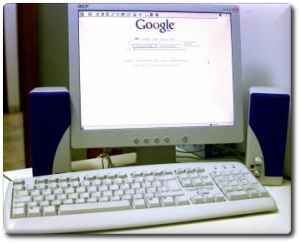
This article speaks for itself.
Google will unveil its own low-price personal computer or other device that connects to the Internet.
It was only a matter of time.
Related item:
Update (05/01/2006): Google renounce low-margin PC speculations
Tuesday, January 3rd, 2006, 4:34 am

A mixed message is delivered to site visitors
 S time goes by, the needs of the disabled are better realised. The Web becomes not only a mainstream phenomenon, but it is also a necessity. To many, banking, shopping and even social aspects or life are dependent on the Internet. Currently, search engines tend to concentrates on content, not on style and graphics, let alone validity of code or issues pertaining to accessibility. Might this change?
It would not be surprising if a search engine emerge , which only bothered with pages that are pure text or are built to possess good accessibility traits. Blind and handicapped people, for example, could opt for this niche-serving search engine. Large players such as Google have already catered for specific types of searches such as localised search (Google Local) and blog-exclusive search. Accessibility-type search may soon become a reality.
Tools such as The SEO Analyzer would perhaps be valuable for ranking sites. Perhaps incorporating modules such as these into crawlers is a worthwhile move. Moreover, rather than separating the engine types altogether, the user could tick a box that says ‘display only lean, stripped-down pages’1 or ‘rank pages for accessibility and sort by quality’. This will encourage better Web standards and open ‘HTTP cyberspace’ to a larger audience.
1 This exists already, I suspect. Page size in the results page provides a clue as well.
Monday, January 2nd, 2006, 3:29 pm

Help the search engines clean up the Web.
Report duplicates.
 recently mentioned site scrapers in the context of Internet plagiarism. More often do I hear about blogs copied systematically nowadays.
Blog plagiarism is a growing phenomenon, or so it seems on the surface. This even happens to me sometimes, but I refuse to spend my time or lose sleep over it. The process needed to remove stolen content is unnecessarily cumbersome. As as example, Podz and Mike Little, who are both WordPress developers, had people copy their entire site merely post-by-post. This can ultimately lead to mirror/duplicate penalties, which deter search engines. As far as I know, they had to engage in a lengthy process of correspondence before action was taken. The best one can do is keep an eye on the dodgy sites and report abuse when all blows out of proportion. As long as a site is public, it is susceptible to copyright infringement and can, in due time, become a victim.
As one example of stolen content, RSS Site Map is one such item that was once copied verbatim and in full. If I recall correctly, a Blogger member was the culprit. A subtle link was at least there, but no real attribution was made.
Other content thieves scrape random bits and stick them together to form ‘doorway pages’. These pages serve as a mechanism which hogs search engine referrals. It is one among many popular aspects of black-hat SEO practices, which are a form of spam by any definition.
Frequently-Asked Questions (or Useful Facts)
- Q: How does one copy content systematically?
A: RSSBlog [rel="nofollow"] and the like. Magpie can do this vis RSS when misused.
- Q: How does one detect plagiarism?
A: Tools such as Copyscape appear to do that trick. I imagine that they run a series of Web searches with large sentences involved. They then attempt to identify excessive overlap across sites on the Internet. These Web-based tools simplify and automate, at an upper-level at least, an old-styled method for detection of duplicates. This type of technique I can still recall from my days as an undergraduate.
- Q: How does one report plagiarism?
A: Probably the most suitable response is contacting the host of the offending site. Examples are needed to support the complaint/s.
Monday, January 2nd, 2006, 10:02 am

The use of money to skew real facts and lure customers
 INUX forums (including newsgroups) often encounter harassment by trolls that spread anti-Linux FUD. This puts off a few participants and adds noise to discussions that are largely Linux-oriented.
There is often a suspicion arising that this community sabotage ‘bubbles up’ to managerial roots. Some would suggest that disruptive involvement by trolls is actually paid for. Past evidence supports such suspicions and is echoed in this blog item which quotes John Dvorak.
“Some years back, Microsoft practiced a lot of dirty tricks using online mavens to go into forums and create Web sites extolling the virtues of Windows over OS/2. They were dubbed the Microsoft Munchkins, and it was obvious who they were and what they were up to. But their numbers and energy (and they way they joined forces with nonaligned dummies who liked to pile on) proved too much for IBM marketers, and Windows won the operating-system war through fifth-column tactics”
Mr Dvorak wonders if Microsoft is today using reverse-dirty-tricks to promote the Xbox 360: pay people to create Web sites that slam the gaming computer in order to provoke a barrage of defenders.
Last week I went to watch King Kong. There were no less than 3 Xbox 360 commercials before the film commenced. Microsoft sure know how to spend money. It is worth mentioning that Xbox 360 units are sold at a cost which accounts for a significant loss. Regardless, the Xbox fails to sell in Japan, despite the heavily-invested-in commotion.
Related item: Xbox 360 Off to a Slow Start in Japan, Microsoft-funded Benchmarks
Sunday, January 1st, 2006, 11:06 pm

 EVERAL days ago, in the context of ‘housekeeping’ computer chores, I stressed the need to manage paper references in an appropriate application. At the time I mentioned JabRef, which is a Java references management program. I have had JabRef installed for quite a while, but did not bother to accommodate it with data.
Knowing the limitation of workstation-bound software, I decided to go ‘shopping’ for a Web-based alternative. I have many such applications installed on my Webspace, so I know their powers. I also know that I can take advantage of remote access, but it can be slow (especially while on vacation), cumbersome, and only loosely inter-operable. JabRef is cross-platform, but installation on each desktop is still a requirement, which is less than desirable.
My pursuit for a Web-based program was very fruitful. I found only one application of the type I had sought. Freshmeat (which is suitable to vegetarians too!) had me aware of PHPBibMan (PHP Bibliography Manager). Here is my own description of PHPBibMan. It is based on what I have been able to gather after a few minutes of exploration:
- PHP/MySQL
- Open Source
- Free, apparently GPL
- Rich graphical interface
- Multiple users, multiple groups
- BibTeX import and BibTeX output (albeit import is not very reliable)
- High level of complexity (over 500 files), plenty of functionality
PHPBibMan is finally installed on my site alongside similar applications, the latest of which is for spreadsheets. So far I like what I see, but the documentation (installation instructions in particular) are poor. There is plenty of potential for PHPBibMan, but merely nonexistent documentation had me digging the files and experimenting before actual success. The projects looks as thought it ceases to be actively maintained last year.
Sunday, January 1st, 2006, 4:12 pm

Many still refuse to discover the power of feeds
LASHDOT informs me of an interesting study which suggests that only 4% of Internet users knowingly use RSS. This implies that a very large number of potential subscribers are yet to be won. Now is the time to make content feeds available.
The item ends with a brief dicussion about the name appeal of RSS. I would also add another factor: inconsistent terminlogy e.g. feeds, XML, syndication and subscription.
RSS stands for Rich Site Summary or Really Simple Syndication. I have special inclination for using the term RSS because it is my name’s initials!


 Filed under:
