Thursday, January 5th, 2006, 8:16 am

 OR quite some time, companies with large budgets have feared the inclusion of free software in their server rooms. Cost was not an issue. Naturally, price was never assumed to lie orthogonally to quality either. Is there a fallacy? There certainly is and it is being perpetuated by those whose interests it serves.
I store about 1.5 GB of mail only to see great reliability. I also maintain Web spaces of roughly the same size and a continuously increased level of complexity. The Linux server and its Linux Web-based applications are both reliable and free. As seems as though the issue remains that in the wealthy working place, people have budgets that they need to make use of. Often they opt for Exchange servers and IIS. The expenditure due to acquisition of ‘premium’ solutions costs people their jobs. Cost cuts are more easily approached due to this. Pure and simple.
The same issues arise in a different context — the context of liability and job protection by sticking to brands. This pattern is an impediment in its own right. FUD continues to impede adoption, as does the norms and perceptions in people’s mind.
Related essay: Operating System Monoculture
Thursday, January 5th, 2006, 6:20 am
 In my own mind, there is one golden rule for design with Flash:
Non-Flash browsers should miss no information. Their users should only miss out on the flash (no capital ‘F’ here), but never any content. If proprietary formats like Flash are made a requirement for information extraction, the outlook for the Web seems grim.
It has been a long time since I last designed with Flash. This goes back to 2001, in fact. At the time, little did I know about the SEO impact, which is why I no longer bother with Flash. Originally, its use was not my choice either; it was the client’s.
As a final word of advice (or caution), menus and text should remain in pure-text form, never embedded in something that requires pattern analysis or closed-source software. The same rules apply to graphics (images) where the alt attribute must be used as a surrogate, just in case images are not (or cannot) be displayed.
Wednesday, January 4th, 2006, 5:12 pm
 The pact which involves Google and Sun Microsystems arouses my curiosity, particularly due to recent speculation about the Google PC and its vocation. It is no secret that Java is having tremendous impact. Nowadays, Firefox incorporates almost everything one needs, either as a joint plug-in that resides next to core, or as Web-based software, which is accessible via Web sites. Such sites are interpretable using Gecko (the rendered) or various other plus-ins for Flash, videos and the likes of them.
It is all about extensions, it seems — merely JRE applications embedded as panes in Firefox, which makes them well-integrated like the centre of all. Thunderbird does likewise and so can OpenOffice. The main implication is gaps being bridges. No more platform dependencies and filesharing protocols. Firefox makes everything transparent, or so one might assume (albeit you never know for sure with today’s Windows-only Firefox/Thunderbird themes and plug-ins).
For those who haven not heard/read yet, Firefox will soon have P2P file sharing incorporated as a plug-in. Rumours about this add-on have been circulating around the Internet for several weeks, if not even longer. There is even a screenshot. All of this commotion could attract a huge number of users from an already troubled Internet Explorer and, as browsers are used by all, this would push copyrights infringement to very worrisome levels.
Update (05/01/2006): Google renounce low-margin PC speculations
Wednesday, January 4th, 2006, 4:18 pm

 AST night, Brad Templeton pointed out that mail servers which run autoresponders or challenge/response filters could get blacklisted by
 spamcop.net. This is a database-driven Web site, which various spam filters rely on as a knowledgebase-type service. It also banned our LUG‘s mailing list earlier today.
I have been aware of the problems with such anti-spam tactics for quite some time, but never thought it could lead to this. As some commenters pointed out, other services may indirectly abolish anti-spam practices such as challenge/response, as well lead to banishment from people’s inboxes. Put in Brad’s words:
I learned a couple of days ago my mail server got blacklisted by spamcop.net. They don’t reveal the reason for it, but it’s likely that I was blacklisted for running an autoresponder, in this case my own custom challenge/response spam filter which is the oldest operating one I know of.
My personal solution, as posted in reply to the article, is to use a spam filter ‘on top’ of the challenge/response component. The intent: lowering the amount of challenges. One can reduce the likelihood of banishment in this way, as well as become less of a nuisance to the Net. In other words, it is possible to rule out cases when messsages are rather obviously spam. It leads to lower volume of messages being dispatched, which in turn can avoid blacklisting.
I use SpamAssasin, which is active at a layer higher than challenge/response (in this case Apache with BoxTrapper). Whatever gets scored as spam will be put aside in a mail folder which is reserved for spam. Only messages not marked as spam (and not in the whitelist either) will have a challenge delivered. This cuts down the number challenges by about 70% in my case. It never entails any false positive because I set the thresholds rather high.
Wednesday, January 4th, 2006, 10:31 am

Entering the virtual world (screenshot of
Manchester snatched in June 2005, Google Earth, click to enlarge)
The Internet is bound to make most sectors of traditional industry obsolete. Below are several examples, which have begun to prove more realistic than ever before.
- Telephone companies- suffer from VoIP for local and international calls
- Internet Service Providers (ISP’s)- giants like Google can gnaw at their revenue by appealing to a large userbase
- Newspapers – readers opt for the Internet, get access to blogs of many ‘flavours’
- Television – user opts for interactive content, not one-way communication with a finite number of channels
- Reviews move on-line – similar impact to that of digital TV (on-demand menus) on the TV guide — a river that have dried up
- Book publishers – the impact of Wikipedia and free books in PDF format; easy printing and sharing
- Film industry – media ‘ripping’, DRM
- Music industry – same as before with but increased levels of piracy, also due to P2P networking
- Classified services, real-estate (among other middlemen-type services) – superseded by eBay, classifieds service from Google, Microsoft, Craigslist, etc.
- Banking – online banks with neither concrete branches nor assets
- Groceries – as previously predicted (along with other wild guesses), warehouses may replace supermarkets and be managed and accessible via the Internet
What will be the outcome of this revolution? Nothing far-fetched, but nonetheless a noticeable transition. More free content, low-cost services and fierce competition among service providers, primarily left in the hands of giants.
Wednesday, January 4th, 2006, 5:22 am

 HREE figures which I tend to quote quite often are John Dvorak, Joel Spolsky, and Jeffrey Veen. There is a lot of discussion these days about the impact of the Internet on mainstream media and all of them address the issue regularly. Veen’s latest item is certainly worthy of special attention.
What we couldn’t have seen back then, and what is so obvious today, is that you can very effectively cut out the middleman. What happens when the entire audience is on the network and has access to the databases? And what happens when they have the tools to publish what they uncover? Some call it chaos, others call it the blogosphere. But you can’t deny that it is transforming media faster than we ever thought it would.
Previous items on the same topic:
Tuesday, January 3rd, 2006, 12:42 pm
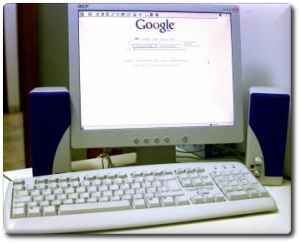
This article speaks for itself.
Google will unveil its own low-price personal computer or other device that connects to the Internet.
It was only a matter of time.
Related item:
Update (05/01/2006): Google renounce low-margin PC speculations


 Filed under:


