Saturday, December 17th, 2005, 4:51 am
 Time and time again, Bill Gates is urging his engineers to push harder towards successful penetration into the Web. His main rival has been identified already and it has a name: Google. Now begins the fight to win over large corporations that can give an exposure boost and yet more marketing pipes. After talks and negotiations with both sides, AOL appear to be getting close to Google. In stake: communication, media, and more.
Under the deal, Google would pay $1bn (£565m) for a 5% stake in AOL, the Wall Street Journal website has reported. The two firms have declined to comment.
Here is an interesting quote comes from Blake Ross on the state-of-affairs between Google and Microsoft Windows. In particular, emphasis is put on the decline of the Windows brand.
As a user, how many times a day do I see “Windows” versus “Google”? My generation doesn’t know or care about “Windows,” and why should they? For all the talk about Google trying to “get onto the desktop,” you rarely hear about the incredible brand strengthening that takes place every time a user types “www.google.com”. Users go to Google and know it; Windows is a foam peanut that comes in the computer box. More than Google trying to get onto the desktop, Microsoft is trying to get onto the Web.
Friday, December 16th, 2005, 12:27 pm
 F I ever undertake a repetltive task that pertains to research, I wish to either automate it using existing (preferably free) tools, script it (e.g. bash, Perl or MATLAB which is by all means expenesive), or costomise the desktop environment to minimize the number of moves, clicks, etc. Productivity through convenience can be achieved using clipboard stacks, mouse focus policies and so forth.
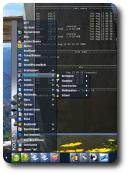 I find Linux to be a powerful tool in research. Windows, for instance, could not replace the multi-tasking capabiltities and expresiveness of Linux. Macs likewise, although they are most popular among designers, technical designers included. They are not, as far as I can tell, an optimal programming platform considering the price which they sell for. Singularity from Microsoft is intended to address the deficiencies related to Windows in the research sector. It is Singularity, as well as Monad, that ought to endow Microsoft with the platform that suits so-called “power users”. Monad is a command-line tool for Windows, that has been hacked a few months ago and will therefore be excluded from Windows Vista. In the mean time, KDE will remain my favourite desktop environment. Linus Torvalds could give a polite nod.
Desktop environement productivity tools and essays:
Friday, December 16th, 2005, 5:41 am
 HERE is a certain rumour, according to which Google are eyeing the acquisition of Opera. Opera is a powerful Web browser that has never attained its much-deserved popularity.
Google already financially support Mozilla Firefox and are sometimes even biased towards it. Evidently, Google cannot buy Mozilla or get directly involved in this splendid project. One wonders what powers Google would have gained if it adopted Mozilla Firefox more religiously. With the buzz about on-line operating systems and speculations over a so-called “Google O/S“ , one can speak of embracing the network boot, then using the browser for Web applications.
Opera was made free (yet it remains a commerical project) some months ago, shortly after its 10th birthday. It was only then that I decided to install it. I must admit that it looks very slick in this latest version, which is great improvement when compared against my memories of it. I first used Opera around 2002 under Red Hat Linux.
Opera is rich in terms of its features, but lacks that freelance developer involvement as it is not Open Source. Therefore, Opera does not have many plug-ins and is about as extensible as Internet Explorer, if not less. The base package, however, is featured and incorporates mouse gestures support and plenty of other goodies. If Google ever decided to gain ownership over this inter-operable browser, they would have a wonderful starting point and be able to use their reputation to spread it among the international community.
Addendum: Google are developing even more plug-ins for Mozilla Firefox.
Update (17/12/2005): Opera Dismisses Google Takeover Talk
Thursday, December 15th, 2005, 7:26 pm

Diversity for the benefits of science
Just when you thought it was by no means possible, Google, Microsoft and Sun Microsystem join forces.
Google Inc. and Microsoft Corp. are setting aside their bitter animosity to back a new Internet research laboratory aimed at helping entrepreneurs introduce more groundbreaking ideas to a mass audience.
Google and Sun have formed an pact 2 months ago, by the way. What wonders if they will use Java, Open Source (notably LAMP), or commercial software in the lab. Perhaps a mixture of all?
Thursday, December 15th, 2005, 7:26 am
 S I approach the end of my Ph.D., I need to keep an open eye on job openings and vacancies in academia. I wish to do so in the least time-consuming way. What better way than feeds of information that give a rapid daily flow?
Vacancies are delivered as search results for a query or criteria specified by the user, e.g. location, sector. This has the same characteristic and advantages that RSS technology typically offers:
- Narrower scope and less visual clutter
- Littler user intervention, ‘pull technology’ versus ‘push technology’ such as E-mail
- Summarisation (title versus detailed description, link/s)
- Flagging of new content as opposed to previously-read entries.
There are many more arguments in defence of feeds, but they will be missing the point of this post and are worth a discussion in their own right. The following are job vacancies Web sites, which I know provide RSS feeds:
- Monster RSS – International coverage, sub-divided by job type
Jobs.ac.uk RSS – Jobs in academia world-wide with emphasis on the United Kingdom- CWJobs – Jobs in IT (United Kingdom). Search for terms, then use the RSS button/facility, currently at the top
[On to personal ramblings] Earlier today I read a more official announcement about the Google headquarters in Dublin. I have known about this for several months as I am/was considered for a Software Engineer/System Administrator position there. I also pointed to photos from the Googleplex in London before. In general, I have openly expresses disdain, skepticism and anger, as well as support, admiration, and sympathy for Google in the past. Their affinity to and backing of Open Source software probably transcends the controversy though.
Related items:
Wednesday, December 14th, 2005, 7:09 pm

A server as your main and central ‘workstation’
 AVE you ever wondered if re-entering passwords, restoring settings, synchronising bookmarks, and exchanging files are at all necessary tasks? Could these repeatable tasks possibly be avoided? Is there a way of working from a variety of places, totally oblivious to the location of data and the state of the applications used? To me, there is a simple method for keeping everything in a single place, but it relies on a quick network connection.
I keep all my settings synchronised by always SSH‘ing (must get X-forwarding enabled) to a single machine that acts as a server. All other machines are used merely as terminals; and yet, one must assume the user is always connected via fast fast Wi-Fi or Ethernet. How truly comforting would it be to have all the computers behave in the same way? With good bandwidth in hand, also the level of responsiveness is identical.
This can definitely be done with Windows and Apple Macs although, if you steer way from UNIX and its variants, that might involve complications when it comes to applications, utilities or commercial software (Windows in particular). It is worth emphasising that you need only install software once — on the server. Data is stored on the server as well and this includes settings, browser cookies and so forth.
In short: same everything, different hardware, from different locations, at any time (provided you do not mind electricity bills for workstations that are constantly on). I always leave my machines switched on because I often find that it is a good return (productivity-wise) on investment.
Related items:
Wednesday, December 14th, 2005, 7:54 am

What would you be told if you stuck one of
those babies in a public cluster machine?
can assure you that technology might arouse your appetite. Have a look at the selection of USB drives that go on sale these days. Some time ago, data loss disasters were mentioned. Pets chewing media were among the main culprits. I imagine that making USB drives look like food warrents their arrival to a dog’s stomach. I’m off to an 8 AM lunch! Where has that USB pen gone?


 Filed under:

