Saturday, September 3rd, 2005, 3:46 pm
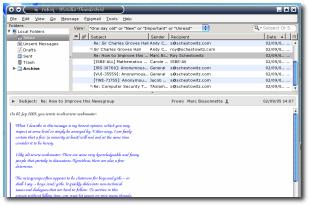
A shrunk-down screenshot of CrossOver-themed Thunderbird
 OZILLA Thunderbird has been my primary mail client for several months, having made it the permanent replacement for KMail. I thought I ought to share a recommendation for a theme. I personally find Apple’s Aqua theme and brushed metal elements in Jaguar/Tiger highly appealing. I even went as far as tailoring my own in Firefox (see below). I have also come to discover that CrossOver, the Aqua-inspired theme for Thunderbird, is by far the most popular theme at the moment with approximately 18,000 downloads in the past week alone.
Related items:

Mac OS X theme for Firefox
Saturday, September 3rd, 2005, 8:51 am

Before and after Hurricane Katrina hit
 HE devastating effects of Hurricane Katrina have been caught by Google Earth’s eye. Constant footage of the ground is made possible owing to many recently-acquired overlays. The devastation is very clear as reflected by before/after snapshots, which can be viewed interactively in Google Earth.
Saturday, September 3rd, 2005, 5:07 am

Mind the game or not, it carries on
 somewhat laughable request for Office on Linux has been put forward by the OSDL. Some would argue that this was part of the recent mind game, wherein Microsoft wanted to fund a joint TCO study. An impartial TCO study from IBM has already shown that Linux is 40% cheaper to set up and maintain than Windows-based equivalents. It makes Microsoft feel very threatened. Also worth a mentioning is their proprietary video format/protocol, which DVD Jon reverse-engineered for the benefit of non-Windows users. This was only reported yesterday, as a matter of fact, so hacks must be circulating around the Net already.
In other news, Microsoft ends Services for UNIX, in a move which they claim will improve inter-operability in the long-term. Whose side would you believe?
Related items:
Friday, September 2nd, 2005, 3:37 pm
 Mazda are replacing cylinder car locks and make use of electronic keys. Such keys come in the form of a USB drive, also known as a USB key or a pen drive. This move is reminiscent of the new Linux-based IBM laptop, which uses fingerprint recognition for user authentication.
Such moves accommodate for a revolution in security, but also a sudden change of habits. For example, keys are easily duplicable while borrowing or stealing of someone’s fingerprint is not possible. Moreover, it promotes cybercrime while circumventing traditional crime. From the article:
In addition to starting the engine, the flash drives can be used to transfer driving directions for long trips along with the latest songs for the day to the Sassou’s internal hard drive.
Friday, September 2nd, 2005, 6:12 am

A comparison to evaluate running costs over a length of time
 ECENTLY, a fair bit of discusion focused on costs of Windows in the enterprise versus Open Source solutions. There are still many arguments between those whose familiarity with Open Source-based systems does not coincide with that of the manager. Furthermore, heavy advertising campaigns which Microsoft launched make it difficult to avoid deceit. More than ever before, there are vicious attempts to convince the public that Open Source is more costly, less secure and even bound to vanish.
One of the more disturbing facts is that a large corporation, which at present feeds on billions from the public, is able to run a propaganda whose budget is merely infinite. Despite all, we now come to discover that IBM have run their own independent TCO study, in which they compare cost (taking effectiveness into account) of the different solutions available. The study concludes that:
Linux is 40% less expensive than a comparable x86-based Windows server and 54% less than a comparable Sparc-based Solaris server.
This provides a long-anticipated answer to many who required it. A typical system administrator, who is inclined to favour Linux, can now use the above as concrete backing. The manager who makes the final decisions will sooner or later digest these facts and figures.
Related items:
Thursday, September 1st, 2005, 3:49 pm
Here is a little riddle. Can you spot the special meaning of the number below? (hint)

I think the above can be considered a case of lateral thinking, which is one way of educating CS students and sharpening up their programming/testing skills. As strange as it may seem, I spent hours with tutors solving problems like the classic below:
A hunter aimed his gun carefully, and pulled the trigger. Seconds later he realised his mistake. Minutes later he was dead. What happened?
Clues: No living creature killed him. It was a cold winter’s day. He had a VERY loud gun…
Solution: The hunter was near a snowy cliff. When he fired the gun, he “triggered” an avalanche which buried him…
Hint: Try to see which English word the numbers form.
Thursday, September 1st, 2005, 8:21 am

The Science Blog outlines a method for teaching the computer various languages without any human involvement, i.e. in a data-driven manner.
[computers can learn languages] “…autonomously and without previous information infer the underlying rules of grammar. The rules can then be used to generate new and meaningful sentences. The method also works for such data as sheet music or protein sequences.”
Having quotes the above, I believe there is nothing truly novel to find in the study. The blog item does not have any mentioning of Markov models. That, in my blunt opinion, is proof that the author fails to grasp the real merits of the method. It also appears as if the author has limited knowledge in the field which is technically discussed. The ability to look at sequences of words up to a certain depth (as much as brute-force permits) presently produces nice textures in graphics and get good flow of coherent text (a paper-generating tool from MIT comes to mind).
The method can indeed perform more admirably than by making use of probabilistic models solely. It can extract grammatical content, but so can logical inference and theorem prover programs like Vampire (Voronkov and his students from Manchester University). As a matter fact, a few years ago, as part of a course on languages and semantics, we wrote programs in ML that translated English sentences into first-order logic. This technology has been out in the wild for many, many years.


 Filed under:
