Monday, July 25th, 2005, 1:20 pm

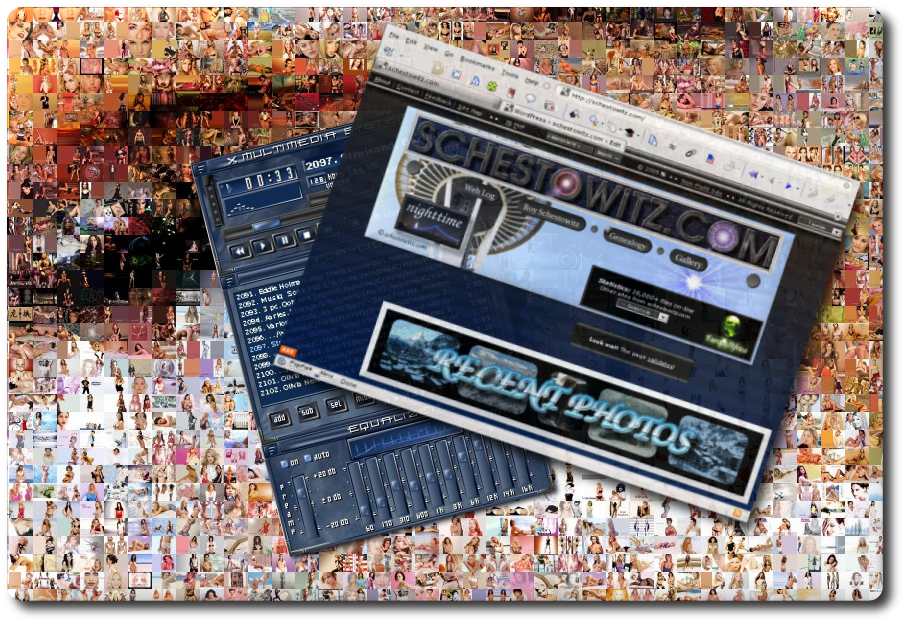
The bits shown above come from an excellent Linux screenshots gallery which bound the following caption to the original image.
Gentoo GNU/Linux, KDE 3.3, xorg 6.8. Demonstrating the new shadow and translucently window features. Consider the new stuff a proof of concept, it’s far from usable, but it works.
Months ago I discovered several Mac OSX lookalikes in KDE-Look, for example White Acqua, which is a nice (yet fragile) window decoration.
Related pages: local gallery of KDE screenshots.
Monday, July 25th, 2005, 6:52 am
 Raymond Kurzweil, the man who made fascinating predictions such as the emergence of the Web and defeat to humans against the computer in chess, foresees artificial rejuvenation of cells by 2030. This essentially talks of inner-body maintenance, leading to longevity provided you can afford it. The article also states: “Given all of Kurzweil’s successes to date, it seems unwise to dismiss his forecasts for 2030 and beyond”.
Skeptics will point out that Kurzweil is reaching the age when his ideas should be taken with a grain of salt. It seems like wishful thinking which comes from a man who will be 82 in 2030. Nonetheless, the article makes an interesting read. The predictions, as the article phrases them:
By 2030, Kurzweil believes, biomedical technology will have advanced to the point where it will be possible to halt the body’s aging process.
…
Soon after that, around 2050, we should be able to reverse-engineer a human brain and upload it into a robot.
Monday, July 25th, 2005, 1:33 am
 emonstration below is no screenshot. It is a fake composition which I pulled together under the GIMP, yet where are the spherical desktops? Where has this initiative disappeared? Microsoft are finally incorporating some transparency in Windows Vista, but why concede an attractive spherical environment? Surely in pragmatic terms, the gain from this graphical developments is nill; it is probably a loss. The heavy computational load, however, can be handled using graphical acceleration hardware.
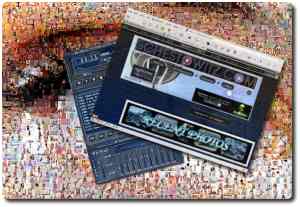
Wallpaper from Houghi (click image above to enlarge; non-lossy PNG version)
Sunday, July 24th, 2005, 9:33 pm
Figures have recently come out, which break down search engine usage in the States. According to one report, Google has been losing some of its impact
Google’s market share of US searches for June 2005 was at 36.9% compared with 37.5% in May 2005.
Then again, according a different study which was cited on the very same site, Google’s usage has been rising lately.
Google’s share of U.S. searches hit 52% in June, up from 45% a year ago, according to Web analytics firm WebSideStory Inc.
A careful read would reveal the obvious. The total volume of queries declines throughout the summer and likewise Web traffic in general. Google is probably more prolific outside the United States and among IT-savvy users.
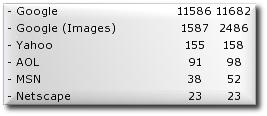
June 2005 referrals to this domain
Sunday, July 24th, 2005, 7:04 am
Example image from the local Gallery installation
Gallery is one of the most popular photo management packages on the Web. As a matter of fact, this domain has a Gallery installation (feed:  ) as well. Gallery was built in PHP and is absolutely free. The number of features it makes available to site visitors and the site administrator is endless.
A fourth beta version of Gallery 2 has just been released and a demonstration purposes site was set up to boast the features of this next generation of Gallery: interface language, tree structure navigation and nice flexible page layouts are only a few enhancement that catch the eye.
I am not too keen on the beta name though: “Flippin’ Sweet!“. Not something you can recommend to your boss…
Saturday, July 23rd, 2005, 4:02 pm
 here are healthy competitions and morbid competitions. A competition which involves handicapping the opponents is always a destructive and dangerous one. Nevertheless, there are examples in industry where Xerox, Microsoft, Amazon and other leaders file laughable patents for what should certainly remain a taboo — a no-go area. After 5 years and 4 rejection, Amazon received exclusive rights to inform customers of what they already bought (history). Sounds outrageous? It gets worse…
Microsoft are patenting the custom emoticons, practically opening the door to control of social behaviour with an army of lawyers. Instead of following such footsteps, companies must strive to innovate and offer some added value, not imitate and shield uninnovative ideas that have floated around for decades.
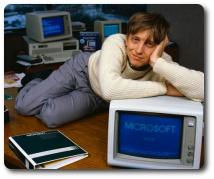
Bill Gates posing for a teen magazine in 1985
with a Mac at the back, from which he nicked the GUI
A competition where giants impose legal barriers to obstruct smaller opponents is like taking the lead in running race, tossing water bootles back at the track. Proprietary, patents and artificial channelling of users all have this effect. At the end of the day, Bill Gates wonders why computer science is slowly dying in the United States.
Saturday, July 23rd, 2005, 3:08 am


Lars Rasmussen, a maps engineer at Google, has just published the following item in the Google blog:
Can’t decide between looking at a map of your house or a photo of your house? See both at once with Google Maps’ new Hybrid mode, available in the US, Canada, the UK and Japan.
Be the first to observe this new feature of Google Maps, which was already incorporated into Google Earth about a month ago. It is now all accessible via the server rather than a local installation of gratuitous software.


 Filed under: