Saturday, July 9th, 2005, 9:26 am

Caution Firefox enthusiasts
 here is an alpha version of Firefox, codenamed Deer Park, which is used to test future releases of the Mozilla browser. The following page explains a little further about the purpose of the package. My advice is to avoid the use of Deer Park as it interacts badly with your Firefox profile and can conflict with your current settings, extensions and themes in particular. The Deer Park page clearly states:
Deer Park Alpha 1 is intended for web application developers and our testing community. Current users of Mozilla Firefox 1.0.x should not use Deer Park Alpha 1.
Saturday, July 9th, 2005, 4:42 am
here comes a time in the lifecycle of an application when reliable and non-lossy export facilities need to be implemented. Unfortunately, ego of developers sometimes leads to good import facilities while there is only limited or no support for export of user data. Del.icio.us are one example which was previously mentioned. Another such example is Microsoft Outlook et al. Microsoft are reluctant to allow easy data export, which implies no trivial escape from proprietary. Thunderbird, however, does a terrific job importing all data (mail and settings) from Outlook or Outlook Express. OpenOffice.org acts upon Microsoft Office proprietary reasonably well too.
 WordPress are currently working on export facilities that simplify and bridge the gap between the administration panel (application) and the data (SQL). It is wonderful to see export facilities realised, which demonstrates no ego among the software developers. This allows users to ‘dance’ between platforms at will. There is always a certain feeling of freedom knowing that taking on one certain application cannot result in a vendor lock-in.
Friday, July 8th, 2005, 6:17 am
Yesterday’s terrible incidents cannot escape my mind, still. By allowing our lives to come to a halt, we allow the terrorist to achieve their goal and expose us to our weaknesses. I would like to quote a statement which I came across in PalmAddicts, written by Mike Cane:
I’ve been watching the news unfold in America and my thoughts and resolve are with the British people and the people of London. Words are inadequate in times like these.
Words may be inadequate, yet how can nothing be mentioned? I would like to express my deepest sympathies to families, friends and those acquainted with the victims.
Friday, July 8th, 2005, 2:29 am

 odern browsers are among the more complex pieces of software in existence. Because browsers are expected to treat similar data (the World Wide Web) and behave consistently, there is plenty of room for bugs to crop up. Big trouble lies ahead if a browser is re-released infrequently or no updates are made available, apart from the critical. This is probably the main catalyst to the “Don’t click on the blue E” campaign.
Web developers spend extra time trying to compensate for Internet Explorer bugs. In css-discuss, for example, almost half of all questions (if not more) concern browser compatibility, fixes and hacks. Internet Explorer is often the culprit. Rather than fixing/hacking around IE bugs, perhaps we should all upgrade to a browser that is actively maintained and released to the public. There is no doubt as to how fed up development communities have become with IE, which for most users ships by default.
Thursday, July 7th, 2005, 5:01 am
ZDNet report that Google will release an official Google toolbar for Firefox.
Google is poised to release a version of its toolbar for the Firefox browser, according to information sent to developers of an open source toolbar alternative.
…
It has pretty much the same features as the latest IE toolbar except of course for things like the popup blocker
Various other bars (using the same API) have indicated erratic PageRank recently and PageRank was sometimes greyed out for no known reason (see below). About a month ago it was greyed out globally for 2 or 3 days straight.
Until google release their own homebred bar for Firefox, the GoogleBar project will serve as a primary alternative. However, PRGoogleBar (formerly the PageRank bar) is much more powerful as it experimentally makes use of Google Suggest for search phrase completion. It also incorporates extra shortcuts and the ability to customise SERPs behaviour. This bar is definitely better than the equivalent from Google.
Another excellent search-related bar is SearchStatus, which additionally provides Alexa ranks and does not occupy much screen space (see below).
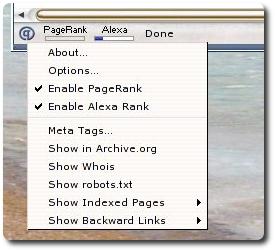 SearchStatus in action
Finally, also worth mentioning is Yahoo’s search bar which has been kind to Firefox for quite some time.
Wednesday, July 6th, 2005, 2:13 pm

 ood news have just arrived: the EU has rejected, with a crushing majority, the software patent bill.
The Register states:
The European Parliament has voted by a massive majority to reject the software patents directive, formally known as the Directive on the Patentability of Computer Implemented Inventions. The vote to scrap the bill was passed by a margin of 648 votes to 14, with 18 abstentions.
Some outrageously simple algorithms have recently been filed as patents. More notably:
- Microsoft filing a patent for address book encapsulated objects (i.e. more proprietary)
- Amazon with the ‘one-click shopping’
- Leaving the best for last: Amazon patenting the recommendation of books based on pages previously viewed
Luckily, such insanity is unlikely to invade Europe.
Wednesday, July 6th, 2005, 6:18 am

 ow does one identify music which has potential of being liked? Music, unlike textbooks, does not contain text or keywords. Its tags are not always valuable either. An interesting paper from Trinity College Dublin describes a method by which music adapts to the preferences of listeners (PDF). However, can this be done purely based on prior data? Data that is provided in advance unlike in real-time? A List of records maybe? Playlists perhaps? We seem to be coming closer to realisation of this idea.
Image similarity measures are one focus point of my research; also sparks to mind is Google’s notion of ‘Similar Pages’. Why not apply similar principles to music? I now collect big daily dumps of music that I listen to (output to files using the following technique ). Bound to each entry is the time when a track started. From this, one can infer which tracks are being skipped. Alternatively, full, raw playlists can be of use and might, in fact, be more manageable as well. By exploiting a large collection of playlists, the nature of the genres can be better understood.
Given all of this data, it can potentially be used for collabortive playlist sharing, somewhat like del.icio.us (see previous reference to del.icio.us with a gentle introduction). Users can then discover other songs they might like based on other people’s playlists. The more data, the more accurate statistics will be. Getting large lumps of input (playlists) is effortless too. Just imagine yourself the scenario:
You can automatically find playlists most similar to yours and recognise the most-played tracks on that playlist. Social software has seen great success recently, so exchange of music preferences and recommendations is probably the way to proceed.


 Filed under:

