


Wednesday, August 17th, 2005, 2:10 pm
The Rise of the Wiki
 Filed under:
Only yesterday, one of the regulars in a search engines discussion group (nntp://alt.internet.search-engines) raised the following question/complaint:
Everytime I search for something on google Wikipedia appears in the top 100 results! Is it taking over the Internet?
Last night, IT guru Joel Spolsky asked for advice on Wiki for his site’s translations. He could no longer resist the productivity of a Wiki, which allows visitors to manage content while vandalistic changes can be quickly rollbacked (reversed). The matter of fact is that Wikis have become extremely ubiquitous and they are conquering the Net, much like blogs. They simplify the composition of Web pages, particularly when composition is handled and managed by a group.
Schestowitz.com has two Wikis — a private one and a public one. At some stage I found that Wikis can conveniently be used for correspondence or for collaboration in academia, e.g. when writing or revising a paper jointly.
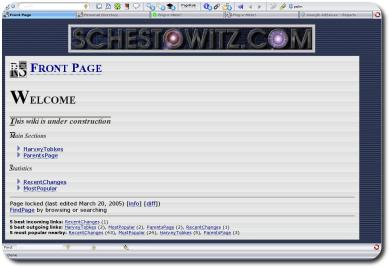
There are all sort of reasons for using the Wiki’s simplified mark-up and not WYSIWYG interfaces (as clean as they may be) or plain HTML.
- Firstly, there is the issue of security such as off-site linking. You need to provide a subset of features. Having said that, this can be prevented by imposing restrictions on whichever composition language/method you choose.
- Secondly, one has to worry about the issue of consistency. I have a friend who manages the content of a site and I cannot recall how many times he did something invalid that broke the integrity of the entire site, which I then had to fix urgently. “More restrictive” means “less things to go wrong”. After a few weeks I completely gave up on making his pages valid XHTML/CSS. He had too much freedom and too little experience.
Finally, on the issue of software recommendation, I cannot comment on the popular MediaWiki, which is used to power Wikipedia. I have never used MediaWiki myself, but PHPWiki has been fairly stable ever since I set it up 6 months ago and had it updated many times a day. If you are looking for ease-of-use and trivial embedment of media, I suggest you go with more mainstream packages such as the admirable MediaWiki, which I am familiar with as a user, but not as an administrator.



 magine yourself the following scenario: To start up your computer you connect an iPod (or any other large-storage mobile device) to your (x86-based) work computer, which then launches the operating system (currently Knoppix Linux) from the iPod. It uses the processor and memory of the local machine rather than the iPod’s, which is merely used as a hard-drive. Then, once work is finished, you take your iPod home and repeat that exact same procudure, plugging in the iPod to a different computer. Not only can you resume your work, but your hard-drive (which contains everything that is personalised) gives you an identical environment, i.e. you have all your recent files, browser cookies, desktop settings, etc.

 venturous article from Softpedia makes speculations with regards to





















 Content spam grows worryingly fast. This new type of spam shows its face in a form which is different from spam that we very well know as uninvited E-mail. Such spam is placed on the Web and later infiltrates search engine results pages (SERP’s). If you recently came across a page full of links and ads that did not provide useful information, you would probably understand what content spam is.
 When a general audience observes Windows being used everywhere, it is natural to assume it is the best operating system. In reality, very few people have seen alternatives to Windows. Even fewer people had a prolonged hands-on experience with another platform. Microsoft are exploiting the placebo effect, giving unnecessary and unproductive software, which you truly think helps you, but only helps lock your data to one particular vendor. Often the vendor destroys the very same community that it pretends to cherish. One day in the future, people come to realise that better software is out there and that influence of the group has shifted its balance. But is it too late once data has been locked to a vendor and habits become less reversible?

 ack when I was in school, some friends of mine were addicted to on-line role-playing games (RPG) such as Ultima (