Saturday, July 2nd, 2005, 3:18 pm
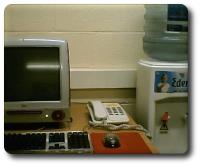
The iMac I sometimes use at work. It’s
rather obvious I’m right-handed.
 have a few pet peeves when it comes to the placement of peripherals for the sake improved interaction. For instance, I would strongly encourage placing the mouse right next to the keyboard and adjacent to the keypad (not diagonally). The thumb is then close to the secondary
 ENTER button and only a mere distance from the arrow keys, which are frequently used for navigation, for example in file managers or text editors. Conversely, the mouse can be picked very quickly to assist editing.
At the same time, the left hand remains poised over the left section of the keyboard, close enough to SHIFT, ALT and CTRL (or equivalent) which are better off used as keyboard accelerators (shortcuts) at the speed of will.
Saturday, July 2nd, 2005, 11:30 am
magine yourself the following scenario:
You open a page filled with links and adjacent to each individual link is a little visual page preview generated on-the-fly — a pseudo-screenshot if you like.
Ever since the inclusion of tabs in major browsers, navigation of several destinations at once (forking) has been possible. Nonetheless, under normal curcumstances, only one page could be viewed at any given point in time. Several previews, much like thumbnails of imagery, can increase productivity significantly. Allow me to illustrate this graphically.
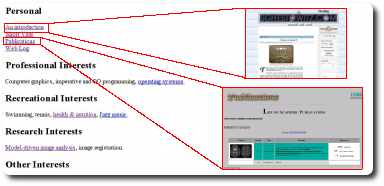
In this text-only page, on-line preview
of destination pages would help greatly
To make such extended hypertext protocol viable, bandwidth barriers must be breached. Every link in any given page (with a possible threshold on the number of previews) will result in site hits. This inconsistent and unfamiliar behaviour has implications on server load, statistics and even CPU load which is required page rendering. Perhaps one can argue that RSS feeds have had a similar impact.
Friday, July 1st, 2005, 10:42 am
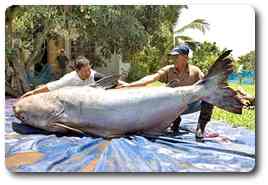
“Now, this is one heck of a big fish!”
 hown above is an enormous catfish. Even my Thai colleague was flabbergasted by the image on my monitor. My strict diet relies on fish so I could not resist posting this picture which demonstrated the size of the very unusual ocean salvage. Unfortunately, it will end up on somebody’s table.
Fishermen in northern Thailand have netted a fish as big as a grizzly bear, a 646-pound Mekong giant catfish, the heaviest recorded since Thai officials started keeping records in 1981. The behemoth was caught in the Mekong River and may be the largest freshwater fish ever found.
Source: Science Blog
Friday, July 1st, 2005, 3:58 am

Will mentioning of the name be good for business?
 here is a fun and yet scary thing about maintaining sites which hold good search engine ranks. The mentioning of names (names of places, but of individual people in particular) ‘invites’ visits by the ‘owner’ of that name or its friends, associates, and clients.
If the person in question is technology-savvy, it should not take more than a day for him/her to locate the source. So-called hat tips make the approach even easier (intentionally so) and services like Technorati assist the process as well. To those who approach the computer only on occasions it can take weeks or months to find out what others have said about them. This perhaps would finally occur when ego surfing (searching names that relate to self).
This power can be exploited or misused, but most importantly, it is something a webmaster must always be aware of.
Thursday, June 30th, 2005, 3:14 pm

Will you trust these for storing your mail?
 uch information is migrating from our hard-drives to on-line servers: files (e.g. FTP), bookmarks (Deli.ci.us or portals), (Web-based) mail, feeds (analysis and statistics by Feedburner), photos (notably Flickr) and newsgroups (e.g. Google Groups) are merely a few more major examples.
Storage of personal data remotely has its powers:
- Data can be accessed from anywhere regardless of the computer used
- Backup is often handled by the service providers
- Liability shifts to service providers
- Inferences, e.g. spam filtering in GMail that adapts in accordance to users’ purging behaviour, social bookmarks, tagging…
Some people, myself included, have learned the hard way why the dependency upon third parties is risky. Hard-core users have their todo lists on-line, their mail on third-party servers and often files or address books stored remotely. The dangers:
- On-line servers may disappear due to bankruptcy, takeovers or corruption
- Import (and especially export) facilities are intentionally limited to suppress user mobility
- Servers fail or periodically go down; timescale for recovery is unknown
- Limited space and ‘premium’ packages that later emerge
- Pricing and policies which change, e.g. Yahoo stopped free POP3 support around 2001 (I too was a victim)
It is easier to blame somebody else but yourself as in the case of third-party dependencies. Yet, things are different when you control your own — shall we say — destiny. Ownership of your own domain is the first step towards an easier life in which the system administrator is yourself.
Thursday, June 30th, 2005, 6:30 am
have searched Google for NORSOC — a society in Manchester for Norwegian students. Surpisingly, there were no proper results.
That society seemed to have vanished or diminished significantly. As I had close Norwegian friends, I was a member of that society for 2 years and slowly accumulated over 200 photos from events. Those photos are no longer available on-line because the site is inexistent. I thought I’d post one (taken by Christian Brox) for memories from wonderful, more social undergraduate days.

I am the guy in the centre
Thursday, June 30th, 2005, 3:09 am

Scrapers: which is the original and which is the fake?
here has recently been a rise in the number of scrapers across the Internet. Such sites ‘scrape’ content off other existing, content-rich sites and put it along with ads on the Internet. They can make a ‘quick buck’ by attracting errant users who use search engines. In the process, genuine sites lose visitors and potentially get penalised for duplicate content.
Apart from illegal scrapers and spam, there are marginal cases of plagiarism. Imported content must always be:
- Contained within quotes
- Quoted in part so that it contains enough text to serve as a ‘teaser’ for the original information source
- Include at least one prominent link to the source


 Filed under:
