Thursday, August 11th, 2005, 1:38 pm

 icrosoft have announced that Windows 2000 users are exposed to hijacking. According to the BBC, “A vulnerability was also found in the Print Spooler service and the Plug and Play (PnP) hardware detection feature in Windows, both of which could leave systems open to attack and vulnerable to remote control.” XP Service Pack 2 is said to have simplified the process of patching up the operating system. The remainder of Windows users are advised to “sit up, listen and take action.”
Thursday, August 11th, 2005, 3:33 am
 oogle have recently revealed that they had used Linux from day one. Looking further into the past, why have they not openly expressed their passion for Linux? Perhaps they realised that over 90% of their target audience were Windows users. No user will be inclined to use the service of one that is different, one whose preferences are in ‘disharmony’ with the clients. Under such circumstances, there emerges an inner-conflict, whereby a Google user admits making a mistake, making a poorer O/S choice.
In this article from Computer Business, Google’s open source programs manager lists arguments as to why proprietary software can never offer what Open Source does. There is a long-standing myth that Linux people are incapable and have reached out for so-called ‘abnormal’ sides due to failure in a world that is largely dominated by Windows. I believe that Google have shown, with quadrupling revenues and an enormous rapid growth, that Linux is all it takes to gain advantage.
From the article:
While showing a slide show of Google’s hardware evolution, which began humbly with an odds-and-ends collection of “spare computers that were lying around Stanford” (hobbled together, literally, with pieces of Lego and duct tape) and ended with a present-day photo of Google’s current server room (darkened to the point of being indistinguishable, for competitive reasons), DiBona said Google has used Linux all the way.
There is still a great deal of secrecy when it comes to Google’s hardware, yet some information is now out. The server rooms have been kept in the dark intentionally. This entire revelation did not come as a total surprise to me as Brin‘s (Google co-founder) Stanford home page showed he had been a Linux user (plenty of Python) in his early days.
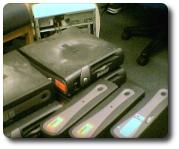
Machines by the dozens. Just toss a Linux distro on them.
Wednesday, August 10th, 2005, 12:15 pm
 ollowing rumours and an official announcement in the Google Blog, feeds are available for news items over at Google. Perhaps this takes us one step closer to full support for SERP RSS feeds (top 10 search results delivered to your feeds aggregator). Google News results can currently be delivered as RSS or Atom feeds. They are composed of items from a specific section (topic) or news returned for a given search term/s.
 This move can certainly make Google Alerts for news obsolete, yet such alerts for non-news searches remain practical, albeit difficult to handle (periodical HTML-formatted E-mails).
Ben Hammersley (c/f: Keeping Track of Google, Google Results as RSS Feeds) has devised a workaround which enables you to get results as RSS feeds for standard Web searches at Google. Be warned that scraping is possibly involved, so the technique is questionable.
Yahoo have been offering news RSS feeds for quite some time. This has been very useful when tracking particular terms, so I am convinced Google will benefit from their recent decision (or implementation).
Wednesday, August 10th, 2005, 6:50 am
 enjoy listening to music, but yet again who doesn’t? There is always catch though — a pitfall if you like: records and files get ‘used up’ after a period of time. Obtaining new music is a time-consuming process whether it involves walking, browsing or loading CD‘s.
Since peer-to-peer (P2P)) downloads are illegal, I have been downloading a lot music from small bands’ Web pages en masse. What I do not like, I can immediately dispose of. Using the command line, I am able to download music in the background without any manual intervention, simply by spidering the Internet.
 I have come to realise that I do not know the names of songs that I listen to. I rarely bother to look at the filenames or tags because it is the same time-consuming ‘luxury’ mentioned above. In most cases, I fail to remember the names of bands too. To use an extreme example, a song which I must have listened to 50+ times in past few days has been completely obscure to me up until now. To repeatedly play it, I would typically use the “jump” function followed by the string “
be” (for the word “belief” contained in the song’s title). This plays the song merely at the power of will, taking no more than a second to find and play it. It all leaves song titles and artists’ names in the dark unfortunately.
While on this issue of ‘music productivity’, XMMS accelerators, for instance, are used to control the music player without changing application focus. In other words, key combinations involving SHIFT, CTRL and/or ALT work universally and affect the player’s state at any time. You can change tracks, adjust volume etc. while in the midst of writing a sentence. The mechanism which enables this is described (also visually) towards the end of an old item about Music Log Files.
I have reached what I consider to be a Utopian situation. This is analogous to have a radio station with infinite supply of music. I have the ability to skip tracks, repeat tracks and organise the music supply at great ease. Moreover, the music supply can be handled purely by robots (cron jobs), as described in an old item on music mass-downloading.
Wednesday, August 10th, 2005, 3:27 am
 SD is the Berkeley System / Software Distribution, which is a popular variant/branch of UNIX. It has already reached the average home computer several times in the past, as opposed to being used in machine rooms (e.g. data centres, computational servers). DesktopBSD 1.0 is a new endeavour (yet another distribution), currently at a release candidate phase. It was brought to many people’s attention via Slashdot.
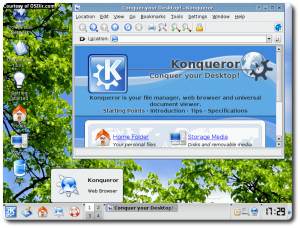
Screenshot of DesktopBSD, on top of which sits KDE 3.4
All screenshots come from the Open Source Directory (feed:  ), which is an entertaining site at best and informative at the least. It provides a clear and extensive previews of Linux distributions, thereby helping people select the right one. Screenshots are taken from the very early installation stages (BIOS level) until a running state is reached. There are also many ‘Grand Tours’ of a variety of *NIX distributions.
Tuesday, August 9th, 2005, 2:16 pm

Having your name on top should take no more than 5 seconds to achieve
Copy and paste the URL below to your address bar and change YOUR_TEXT with any text of your choice.
http://www.logogle.com/ggl.php?hl=ja&lo=YOUR_TEXT
The page functions as if it is the authentic Google homepage by using Google for all operations. One wonders how Google feel about use of their bandwidth from sources on another domain. However, this certainly benefits their overall status.
Tuesday, August 9th, 2005, 8:18 am
lames have recently been thrown due to confessions about bad experiences with New Yanoff. New Yanoff is the successor of Yanoff, which is the well-known newsgroups reader for the Palm platform.
Let us begin with compatibility issues. New Yanoff is not compatible with some recent models of the Palm such as the LifeDrive.
Secondly, the user interface of the trial version ($24 for the registered version) is filled with many nags. It is understandable given the purpose of this trial package. Nevertheless, nags were claimed to be excessive.
On to more major flaws, the user interface is relatively unprofessional, as indicated in a Yanoff 3.0 review. Below is one screenshot that has been borrowed from this review.
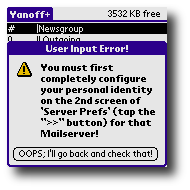
Example of bad UI design
Finally, the default signature for sent messages bears citations from the bible. It works this way by default and gives no warning and indication that this is happening. To some this will be no cause for concern, but religion, much like politics, is a sensitive issue to many. This is in fact the point which initiated the flames in nntp://comp.sys.palmtops. The developer strongly defended his choice to “spread the gospel” (exact quote), which is a very controversial step among most developers (imposition of the developer’s views).
As the discussion developed, New Yanoff turned out to be a relatively disappointing piece of software that is not sufficiently reliable. GPL Yanoff, which is of course free, can still be downloaded from its Sourceforge Web site.
Cited by: PalmAddict


 Filed under:

