Wednesday, June 1st, 2005, 3:09 am
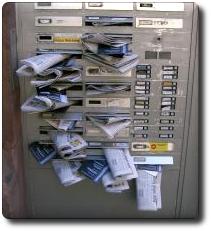 To spammers, one of the greatest sources for victims are archives of newsgroups. Many archiving systems which process mailing lists and forums omit E-mail addresses from message headers. However, some E-mail software quotes explicit addresses in the body of messages, thereby exposing these addresses to spam-bots.
Likewise, information that is entered in Web forms will rarely be kept confidential. Privacy is not always honoured and E-mail addresses can find their way into so-called affiliate companies.
Whenever possible, avoid disclosure of E-mail addresses. Spam protection is still immature and can rarely be trusted.
Taking this point slightly further, it is important to be assigned different passwords in different sites. Always. Only days ago, Wikipedia inadvertently leaked passwords.
Tuesday, May 31st, 2005, 1:44 am
Open Source software might slowly conquer the market according to this item from IT Manager’s Journal:
Is the enterprise software business dying? Is anybody out there buying new licenses? Based on news from the past few weeks, it seems that there are very few buyers. The collapse of new licensing revenue isn’t news — it started five years ago — but the latest news makes it look like a permanent and accelerating fact of life for software vendors.
Regarding operating systems and the take on computers in general, Clayton Hallmark from Argentina predicts that low cost computers from Asia will bring Microsoft to its end.
 MOBILIS apparently goes for only $220 in India
Monday, May 30th, 2005, 2:25 am
It appears as though Google removed PageRank from the public. No official announcement has been made though. Google once warned about abuse of public PageRank and trading of links. They were probably most dissatisfied by the involvement of AdSense, their advertising program, in the midst of this abuse.
It is difficult to surf the Web without an indicator of any kind. It is hard to establish trust in information unless there is a measure of reliability bound to it. As a substitute, Alexa rank can be used as part of a Firefox extension called SearchStatus. Alexa rank is not as verbose and dynamic as PageRank, but it is far better than nothing.
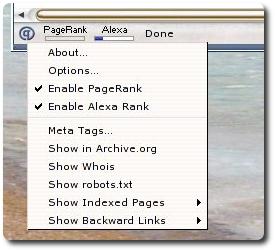 SearchStatus in action
Sunday, May 29th, 2005, 9:07 am

Bill Gates arrested in his younger days (photo in public domain)
Intel are approaching dangerous territories as they now embed Microsoft-specific functionality (namely DRM) at hardware level. From DIGIT:
It will get worse before it gets better, according to your point of view, because Intel continues behind the scenes to push hard on the trusted computing modules and Microsoft’s future OS is expected to implement these features in full.
This politically-incorrect move gives one more reason to opt for AMD, who are crushing Intel already.
Saturday, May 28th, 2005, 4:35 pm
For the past day or two, the Google PageRank indicator has been greyed out (or invisible in Mozilla Firefox — see above). There are speculations and rumours regarding the reason:
Is it the end of Google Pagerank as we know it? Is Google replacing or eliminating our ability to read the value of a website (as they see it)
Google’s “Trust Rank” algorithm has been around for a while, but I don’t believe fully implemented. Maybe we’re seeing the change from Pagerank to TrustRank.
The thread makes insightful observations, but the original poster fails to provide information to support his statements. Also, the transition to a new ranking system would have been seamless. Are Google preparing an announcement and halt PR in the interim? This has already lasted too long to be a technical fault.
Saturday, May 28th, 2005, 7:36 am
Gentle Introduction to Del.icio.us
Del.icio.us is a fast-growing social bookmarks network. It enables people to centralise their bookmarks (favourites) on-line, share them with others, and even view bookmarks of people whose interests intersect. This also provides insight into the popularity of links.
Each bookmark in Del.icio.us can be delivered as an RSS feed, which can then be added to the native browser as a live bookmark, i.e. a dynamic bookmark whose source is remote. Bookmarks as such are still significantly slower than a personal portal.
 An example of a del.icio.us bookmark
Import/Export in Del.icio.us
Here is one major pitfall: Del.icio.us do not yet incorporate import and export facilities, which is surprising. This has two implications:
- All bookmarks are dependent upon a remote source, namely del.icio.us. They may not always be available and there is a vendor lock-in situation.
- Assemblage of bookmarks must begin from scratch, with little or no chance for re-use.
There are third-party solutions, but they are not ideal:
Friday, May 27th, 2005, 12:45 pm
There are (at least) 3 conceivable methods to keeping track of Google:
- Google Alerts: HTML-formatted E-mails which occasionally get sent. Recent changes in SERP‘s of interest are highlighted.
- Perl and Cron Jobs: keeping track of Google from the command-line.
- RSS Feeds: RSS interface to Google search results (Ben Hammersley).


 Filed under: