Saturday, May 28th, 2005, 7:36 am
Gentle Introduction to Del.icio.us
Del.icio.us is a fast-growing social bookmarks network. It enables people to centralise their bookmarks (favourites) on-line, share them with others, and even view bookmarks of people whose interests intersect. This also provides insight into the popularity of links.
Each bookmark in Del.icio.us can be delivered as an RSS feed, which can then be added to the native browser as a live bookmark, i.e. a dynamic bookmark whose source is remote. Bookmarks as such are still significantly slower than a personal portal.
 An example of a del.icio.us bookmark
Import/Export in Del.icio.us
Here is one major pitfall: Del.icio.us do not yet incorporate import and export facilities, which is surprising. This has two implications:
- All bookmarks are dependent upon a remote source, namely del.icio.us. They may not always be available and there is a vendor lock-in situation.
- Assemblage of bookmarks must begin from scratch, with little or no chance for re-use.
There are third-party solutions, but they are not ideal:
Friday, May 27th, 2005, 12:45 pm
There are (at least) 3 conceivable methods to keeping track of Google:
- Google Alerts: HTML-formatted E-mails which occasionally get sent. Recent changes in SERP‘s of interest are highlighted.
- Perl and Cron Jobs: keeping track of Google from the command-line.
- RSS Feeds: RSS interface to Google search results (Ben Hammersley).
Friday, May 27th, 2005, 9:18 am
Warning: this is a rant
 have become absolutely fed up with travel. Travelling seems rather analogous to brocoli. Even though it offers benefits, it is fairly hard to digest. Having come back from Oxford 2 days ago, I asked myself:
- Did I enjoy my time there? Definitely not.
- Was I under the impression that this research meeting would be different? Maybe fun even? Definitely yes; I was hoping, as always.
Should I have any guilt? Is it a bloat of ego? I believe not. When one speaks, then attendance clearly becomes necessary. If the purpose of presence is merely to fill a chair, why not stay home and support more meaningful projects? I have come to realise that travelling is nothing beyond an opportunity to brag; Yes, it is all about social status. It prevents me from doing what I love doing and what I think touches more people — programming, experiments, technical support and the like.
I was about to register for a conference in Colorado last night (IPMI 2005). After looking at the cost (nearing $2000 including the flights) and considering how unnecessary this would be, I couldn’t help but change my mind. I am co-author of a paper to be presented, but not first author. In other words, my presence is pointless.
People say that conferences are a good venue to meet people and “show your face”. This notion stems from older day, when paper were the primary means by which to disseminate research work. The Internet allows us to interact with people and actively work rather than just ‘absorb’ information or try to stay awake in far-away lecture theatres.
I expressed similar sentiments back in January. To many, travelling around the world is about new places to cross out and off the map. What is it that drives sp many to become the next Christopher Columbus? Inarguably, there is nothing to be discovered. An Internet search will reveal stories and photos from each and every part of the world. Perhaps travel has become a norm, which is simply hard to dismiss. I have come to the very same conclusion many times before:
“There is no place like home”

Thursday, May 26th, 2005, 12:52 pm
The key to success in on-line auctions (such as eBay) is rapid and frequent flow of purely useful information.
There are at least two circumstances where RSS feeds can greatly assist:
- The first: Keeping track of rare item/s
- The Second: Finding the very best deal, as defined by a low range of prices
rssauction.com is a Web site that provides customised, self-tailored eBay feeds. For those who do are not familiar with RSS feeds, JavaScript equivalents are made available too.
 Remembering the days when
auctions were announced by paper
Wednesday, May 25th, 2005, 4:16 am
Following a previous item on using Wikis for correspondence, I decided to share a prophetic view on one communication method, which I believe to be spam-free and highly convenient. Have a look at the figure below:
 A synthetic view of what future RSS aggregations might comprise
One can create channels of communication and broadcast message to friends, colleagues and family (and vice versa). This can definitely work once more people are ‘RSS-enabled’. This idea essentially converts correspondence into feeds. I once proposed unifying newsgroups (NNTP) and feeds, which is a similar step forward.
This method is spam-proof. In E-mail, blocking of messages that do not arrive from known people (whitelist) means that genuine, unexpected messages will be thrown away. With RSS there is no such problem. One need not receive message, but listen to them instead. Nobody will be listening to sources of spam.
Tuesday, May 24th, 2005, 3:54 am
There are Open Source projects that claim to be able to convert PDF files to HTML. See, for example:
None of the tools which I have come across and tested appears to work in a satisfactory manner. It appears that a LATEX (or equivalent) source is required; then, tools such as LATEX 2html or LyX2html can be used with great success.
Personal experience has shown that commercial Windows products will not do a good job either. Needless to mention, screenshots of pages are out of the question because they neglect to treat text properly. That is probably why PDF is not truly open (yet it is secure) and feelings about it are somewhat mixed.
On the contrary, many tools exist for converting HTML (which is open) into PDF. See a Google survey to convice yourself that it is so.
 A one way conversion is always a bad thing
Monday, May 23rd, 2005, 3:09 am
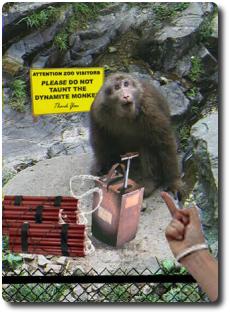
Graphics and photography on this site is either openly shareable or self-produced. Yet, there are cases where thieves HotLink images — that is — they refer to images on another site, thereby exploiting others for bandwidth. Fat Sam from NNTP://alt.www.webmaster posted this hilarious message today:
We’ve probably all experienced the problems of people remotely linking to images on our websites….
Well, this made me laugh…I found it in another newsgroup, but I thought it would be relevant here….
Imagine the scene
Ebayer1 decides to sell a graphics card, and in order to better show the product, he links to some images that he has stored on his own server….
Along comes Ebayer2, who happens to be selling the same graphics card….He checks ebay to see if anyone is selling anything similar, and finds Ebayer1′s auction with all those lovely extra images….
So he decides to remotely link to them too….
Naturally, Ebayer1 notices this extra traffic, probably in his referral logs, so he changes the images on his server…..
The resulting page of Ebayer2′s auction can be seen here (UPDATE: The seller changed the pictures after a few days, but one of the pictures is shown at the top of this item)
I especially love the image of the Plasma TV with the caption, “This Plasma TV included free”….


 Filed under: