Monday, January 17th, 2005, 3:03 am
Google Suggest is a tool which many Web surfers are talking about these days. Just when you think that Google is the best way of searching the World Wide Web, you find out about a more responsive user interface. Google Suggest will propose completions for search phrases, thereby guiding a user who is less than certain about how to find desired information. The project is still in its testing phase, but it looks promising.
Brought to my attention by Scott Tobkes.
Sunday, January 16th, 2005, 2:24 am
An item from the BBC reports on the severity of global warming, which appears to exceed past expectations.
We are all seeing rather less of the Sun, according to scientists who have been looking at five decades of sunlight measurements.
They have reached the disturbing conclusion that the amount of solar energy reaching the Earth’s surface has been gradually falling.
…
That means a temperature rise of 10 degrees Celsius by 2100 could be on the cards, giving the UK a climate like that of North Africa, and rendering many parts of the world uninhabitable.
Saturday, January 15th, 2005, 8:53 am
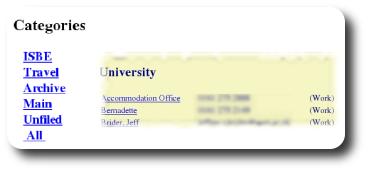
It has been possible for quite some time to convert Palm data into well-linked HTML. At present, free tools are available for full conversion of AddressBooks and Memos. AddBook2Web does the former conversion and Memo2Web can handle the latter. The results (see example below) are rather raw HTML code which is easy to navigate through.
Cited by: PalmAddict
Saturday, January 15th, 2005, 7:27 am
Mail checkers are light-weight programs which notify the user when new E-mail messages arrive. They rid the user of the need to run heavy mail applications in the background. I have used a variety of mail checkers and here is a summary:
For Windows: PopTray (left-hand-side) offers a very large range of features, but perhaps too many. It also does not support a pop-up preview of new mail. SyTinem (middle) is a mail checker that I have used happily for almost 4 years.
For Linux: KBiff (right-hand-side) generally fits most of my needs, but it sometimes fails to distinguish between old and new mail.
Friday, January 14th, 2005, 4:16 am
Simply by serendipity, I came across a particularly surprising site the other day. Sergey Brin, co-founder of Google, still keeps his academic site alive. Very recently I heard that he drives a small Japanese car. I salute the young man who is destined to become one of the most powerful world figures, along with Larry Page. Financially speaking, he is not there yet.
Worth noting: Apparently, Brin cared enough to remove his family and personal photos off the page.
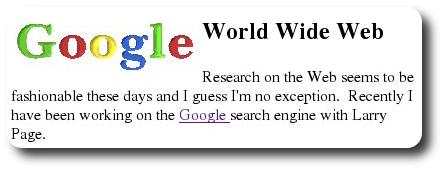 Here is Brin’s description of Google which was experimentally used in Stanford University
Thursday, January 13th, 2005, 3:20 am
 This afternoon I will get my brain scanned. The 3 Tesla MRI equipment will revolve around my head while I listen to music. There is nothing wrong with my brain, but my colleague and friend uses the data to perform her experiments for the Auto-regulation Grand Challenge. On the right is an image from a previous session, back in July 2004.
Wednesday, January 12th, 2005, 3:16 am
 Large companies begin to identify individuals using biometrics, fingerprint recognition systems being the most common methodology. This has become controversial, but need it truly be the biggest concern?
For example, other privacy issues include detailed log files which contain IP addresses, domain names and in academia — even names. Everything about a user is recorded along with recent activities. Privacy is continuously compromised more and more. Google can help identify many of us given our full name (NameBase can pin-point links and connections). It can then refer to people’s public thoughts and opinions about us. The availability of more information is unavoidable and the young generation has adapted to accept it.


 Filed under: