Saturday, January 15th, 2005, 7:27 am
Mail checkers are light-weight programs which notify the user when new E-mail messages arrive. They rid the user of the need to run heavy mail applications in the background. I have used a variety of mail checkers and here is a summary:
For Windows: PopTray (left-hand-side) offers a very large range of features, but perhaps too many. It also does not support a pop-up preview of new mail. SyTinem (middle) is a mail checker that I have used happily for almost 4 years.
For Linux: KBiff (right-hand-side) generally fits most of my needs, but it sometimes fails to distinguish between old and new mail.
Friday, January 14th, 2005, 4:16 am
Simply by serendipity, I came across a particularly surprising site the other day. Sergey Brin, co-founder of Google, still keeps his academic site alive. Very recently I heard that he drives a small Japanese car. I salute the young man who is destined to become one of the most powerful world figures, along with Larry Page. Financially speaking, he is not there yet.
Worth noting: Apparently, Brin cared enough to remove his family and personal photos off the page.
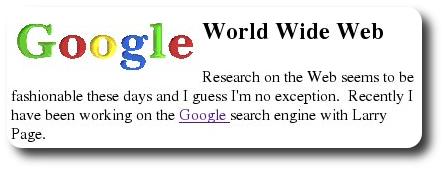 Here is Brin’s description of Google which was experimentally used in Stanford University
Thursday, January 13th, 2005, 3:20 am
 This afternoon I will get my brain scanned. The 3 Tesla MRI equipment will revolve around my head while I listen to music. There is nothing wrong with my brain, but my colleague and friend uses the data to perform her experiments for the Auto-regulation Grand Challenge. On the right is an image from a previous session, back in July 2004.
Wednesday, January 12th, 2005, 3:16 am
 Large companies begin to identify individuals using biometrics, fingerprint recognition systems being the most common methodology. This has become controversial, but need it truly be the biggest concern?
For example, other privacy issues include detailed log files which contain IP addresses, domain names and in academia — even names. Everything about a user is recorded along with recent activities. Privacy is continuously compromised more and more. Google can help identify many of us given our full name (NameBase can pin-point links and connections). It can then refer to people’s public thoughts and opinions about us. The availability of more information is unavoidable and the young generation has adapted to accept it.
Tuesday, January 11th, 2005, 6:59 am
This image-to-text tool is possibly what you need to impress your friends. I produced a very small-scale example. A larger size was possible as well, but it would have taken up much of this page.
Here is the famous Lenna image:
Here is the result of translation/rendering. It is purely text.
Tuesday, January 11th, 2005, 1:13 am
It is surprising to see that portals such as Yahoo are still being used. What’s even more surprising is that many people’s entry point (and only central point of navigation) remained Google. Some people have extensive bookmarks (Favorites in M¥¢ro$o£t terminology) which are most frequently used.
Nevertheless, one of the most efficient and convenient ways to browse is from a personal portal — one which you create yourself. My portal consists of about 200 links, sub-divided into some 30 categories. They all reside on the same page so that they are only a single click away. With tabbed browsing, this becomes a crucial factor.
At the top of the page, I choose to have a snapshot of the weather, a clock, and basic search facilities for this site and the World Wide Web.
For good fit of a large number of links, I use 3 columns. Their aggregated width fits all browsers and screen resolutions.
Here are a few extra bits that are worth mentioning:
- Put usernames or numbers below links for quick copy-and-paste.
- Set up keyboard accelerators using the
accesskey attribute.
- Group similar links under the same heading and use a hierarchy of header levels.
Also see: Portal Zen Garden
Monday, January 10th, 2005, 3:37 am
 The moral values of salesmen decline and business credibility is lost when almost laughable lies are being made; without guilt! High street shops have been using this strategy for as long as they existed. “While stocks last”, “Limited supplies”, hotel clerks who say “We have just a few rooms left” and travel agents who say “The flight is almost full so make a quick choice”. 95% of the time this must be bogus (simply urging you to make a transaction) and yet nobody rants loudly. Make a stance and become more sceptical.
On the right: “have you seen this man?”


 Filed under:


