Introduction About Site Map

XML
RSS 2 Feed RSS 2 Feed
Navigation

Main Page | Blog Index

Thursday, February 16th, 2006, 3:56 pm

Oracle Want MySQL

Crystal ball
The Oracle predicts Open Source abundance

In the headlines:

“SAN FRANCISCO–Oracle tried to acquire open-source database maker MySQL, an indication of the profound changes the software giant is willing to make as it adapts to the increasingly significant collaborative programming philosophy.”

Source: CNET

Many questions spring to mind. Among them: are Oracle out of their mind??? They have kept buying Open Source companies ever since that ground-braking statement from Larry Ellion, which called for an Open Source strategy. That recent move probably had many employees sacked, yet it can also be attributed to (or blamed on) a large merger. I personally think it would be interesting to see if Oracle transformed into a new type of company, which heavily relies on Open Source, even more than IBM do.

Oracle databases were lately shown to be poorer in terms of performance when compared against MySQL. Other commercial software fails to keep up with Open Source, so it is one example among several. Will companies like IBM, Red Hat and Novell, who make money out of Open Source, ever become the stalk of a new trend? Is it truly a commercialisation of Open Source, which only Google passionately avoid for the time being? Is it at all acceptable?

Thursday, February 16th, 2006, 2:20 pm

Proprietary Formats and Their Sordid Mess

OPEN formats are based upon a standardised specifications, which ensure global collaboration among applications. Without common formats, hardware are software are simply unable to communicate, unless they come from the same vendor. Formats are also analogous to the notion of a language, or technically speaking, “protocols” and “standards”. They are often agreed upon by an ample panel, which involves industry experts and industry/academy leaders.

What happens, however, when a company goes astray and implements its own formats, which it is unwilling to disclose for competitive reasons? What happens when a format is extended without acceptance by others who already use and depend on it? When common language is violated, disaster is foreseen. An industrial majority (or a monopoly) can use miscommunication as a ‘tool’ which drives competitors away. The temptation to use that tool as a weapon is often there, yet the seminal formats must always be honoured. If not, conversion facilities must be made available, so that a non-lossy route can be followed to ‘sanitise’ the unknown data structures and appendages.

LockI have already complained about proprietary formats that lock one’s personal data. The context in this blog was Palm-powered devices, as well as software packages from Microsoft. It is a terrible scenario when one chooses an appliance or a software package over open formats and is thereafter obliged to use it perpetually. It is an utter lock-in, which has even reached the Web that is openness-motivated. Internet Explorer-only beame more commonplace, yet Firefox has shouted out for a change in recent years.

Let us illustrate the primary contention with the aid of yet another specific example. In question are the advantages of open fromat and exportable data, so let us consider address book (contacts) data on a variety of platforms. I currently hold my address books on Palm’s Address, KDE’s KMail, and Mozilla Thunderbird. Maybe I base my statements on the wrong factors, but experience shows that address confusion and poor organisation skills are prevalent among those that still rely on Microsoft to organise and manage their data. I used to be among those who delegate data organisation to applications (packages) rather than formats. As a consequence, I struggled to move between application, inter-operate or even decipher my own data in the absence of one particular commercial application. Sounds familiar?

In summary, as food for thoughts to ponder: maybe it’s the obscurity of moving data without adherence to standard formats. Maybe it is the lack of import/export utilities and maybe frequent hard-drive re-formatting due to virus attacks and the like. Either way, Linux and Mac users appear to have extensive data which is easily-locatable, inter-changeable, rocoverable and resilient. Openness entails true benefits, which are better understood in the long term.

Thursday, February 16th, 2006, 6:14 am

Search Engines and Benchmark Subjectivity

SEARCHING of the Web is no exact science. If it was, its exhaustive exploration would be infeasible. The more formidable search engines amass information from million of Web sites, each containing huge lumps of information — both textual and media. That information, in turn, could be interpreted and/or indexed in a variety of different forms. Rarely is the content truly understood, which is my personal motivating for knowledge engines.

Mathematics and physics could be argued to be inexact sciences as well, at least when a variety of man-made, non-fundamental fields are introduced. Think of computer science, for example. Its fundamentals assimilate to this complex problem, which is searching the World Wide Web. It is associated with ad-hoc solutions. Computational theories which relate to Turing machines are not tractable enough to make a most correct and efficient algorithm ever crop up and stand out.

Don Knuth has written his popular series of books on the issues of correctness and efficiency in common algorithms. It proves an elegant reference to many computer science practitioners. Problems which are simple, such as element or number sorting, are still handled differently by different algorithms and their efficiency is dependent upon the architecture involved, the scale of the problem, and its nature. Search algorithms likewise, which is why they should be engineered differently depending on a number of key factors. Hence, judgement of the quality of search engines cannot be done objectively, but only ever be estimated using test cases and artificial scoring schemes.

Search buttonStill, everyone wants to discover the perfect recipe to outperforming Google. Others try to reverse-engineer their algorithms and cheat (fame and riches owing to ‘Google juice‘ that is channelled to one’s site/s). Many of us continue favour and recommend Google, which brings the largest number of referrals to most sites in existence. There is a danger here though. Large search engines are the main target for deceit and they are easily confused by spam inasmuch as they are inclined to pick up rare and valuable content.

Quality of search is probably in the mind of the searcher and the result of hearsay — somewhat of a ‘cattle effect’. Even engines that spit out cruft might be defended unconditionally by their innocent users. This may lead the competition to forfeiting the battle and invest fewer resources (e.g. datacentres) in the attempt to catch up. Phrases like “Google it” do not help either as they promote a search monoculture at best.

Related item: Search Engines and Biased Results

Wednesday, February 15th, 2006, 3:19 pm

Tiny Projectors for Phones and Handheld Computers

Internet Explorer 7 screenshot
Looking forward to running a presentation solely off your PDA?

ANOTHER tiny toy is yet to hit athe market: a matchbox-sized data projector that can be mounted onto a cellular phone or a PDA. Its projected resolution can be as high as 2048×1280 pixels and power consumption is not a major issue.

Light Blue Optics Ltd (LBO) has developed a revolutionary technology for miniature laser projectors dubbed PVPro. Today they announced their latest demonstrator unit, which is only 3.78 cubic inches in volume, and is similar in size and shape to a typical matchbox.

The gadget is of particular interest to me, perhaps owing to a personal vision. For quite while I have been wishing to have my PDA connect to external displays (analogous to projectors) at greater ease — something which is possible already, using third-party hard/software for Palm. Rather soon, one would hope, with miniature data projector readily-available and peripherals likewise, full-scale computers can unfold off our small pockets.

Related item: Spherical Display

Wednesday, February 15th, 2006, 7:07 am

Ever-Lasting Open Source Projects

Iron links
When one projects builds directly upon another

OPEN-SOURCE software development models are said to be poor. Some would argue that they suffer from sudden discontinuation of projects which people truly rely on. There is a fallacy which suggests that non-profit project ‘die’ more often. The GPL , however, makes the contrary a truth.

Take WordPress for example. It is a predecessor of b2, which became dormant in the past. Netscape and its evolution towards Mozilla and Firefox resulted in what is arguably the best Web browser, among many browsers in existence. AbiWord, KOffice, OpenOffice and StarOffice share some common fundamental codebase and they all (if not most) are here to stay. This comes to show the power of looking upon the shoulders of others, constantly extending in this code-driven community.

My favourite Open Source initiative is probably KDE. K in KDE stands for “Kernel hackers” (arguably so) and I believe it holds much promise. One day, it might even serve as the front-end in most workstations worldwide, possibly under a different name (a successor project). On the contrary, commerical
software out of use is disposable POS on the shelf. It is plenty of work that is simply wasted.

As tribute to KDE, I recently posted a KDE translucency illustration (local copy of screenshot) to the KDE Web site.

Tuesday, February 14th, 2006, 7:33 pm

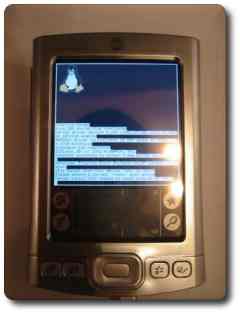
Goodbye Palm OS, Welcome Linux

Linux on the Palm Tungsten E
Amateur attempt at Linux on the Palm

PALMSOURCE, former software makers of Palm (after fragmentation and before re-joining), have finally announced the inevitable transition to Linux. To be more specific, they intend to release a Linux-based mobile phone to the market. This exciting move will mark the death of Palm OS. It also explains the delayed Cobalt, as well as the relatively dormant state of Palm O/S.

Access subsidiary PalmSource revealed details of its Linux-based mobile phone operating system, Tuesday at 3GSM in Barcelona.

With the millions of existing Palm users, think of the exposure Linux is yet to get. This also puts behind some worries that Palm have sidled with Pocket PC.

Recent rumours spoke of a possible Palm takeover. Even Apple were at some point mentioned as a possible candidate/runner-up.

Old items on Palm and Linux:

Tuesday, February 14th, 2006, 6:13 am

Pitfalls of Telephone Communication

Telephone

OVER the past few years I have come to loathe telephones. At first, it was just plain disdain for cellular communication. That kind of disdain dates back to the day when it was first introduced to in the public sector (as opposed to prestigious businesses). More recently, I decided to disconnect my phone or refuse to answer, having already avoided giving out my numbers. Snail mail likewise, but it’s an entirely different topic, which I will attempt to steer away from.

Why have I chosen to abstain from verbal communication that is job-related? For starters, electronic form saves space. I tend to scan every important paper anyway, but it is not searchable and it is time-consuming to acquire a copy. It is also difficult to file sensibly.

Moving on to a major pitfall of telephone-based comminication, negotiating tasks over the telephone is not efficient in terms of time. Moreover, nothing is logged in textual form, despite the rapid and rich communication, which is vocal. On top of that, vocal output from streams of consciousness is unorganised. It is the flawed way of talking, which results in serialisation of improperly-correlated ideas. In practice, this means that TODO lists that are agreed upon over the phone will be unpolished and badly written.

One more important issue is uncertainty and inaccuracies. I am inclined to prefer E-mail as it can be re-polished before the point of despatch. It can also looked at as a reference later. It can be duplicated, even forwarded to other people without any effort. Think about an E-mail containing “I spoke to Fred Bloggs yesterday and he said that…” versus just a forwarding of some mail within seconds.

Finally, to balance this discussion and give an opposite viewpoint, research suggests that textual communication can be damaging to relationships between peers. It conceals sensible tone and manner and adds tremendously to ambiguity.

According to recent research published in the Journal of Personality and Social Psychology, I’ve only a 50-50 chance of ascertaining the tone of any e-mail message. The study also shows that people think they’ve correctly interpreted the tone of e-mails they receive 90 percent of the time.

Real-time Posts

Posts by @schestowitz

Retrieval statistics: 23 queries taking a total of 0.089 seconds • Please report low bandwidth using the feedback form
Original styles created by Ian Main (all acknowledgements) • PHP scripts and styles later modified by Roy Schestowitz • Help yourself to a GPL'd copy
|— Proudly powered by W o r d P r e s s — based on a heavily-hacked version 1.2.1 (Mingus) installation —|