Introduction About Site Map

XML
RSS 2 Feed RSS 2 Feed
Navigation

Main Page | Blog Index

Tuesday, February 14th, 2006, 4:26 am

Linux is Easier than Windows

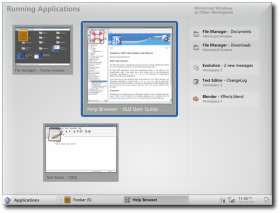
GNOME mockup

Few desktop environments can brag being as
user-friendly and simple-to-use as GNOME

A widespread fallacy is that Linux remained command-line-based and customised to be used by geeks only. Those who have actually tried Linux throughout this century consider this presumption to be utter rubbish. Certain Linux distributions are as easy to use as Mac OS, let alone Windows, which requires security-related ‘skills’ and offers poor utilities at its base.

A larger-scale, market-driven survey concludes that Linux is not tougher to manage than Windows.

The proof is in a survey of 200 managers by Enterprise Management
Associates, a market research firm. It was sponsored by Levanta, which
makes a Linux-based change management product.

Here’s the bottom line. According to EMA, “Sophisticated management tools now allow Linux management to be fast, effective, and inexpensive. With far lower acquisition costs, Linux is now a cost-effective alternative to Windows.”

Another timely article points out the value of Open Source in the corporate world.

A few years ago, releasing once-secret source code to the public would have been a highly unusual first move for a company with a newly acquired software product line.

Related item: Free Software – What Does it Truly Mean?

Monday, February 13th, 2006, 5:38 pm

Software Discrimination

Bill Gates

MERELY everyone has come across corrective discrimination wherein gender/race quotas are specified, and in turn promote diversity. We should be taking similar principles to diversify computing. This would be an intersting experiment, from which all would benefit. The move has an increasingly-justified place in the avoidance of software monoculture, which must no longer be accepted or even accommodated.

The results of an operating system monocolture leads to a discriminative cycle. Non-Windows users often get punished in terms of service. This must be reversed using litigious powers, much like the observation that people with special dietary requirement (e.g. vegetarians) get served first. How does one change the law? By staging a positive showcase for his/her arcane platform.

Monday, February 13th, 2006, 1:14 pm

Airports, Alcohol, and Shopping Traps

Big Plane

OCCASIONALLY I feel like as though we are witness to an ethical corruption. There is a thriving industry out there that takes advantage of people being drunk or stranded. In other circumstances, social weaknesses are to be blamed, in what can only be described as ‘cattle effect. I’ll present a couple of examples.

Airports charge a lot for food from hungry people whose access to outside shops is fictional at best. These foods can have their price elevated beyond the standard rates. This includes large chains of junk food, whose price should be moderated and remain relatively consistent. Yet, their price can sometimes match that of a fine restaurant in an airport and the same rules apply to other ‘exotic’ locations like pricy resorts. Such obscene prices are tolerated owing to the lack of alternatives; the lack of choice.

Cash machines are another example. Some of them charge extra fees for withdrawals (commission) and that often exploits nights out and ‘alcohol sprees’. This extra fee is reminiscent of the existence of gambling machines that benefit from the state of one’s mind, which is possibly under the influence of alcohol.

Lastly, and on to a point which is equally important, there are example which could become generic examples in their own rights. Fashion continously changes to encourage people to buy new clothes and replace the old ones. Showing and boasting the ‘hip effect’ culture (okay, I’ll use the word “cool”) in reference to cars, lifestyle et cetera is another factor. It urges people to expend money on a variety of unneeded luxuries. Christmas is finally said to be more of a necessity to motion in industry than it is a religious holiday. But on we live, and on we spend. Industry is led to a state of contentment.

Monday, February 13th, 2006, 10:40 am

Linux Certified Engineers (LCE/MSC)

Season of the playful penguins
Season of the playful penguins from Oyonale

Novell are reporting that Linux is soon to be perceived as a discipline. Judge the article for yourself.

Masters in Linux down under

Novell has teamed up with Charles Sturt University in Australia to offer what we believe is the first Masters Degree focused on Linux. The university decided to debut the degree because of rapid growth in demand for Linux training and expertise. The degree program includes obtaining Novell’s Certified Linux Engineer certification, including passing of the Novell Practicum exam. This is good evidence of growing interest in Linux by new entrants into the IT workforce, and the University’s choice to go with Novell in the curriculum is a nice vote of confidence.

Related item: Open Source in Schools

Sunday, February 12th, 2006, 1:56 pm

Microsoft and Google: Collative Roundup

Big brother
Can Google and Microsoft ever walk hand-in-hand?

NUMEROUS notes have accumulated on my Palm, so I decided to publish them in a logical (not necessarily chronological) order. The notes are all associated with questionable practices and controversial moves, which have been embraced by the Internet’s largest forces, putting Yahoo aside for the most past.

We all wish to gaze into the crystal ball and see what Google comes up with. Moreover, Google remain the centre of attention to many of the media sources. This happened for a reason. Public opinion is rather negative when it comes to Microsoft, primarily due to their shady past and unethical paths, which involve misuse of their monopoly in desktop computing, including a customer lock-in strategy. Then come Google, which seem like a Luddite to Microsoft who perceive Google as their giant threat. Many eyes look at up Google as if it was the knight on the white horse — the one to save the world from a vicious ruler.

The reasons to dislike Microsoft do not only involve exploitation of their monopoly-like state-of-affairs. Microsoft’s CEO once made some derogatory statements about competing operating systems. In reference to Linux he once said “are you going to trust some guy from China?”. It is not just midleading, but also racist and disrespectful. It also comes to show lack of sportsmanship in this competition over the operating systems market. Steve Ballmer of Microsoft used similar types of FUD in reference to Google, saying it would disappear within 5 years. That was a couple of years ago and, ever since, Microsoft have only played catch-up on the Internet, merely copying everything from Google. If controversies ever arises (as in the case of book scanning), the will stipulates that Microsoft will embroil their counterparts into the very same mess, detracting them from victory. Aggressiveness and deep pockets remain in Microsoft’s valued arsenal.

Apart from Trojans, spyware and viruses, I see no real motion in Microsoft Windows. Neither do most existing Windows user, who begin to glance elsewhere. Even when properly protected, the platform has many critical flaws and suffers from the saturation of nagware (homonym of nagger), which we also know as shareware or freeware. Any alternative can be rather pricy. To make matters worse, large quantities (intentional storage room vocabulary) of computers are made captureable from afar. Zombie networks (or BotNets) are constantly being formed. Suddenly, a seemingly harmless and innocent existence of an O/S — one with hijacking vulnerabilities and viral complications — can attack and bring down large Web sites. The flaws are simply infectious. They hurt the entire Web, which is unacceptable.

Read the rest of this entry »

Sunday, February 12th, 2006, 8:52 am

Spam Appendage

Separate boxes
Separating ham and spam

ARE you familiar with the misfortunate ordeals where you must cope with uninvited mail from a solicited source? What happens when this recurs, as in the case of getting mail that is directly or indirectly bound to a ‘newsletter’? Such newsletters are often hard to unsubscribe from.

I typically just bin such messages automatically rather than bothering to unsubscribe. Why? Experience suggests that it is the easier solution. Some companies voluntarily ‘decide’ to subscribe you and make unsubscription paths difficult and/or poorly tested. Call that “aggressive” if you will. Such messages ought to go to spam@your_domain, which can be emptied every day/week/month after a quick eye glance. Filtering based on headers is a true friend in such circumstances and, if done properly, no false positives (improper spam detection applied to real messages) should follow.

I do not like the idea the idea of re-directing mail to dev/null (i.e. deleting it immediately). Some people whom I know actually do that without hesitation; they particularly enjoy saving files under /dev/null as there is infinite free space there! The thought of something going amiss without the recipient’s awareness (perhaps a false positive) is worrisome. I tend to worry too much. I even check at queue of my BoxTrapper (Challenge/Response filter) at the end of each month, only to find merely nothing which is of use, among heaps of junk. That said, Challenge/Response filters have a few problems. On my domains, there are 5 accounts that which are protected by Apache’s BoxTrapper and merely all messages that get trapped are spam that refuses to verify its genuineness. So why should one bother? I still bother; I just punish no-one but myself.

Related item: Genuine Uninvited Mail

Saturday, February 11th, 2006, 5:41 pm

The ‘Common Text’ Technique

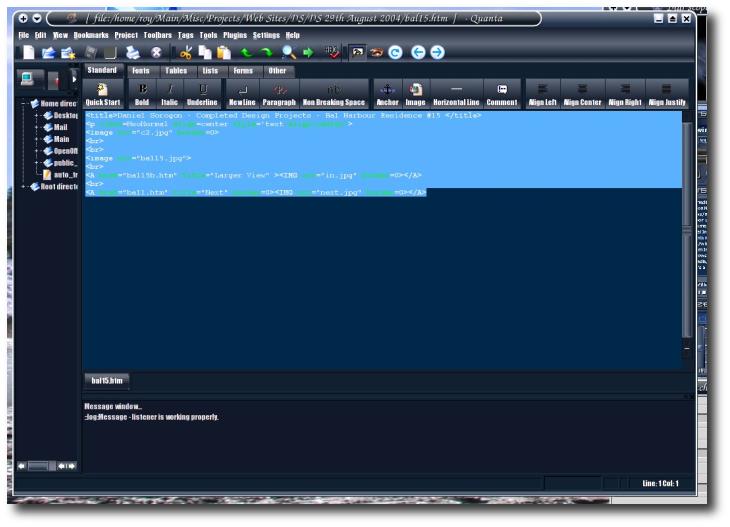
Quanta Plus

OVER the years I found myself inputting similar commands and/or text time after time, only with slight variations. This yelled out for re-use of some kind. In due time, tt seemed natural for me to keep these quickly-accessible for copying and pasting whenever required.

As of last year, the problem was nearing its end. I began to retain 3 separate text files: one for complex Linux commands (including various Internet address and scripts); one for commands in academia (usually experiments); last and by no means least, I kept together general-purposed text and the like. I refer to the last bit as “common text”, which can be valuable at times. It definitely saves time and prevents typos.

As an example that is based on practice, let us consider one’s personal details. In case a browser’s auto-complete functionality does not work, I open a text file, which resides on my domain. It contains the following arbitrary bits, which fit in commonly-served boxes in most Web forms:

Roy
Samuel
Schestowitz
roy@schestowitz.com
+44 870 xxx xxxx
Manchester University
Imaging Science and Biomedical Engineering
F5-17 Sir Charles Groves Hall, 4 Booth Str. West
Manchester
Lancashire
M15 6PY

How does one use this efficiently? Quick double-click and grafting of the text onto forms is the intuitive approach. It is often a matter of highlighting and mouse-clicking the center button in Linux.

That said, auto-completion sometimes (rather often) works in Mozilla Firefox. It is based on field labels (or captions), but on occasions no suggestions are made. So, working with the template and the form in tandem (e.g. browser tabs or separate monitors) is a method which works admirably well.

Common texts reside on a Webspace to serve my particular needs and there are accompanying keybindings in a personal links portal (example only), which makes access to text even more immediate.

I also store particular signatures for E-mail. These are usually triggered by an event which needs a suitable yet repeatable reply such as:

Please avoid sending me Word or PowerPoint attachments. Word, Excel, and PowerPoint are unreliable, unmaintainable, and unsafe. Send plain text, rtf, pdf, or W3C html instead. See http://www.gnu.org/philosophy/no-word-attachments.html

I grabbed this statement from somebody else whom I spotted in a mailing list. This signature can rapidly be used for unwanted E-mail attachments. Fortunately I only felt compelled enough to use it once in the past. Drawbacks that are associated with proprietary formats are finally beginning to be widely understood here in the United Kingdom. This saves some trouble to all and unburden non-Windows users.

As a side note, I learned this technique from a lecturer whose habit was to keep his frequently-used commands in text files. More complex, multi-line commands are stored locally as scripts, to avoid clutter and to keep everything organised.

Real-time Posts

Posts by @schestowitz

Retrieval statistics: 23 queries taking a total of 0.099 seconds • Please report low bandwidth using the feedback form
Original styles created by Ian Main (all acknowledgements) • PHP scripts and styles later modified by Roy Schestowitz • Help yourself to a GPL'd copy
|— Proudly powered by W o r d P r e s s — based on a heavily-hacked version 1.2.1 (Mingus) installation —|