Thursday, January 12th, 2006, 3:13 pm

Akismet cleans up your blog spam,
but false positives sometimes go unnoticed
Akismet is a comment spam prevention mechanism. It can tell apart genuine comments from ‘comment bombing’ and used do so almost flawlessly. The Akismet filter has quickly gained popularity among its origins: WordPress blogs. I set up Akismet in my WordPress 2.0 test blog and mentioned this before in a writeup on ending comment spam using collaborative spam flagging.
Akismet can be used only given a key which establishes some trusted identity. Nevetheless, its performance is said to have degraded recently. I have been wondering for quite a while what would prevent a guild of spammers from downloading and installing WordPress 2, getting an API key and then posting comments to self. They could begin marking comments improperly en masse. Only a trusted few need be able to flag messages. It is is a necessity when one wishes for robustness to fraud to ever prevail. I even mentioned this before, roughly a month before the tool was publicly available.
I have an API key for one blog and another test blog that ran Akismet without a key. That was back in the early days when spam-stopper, as is was named at the time, was actively developed and tested by a set of individuals. Ever since, I believe it has reached many hands and became too easy to gain access to, for malicious purposes as well.
There is hope of successfully reverting the learner back to a more reliable state if backups were made of it on occasions.
Thursday, January 12th, 2006, 4:23 am
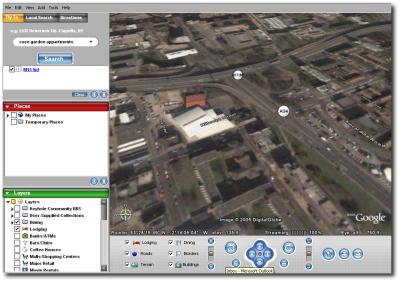
Google Earth on Windows; screenshot taken
when it was first released; click to enlarge the image
 FTER several months of waiting, the Windows version of Google Earth has been ported to run on Macs too.
If I recall correctly, they did the same with Google Talk recently. Will a Linux version be next? That would the real test. So far they have primarily, if not exclusively, catered for commercial, closed-source platforms. Perhaps Google Pack was a key milestone, due to which they could not afford to lose time on ports.
Rants about interoperability have been voiced before although Google’s media player was cross-platform from day one. Google’s clear intent is to remain Open; in fact, all of their Web-based tool are rarely ‘platform-discriminatory’.
Wednesday, January 11th, 2006, 5:07 pm
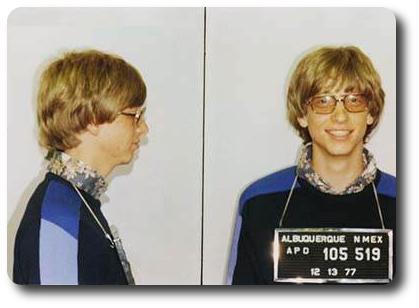
Bill Gates arrested in his younger days (photo in public domain)
This one particular story comes from CNET and it speaks of a patent which has just been upheld. This patent has apparently suffered from some court battles and rejections in the past as it is very controversial. Judge for yourself:
[...]
The FAT file system, a common means of storing files, was originally developed for Windows but is also employed on removable flash memory cards used in digital cameras and other devices. Some Linux- and Unix-related products also use the system to exchange data with Windows.
[...]
To many this means that files will be ‘locked’ not only by proprietary formats, but also by the underlying filesystem. The filesystem in itself becomes proprietary and very restrictive. I wonder not only how this affects Linux, but merely any device that attempts to communicate with the closed-source ogre. The European Commision is less than pleased about aggressive attempts to lock out the competition.
The European Commission has threatened to fine Microsoft up to 2m euros (£1.36m; $2.4m) a day until it gives rivals more access to its systems.
Wednesday, January 11th, 2006, 8:31 am
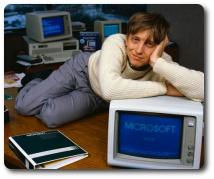
Business as usual…
Slashdot has revealed to me this mild critique:
Four years ago, Bill Gates dispatched a companywide e-mail promising that security and privacy would be Microsoft’s top priorities. Gates urged that new design approaches must “dramatically reduce” the number of security-related issues as well as make fixes easier to administer. “Eventually,” he added, “our software should be so fundamentally secure that customers never even worry about it.”
The grim reality:
Wednesday, January 11th, 2006, 6:34 am

Decisions and announcements that makes me as happy
as a child (photo from around 1986)
 UR paper which was submitted to ISBI 2006 has just been accepted, so I will be going to America in April. In March I will know if another paper of ours (CVPR 2006) has been accepted. The content of this paper is similar to the one contained in a recent presentation.
I mentioned both submissions in the past in the context of deadline pressure. I will most likely take advantage of this journey across the Atlantic and visit some of my family in Florida. This will make up for the pressure I am constantly subjected to (as well as — in this case — presenting in an international conference).
My relatives seem to anticipate my visit and, quite frankly, so do I! The deadline for another submission is drawling nearer, so we must take it up a gear and invest more time in experimentation and writing. The trips abroad will give me a significant motivational boost.
Wednesday, January 11th, 2006, 2:25 am
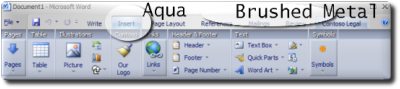
A screenshot of Word (Office 12) with copied graphical themes highlighted
PENOFFICE 2 was officially released a few months ago. Microsoft Office 12 will probably be out in the near future and it imitates much of the Mac OS X look, for which it has been criticised. See the above image if persuasion is needed that the contention is true.
Around the release time of OpenOffice, a particular controversial article made the rounds. It described OpenOffice as slow and inferior. Comparisons involving Microsoft Office and OpenOffice were only conducted under Windows, for it seems the only possible platform for benchmarks of this nature. However, it is a ‘home and away’ situation.
Windows is optimised to run Microsoft Office. It keeps many common objects in memory, for which there is a noticeable cost. On the other hand, OpenOffice ‘feels’ most comfortable in its origins: Open Source environments. The Windows OpenOffice version could be treated as merely a secondary port. Moreover, someone claimed that the OpenOffice build which was used in this comparison had been compiled with debugging ‘bits’ which accommodated for bug reports. It was not the final product, but merely a candidate with a practical purpose that entailed improvements.
Judging and comparing office productivity tools on Windows is unfair and grossly biased. It is like assessing the performance of a football team based only on its home games. This is not the first time that biased studies are conducted. Web servers, legacy hardware, and security are a few more examples. There was recently a big controversy over a study which counted security flaws, but compared Windows against many dozens of different Open Source platforms and applications like Apache and Firefox. The miserably-delivered figures were very deceiving, almost intentionally so. Flaws count was aggregated from just about any distribution or derivative of UNIX and then compared against the corresponding number from Windows.
Tuesday, January 10th, 2006, 5:25 pm
 Season of the playful penguins from Oyonale
I decided to explore and assemble a few favourite essays that explain what “free software” actually means. It does not mean what people tend to believe. I can assure you that, so please read on.
Essay #1: What software freedom means to me
Some seem to view software as a closed sphere; meaning that one person or group’s success must come at the expense of another’s. For those that have this rather selfish and narrow view of a closed world of zero sum games, I guess it makes sense to be able to take software and ideas that others have created, and offer them back with some modifications as proprietary solutions under the exclusive control of one individual or group.
Essay #2: Debunking common GNU/Linux myths
(Fallacy:) Free software is Communism. Free software promotes a gift economy and is anti-capitalist. Free software will kill the software industry and hurt the economy. First let’s examine free software. Basically it is software that you are allowed to use, sell, distribute and modify in any way you see fit. Compare that with proprietary software, which most often only allows you to use the software on a limited basis — no redistribution, sale, or modification of the software is allowed. Actually it goes further than that; criminal and civil penalties can be imposed on you for doing any of those things. It would be more accurate to say that proprietary software is fascist rather than suggest that free software is communist.
The “free” in free software does not mean “free of charge;” it means “free of restriction.” That’s free as in rights, not price. This is a point often misunderstood or misrepresented by proprietary software CEOs and others who have a proprietary software agenda to push.
That being said, free software is often also free of charge.
[...]
So, as the GNU slogan clearly says, it is “free as in freedom“.


 Filed under:


