Introduction About Site Map

XML
RSS 2 Feed RSS 2 Feed
Navigation

Main Page | Blog Index

Friday, December 9th, 2005, 10:33 am

Computer-Guided Bus

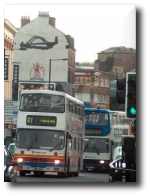
Manchester bus
Manchester’s notoriously busy transport system

There are some big plans for the transport system in Manchester. Buses might become similar to trams, but will involve no driver or rails. Alas, after scraping of the long-anticipated tram extension, we shouldn’t get our hopes up.

It may sound like science fiction, but Stagecoach, which runs most of the buses in south Manchester’s, says the new service could be in place years before any Metrolink connections are built. The computer-guided buses would be manned by a driver but new ‘optical guidance’ technology means the bus would steer itself along a prescribed route and pull up flush to raised platforms.

This is particularly interesting to me because it happens at the very centre of where I live and work. Moreover, it is related to my research, which is focused on computer vision.

Old stories:

Related news: Google launch service offering public transport schedules

Also see: Assorted Manchester photography

Thursday, December 8th, 2005, 4:22 pm

Tabs in E-mail Programs

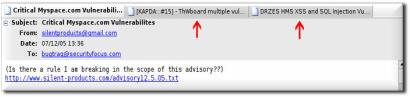
Tabs in Thunderbird
Tabs corresponding to separate E-mail messages in Thunderbird

TABBED views in E-mail applications (also referred to as “mail clients”) are a brand new idea as far as I can gather. Thunderbird developers are now said to be going down this unprecedented route. From the recent article:

A developer has added tabbed browsing of e-mail messages to Mozilla’s Thunderbird e-mail client, mimicking one of the most popular features of the Firefox and Opera Web browsers.

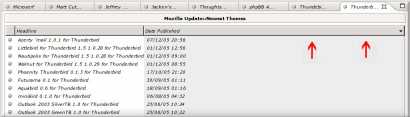
Tabs in RSSOwl
Tabs corresponding to separate RSS feeds in Owl

I have seen tabs in feed readers before, namely in RSSOwl (shown above). Nonetheless, I believe that incorporation of tabs into E-mail/newsreaders would be uncalled for. Much-familiar applications like Thunderbird would prove confusing to many users unless tabs are shrewdly hidden, thereby protecting users from their freedom.

Tabs make the controls finer, maybe unnecessarily so. E-mail, as oppose to feed readers, is used by merely everybody (assuming Webmail is put aside for the sake of the argument). Not everyone who uses Outlook (Express) can handle higher levels of complexity, let alone those who are new to E-mail altogether. Overall, tabs can make the entry barrier even higher. In firefox, tabs do not appear by default until/unless a second one appears. This makes tabbed browsing a function which is easy to enable if/when the user feels confident. Yet, owing to smart UI design, it never contributes to unnecessary clutter.

Thunderbird and RSSOwl are of course Open Source projects that are not bound to desires of large companies. According to Wozniak (AKA Woz), who is co-founder of Apple, the worst applications come from the large companies, Apple included. To quote Woz, “Microsoft, Apple and AOL, they tend to turn out the crappiest products, you know, software-wise”.

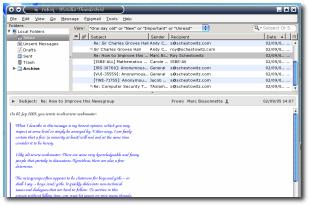
CrossOver
A shrunk-down screenshot of Thunderbird
‘dressed’ with the CrossOver theme

Thursday, December 8th, 2005, 6:20 am

Quiet as a Positive Sign

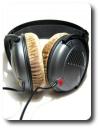
Big headphones
Isolate yourself from noise and life will get easier

QUIET in a technical context is a scenario where users require little or no support. Yes again, the principles described in this post apply to most things in life. Some time ago in the Palm newsgroups, somebody raised a question and then made the observation that few people ever mention Tungsten E devices. The Tungsten E is a modern, lower-end PDA, which is certainly popular, so how could its quiet existence be explained?

The discussion groups tend to have a troubleshooting, technical nature, so fault are usually reported while praises are deemed irrelevant and almost frowned upon. Should a person assume that the Tungsten E does not sell well? No. The very few mentionings of it simply imply that the model is reliable and nobody complains about it. Quiet, you see, is often a sign of success. It means that people carry on with their work and never bother to complain. Noise, on the other hand, is an indication of failure. To use a popular example, if Windows hits the headlines very often, it is in the context of security exploits. If people speak to their friends and colleagues about their computer, even while in the pub, this often involves a rant or a request for advice — a cry for help perhaps.

Better Palm PDA’s can be compared to a power plant. Linux servers likewise. We do not hear about Linux success stories quite so often despite the fact that many organisations happily use it. Google and Hewlett Packard are almost shy to admit that they use Open Source for their operations. We rarely hear about server problems that involve Linux because mail servers running Linux can go on for many years without even requiring a reboot. All they do is collect dust and often be forgotten about. The independence of a workstation often leads to forgetting the value of stability and low maintenance requirements.

As we hear about large migrations to Linux across schools in Macedonia, one wonders if the story will ever be used as a case study. When all operations succeed, nobody will bother to say a word. Nobody can fund or promote media commotion either because Linux is not directly bound to a profit-making organisation. Only when matters go out of hand, enemies are able to grab the opportunity and amplify the story of failure. With large budgets, a certain company can also fund and echo deceiving facts — a ‘disinformation’ perhaps — which can only be described as falsified propaganda.

The bottom line: be aware that information (or conversely misinformation) can receive varying levels of amplitude, which is sometimes affected by financial incentives in companies. Also remember that when problems are not echoed, the implication is that work carries on smoothly. People are good at making a fuss when things go wrong, but choose to remain focused and isolated when no problems crop up.

Wednesday, December 7th, 2005, 5:41 pm

KDE Pushed to the Limit

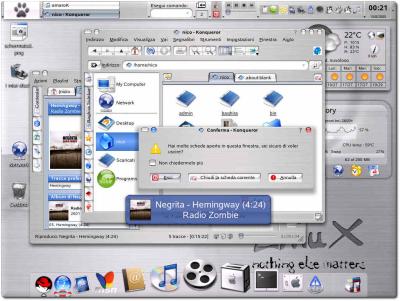
Tiger in KDE
KDE (yes, it’s Linux above) can be customised to
look and behave like Jaguar/Tiger
(and far beyond)

QUITE recently I enabled all shadows, translucency, and fade-in/out effects in KDE. The results are stunning, but they require a real-time demonstration (or animation) to be fully appreciated. The load on the CPU is almost bearable while translucency is the biggest detriment of all.

The progress made by the KDE team is tremendous, so envy (sometimes hatred) among GNOME’rs seems beyond understandable. Admittedly, I am working in GNOME while I compose this item, yet I always long for KDE. I am not mesmerised by a default KDE desktop, which is simple, user-friendly, yet somewhat dull. I am actually thinking about heavily-customised environments and powerful settings enabled as in the example above, which illustrates Mac OS X intersections.

It is also worth checking what shall come up in KDE 4. It is said to incorporate the new component titled Plasma. It’s not just eye candy, but a productivity tool, which gives power to the power users.

External Link: KDE 3.5 Released

Wednesday, December 7th, 2005, 11:09 am

Third IEEE Submission

OVER at the Computer Vision Digest, I recently mentioned the IEEE in the context of RSS feeds for journals. It is most pleasant to see RSS feeds penetrating even the world of academia, which usually lags behind in terms of state-of-the-art anything. The IEEE makes the admirable exception, as always.

Several weeks ago I also mentioned my two submissions to IEEE conferences, as well as two other successes. Everything seems to have settled on the right route, which grants me a quick Ph.D. at the age of 24. This was by no means easy for me; I will not pretend it has ever been the case. The first year was sluggish and unpromising. As a matter fact, I was warranted (or rather warned about) a difficult program with potentially rewarding outcomes. This warning was raised on the very first week, as soon as I joined the Division.

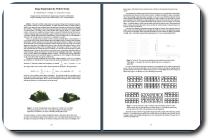
MIAS-IRC 2004 AbstractNowadays I work on my submission to an IEEE journal, namely Transactions in Medical Imaging. I must admit that their LATEX templates have been made simple to use — something which I am very pleased with because I am TEX-illiterate ( I normally use LyX as a front-end). We are aiming for the special issue on validation.
NB: because this item will be of little interest to many, I have just added a new category aptly named “Personal” and assigned this item to it. If you wish to subscribe to just a few particular topics, see the feeds page where a broader category breakdown gets listed. I still try hard not to ‘noisify’ the blog with personal chit-chats and raves.

Wednesday, December 7th, 2005, 4:58 am

Funny Data Loss Disasters

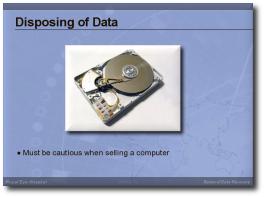
Data Recovery - presentation
A single slide from my talk on data recovery (XHTML)

Below is a snippet from an amusing BBC article.

One incident involved a dog that used a USB flash drive as a chew toy and almost ate all its owner’s data.

[...]

But top of the list is an old laptop containing key company data that was found filled with cockroach corpses.

It seems as though computer disasters and Darwin awards are becoming a golden source of joy to the computer literate. This could leverage tentions. People should never be humiliated for being unfamiliar with technology, but then again, this is a blog…

Similar items:

Tuesday, December 6th, 2005, 7:32 am

Wikipedia Introduces New Restrictions

Book shelves

Wikipedia will never collect dust on the shelves

A story that has hit many headlines speaks of Wikipedia closing a few doors, making it slightly more difficult to contribute content.

For more details, select your favourite source:

Related item: Wikipedia Statistics

Real-time Posts

Posts by @schestowitz

Retrieval statistics: 23 queries taking a total of 0.210 seconds • Please report low bandwidth using the feedback form
Original styles created by Ian Main (all acknowledgements) • PHP scripts and styles later modified by Roy Schestowitz • Help yourself to a GPL'd copy
|— Proudly powered by W o r d P r e s s — based on a heavily-hacked version 1.2.1 (Mingus) installation —|