Introduction About Site Map

XML
RSS 2 Feed RSS 2 Feed
Navigation

Main Page | Blog Index

Friday, November 4th, 2005, 10:36 am

Google Blind to Controversy

Book shelfThe memo/statement titled “Reining in Google” is becoming rather popular in cyberspace. It discusses Google’s attempt to re-write copyright laws or at least reach a point of acceptance through persistence. They have already begun scanning books in 3 large libraries despite the looming lawsuits. I recently mentioned an item which Google had posted in defence of Google Print, but has it not gone out-of-hand already?

Where is the Google that I used to know? The Google that vowed not to do evil and even considered employing me as a system administrator. I am filled with mixed emotions. Before the IPO, Google reflected on Page and Brin. It is now that lunatic Schmidt and thousands of greedy investors.

UPDATE (05/11/2005): With reference to a previous mentioning of Microsoft book scanning, it is now official. Microsoft begin digitising books as well.

Friday, November 4th, 2005, 5:11 am

Microsoft Back to Day One?

Longhorn

Longhorn spherical desktop screen-shot
Taken from a Microsoft meeting/demo in Chicago (click to enlarge)
Apparently, over-complexity did not permit this to become a reality

PERHAPS struggling to cope with existing Windows code, an operating system like Longhorn/Vista had to be re-built from scratch. To weed out competition, Microsoft face some serious dilemmas and have just taken some action.

Windows code, which was admittedly insufficiently modular, could no longer be run properly. Troubled and over-occupied with bug fixes and time-critical security patches, the O/S ended up ‘plastered’ all around. Consequently, Longhorn (Vista) lacked several long-promised features. This disappointed many customers and gave no compelling reason to ever upgrade. At present, Windows is conspicuously lagging behind some innovation and development over at Apple, not to mention Linux.

Major news are flowing in as I speak. Microsoft now turn their attention to a new operating system that will be built from the ground up and be named Singularity. Is it possible that Windows is so flawed (beyond our comprehension) that even Microsoft recognise a need to restart? Is the market unaware of the mess Windows closed-source actually is? With so many necessary patches and bloat, it seems to have gone out of the programmers’ control. With managers and staff leaving Microsoft (notably Lee), experience, competence and leadership are lost as well.

Apple was once in a similar situation. Mac OS 9 was rather weak. It seemed to have reached a dead-end and was often complemented by Windows software such as Internet Explorer and Outlook Express. Then, Apple took Darwin as codebase while merely discarding OS 9. Nowadays, we can only behold what a good product they ended up with. Marketing, however, has a limited budget at Apple.

From Microsoft’s Web site:

Singularity is a research project focused on the construction of dependable systems through innovation in the areas of systems, languages, and tools. We are building a research operating system prototype (called Singularity), extending programming languages, and developing new techniques and tools for specifying and verifying program behavior.

It sounds as if Microsoft primarily target the research niche, which is dominated by platforms other than Windows (predominantly Linux).

Thursday, November 3rd, 2005, 3:12 pm

The Enemy is Inside

Bill Gates
Bill Gates arrested in his younger days (photo in public domain)

ROBERT Scoble is a well-known Microsoft evangelist and blogger. He has recently set up a free blog in wordpress.com, which is of course based on Open Source software. I decided to ask him what he was up to. I was highly skeptic as he made this questionable migration of his popular blog and heavily-requested feeds. Earlier this week I sent Scoble an E-mail and got a disappointing reply; both of which I post verbatim below:

Me:

You are of course aware that you run your blog on Linux while evangelizing Windows. Hypocrisy?

Robert:

No.

An evangelist must be credible if he wants to be listened to.

The only way to be credible is to actually use other methodologies and products.

You must have evangelism confused with marketing. The two are not the same.

Rather than being critical of Open Source or PHP/MySQL, he implicitly revealed devious intentions; at least that’s the way I interpreted it. Only a couple of days later Scoble posted an item titled “WordPress Sucks”. He gets paid to say that stuff. He came in to give a critique and when the WordPress community posted follow-ups in defense of WordPress, they simply echoed his unjustifiable rants.

To make matters worse, Scoble opted for a free software package and complained about an extremely powerful feature in WordPress: RSS feeds. Is he complained about WordPress feeds, he could bash his wrath anything (or envy anything for that matter). Owing to that, he loses credibility rather than gain any.

Scoble on WordPress was a ticking bomb from day 1 and it exploded prematurely for all the wrong reasons. Like Matt said, WordPress is the Burger King of feeds. WordPress.com must become more selective when it comes to people it permits access and subscription to. I once mentioned the importance of WordPress invites. They are perhaps insufficient as they only deter splogs and mirrors, not enemies.

Thursday, November 3rd, 2005, 6:11 am

Coffee Beer

Coffee grains

SLASHDOT points to a laughable patent, which is mentioned in the New Scientist. Coffee beer might soon be no weirder than ice tea or even my odd adaptation to concentrated coffee.
A drink somewhere between coffee and beer could soon be on the menu. Nestec, part of the Nestlé empire in Switzerland, has filed patents in every major market round the world on a “fermented coffee beverage” that pours and foams like beer, but smells of strong coffee and packs a concentrated caffeine kick.

Only two days ago, the guys at the gym were joking about Starbucks and coffee junkies. “Give me 5 shots of latte!”, they said. Will that joke become a reality shortly?

Other items on coffee:

Wednesday, November 2nd, 2005, 6:20 pm

Alexa Rank Mistakes

AlexRank
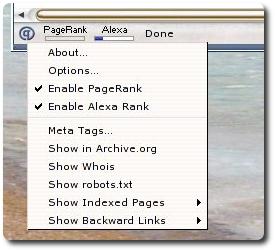
SearchStatus in action

SITE ranks are largely volatile and this post addresses the issue by referring to a few case studies. msn.com has just returned to PageRank 9, having stooped down to PageRank 2 during early stages of an ongoing Google update (Jagger Update was briefly mentioned in the past). Moreover, I have just noticed an Alexa rank (context/what is Alexa) oddity:

If one takes a glimpse at:

http://www.slate.com/

It’s surprising that it bears the Alexa rank of 2, which means that it is (grossly) estimated second in the world in terms of Web traffic.

Surprising, is it not?

Flicking back to MSN (Yahoo has been number 1 for quite some time and Google is typically third):

msn.com bears the Alexa rank of 2 just as well.

Are Alexa ranks not telling the full story? Is that a bug? It is a form of ambiguity, but not quite so. Perhaps Slate Magazine have plenty of traffic, but judging by other traffic metrics such as Netscraft, that is highly doubtful if not impossible. So how can it be on par with MSN? I used to think that Alexa provided a meaningful measure for the top 100 or so sites. Recently, it lost its credibility for a whole variety of reasons. For example, its spying on the innocent surfers recently led to my observation that the Web Archive can crawl hidden pages.

Mind you, the PageRank oddity mentioned above is not to be ignored either. It reminds us all that PageRank should be with a pinch of salt, especially throughout major updates of the indices.

Wednesday, November 2nd, 2005, 4:39 am

Web-based Office

AS it finally turns out, a Web-based Office suite, which could be an almost unprecedented step, is embarked on by Microsoft. This comes after numerous rumours about an innovative Google Web-based Office. These rumours, which spread like a plague and rapidly made the rounds, were just as quickly shattered by Brin. Google are in fact concentrating on OpenOffice at the moment.

It is worth pointing out that Microsoft have recognised Web-based applications as a major threat to their ‘milking cows’, namely Windows and Office. Office-like Web applications exist already although they are not cohesive. Returning to Microsoft,

Kicking off what he called the “live era” of software, Microsoft chairman Bill Gates said on Tuesday in the United States that the company plans to launch new Internet-based complements to its core products.

Gates said Microsoft is working on two products, “Windows Live” and “Office Live,” that create opportunities for the company to sell online subscriptions and advertising. Both are targeted at smaller businesses and consumers.

Interesting implications are worth pondering:

  • Will MSIE-only compatibility be likely?
  • Will non-Microsoft users be able to load Office document reliably using the Web-based equivalent?
  • Will people eventually get used the the idea of adverts next to an Office document?
  • How will subscription work and will it exclude certain people or be overly expensive?

Making that type of service available to anyone (i.e. without a paid licence) is suicidal. It could drive users away to platforms other than Microsoft Windows, unless of course there is a lock-in. This is why I imagine that there will be a catch. For instance, think of being permitted access to these Internet services depending on some requirements, e.g. premium features are exclusive to holders of a licence for the native version of Office.

Either way, Microsoft now open a peephole to a first glimpse, which I will of course rel="nofollow". Regardless, it looks rather appalling at the moment and is more of a placeholder, I presume. I quite like the standard-compliant clone below as it is not truly associated with Windows. It is a nice demonstration of the power of AJAX nonetheless, so I urge readers to take a look.

Windows AJAX
Windows XP in AJAX – follow the link and tune in

UPDATE: (03/11/2005) Joel re-affirms my point regarding Microsoft’s “half-baked” Web site.

Tuesday, November 1st, 2005, 12:30 pm

Google Print and AI

Iuron

I have already introduced my latest Open Source project (namely Iuron, the Semantic Knowledge Engine) a few times in the past. This afternoon I will be meeting who is questionably the father of the Semantic Web to discuss this project. However, I begin to suspect that Google have picked up on similar ideas by now. From the article which can be found in the Edge (among other places):

“We are not scanning all those books to be read by people,” explained one of my hosts after my talk (at Google). “We are scanning them to be read by an AI.”

There is a certain hint in that Web site as to long-term intentions and goals at Google. Overall, I don’t know if Google have beat me to it, but I suspect it was not something too crypic or far-fetched. Anyone in the field of machine learning must have thought about it at one stage or another. I hope that my speculation is mistaken and that Google will stick with naive indexing of unreliable Web content.

Speaking of threat from the giants, Google Reader, being an AJAX-rich Web application for reading feeds, has had direct impact on Feedlounge, which is an application I help test. Ever since the launch of Google Reader, Feedlounge development has been in a rather idle and fragile state. I hope Iuron will tread strongly despite the known perils. It is a non-profit, Open Source initiative after all.

UPDATE: I have been told that knowledge representation might be a greater barrier than I had imagined. My preconceptions regarding its maturity were slightly optimistic.

Real-time Posts

Posts by @schestowitz

Retrieval statistics: 23 queries taking a total of 0.124 seconds • Please report low bandwidth using the feedback form
Original styles created by Ian Main (all acknowledgements) • PHP scripts and styles later modified by Roy Schestowitz • Help yourself to a GPL'd copy
|— Proudly powered by W o r d P r e s s — based on a heavily-hacked version 1.2.1 (Mingus) installation —|