Friday, March 18th, 2005, 2:51 am
 Numerous people argue that Web browsing will be replaced by feeds of information. one can get everything from film reviews, weather, and the news to photo galleries of friends, all in a matter of seconds. Heavy pages with varying design and navigation methods are cumbersome. Consequently, content becomes king.
Here is the word from Robert Scoble, a popular Microsoft evangelist:
…RSS news aggregator. That’s where I spend 90% of my Internet time now anyway. Are you still using a Web browser? Good. I’ve been telling audiences that those of you still using Web browsers are wasting your time…
…Think I’m alone? Audiences at SXSW and Northern Voice have been very heavy RSS users. So much so that at SXSW there was a panel discussing whether or not design mattered anymore…
If you do not know where to start, visit RSSOwl.org where free software is available. You can find links to feeds in extensive directories, or maybe among the local links.
Thursday, March 17th, 2005, 2:00 pm
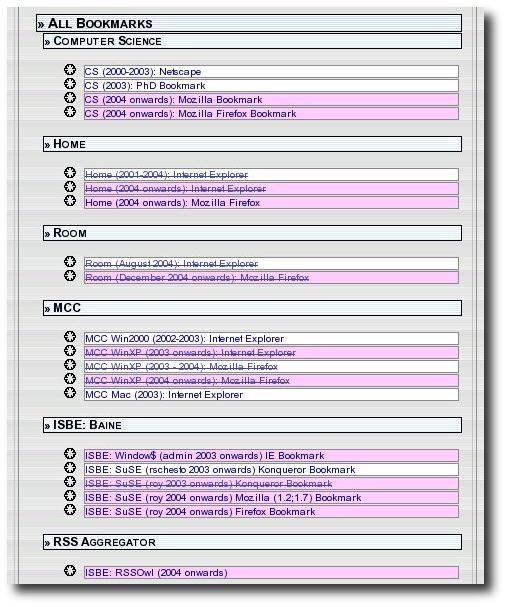
If you have worked on more than one computer, you probably had difficulties in keeping bookmarks (favourites) synchronised, or at least keeping them all in a single location. There are at least 3 ways to tackle this problem.
Method #1: Merge
Synchronise with the aid of tools, e.g. BookmarkSync, which is free.
Method #2: Upload
Use an on-line bookmark service like Yahoo! Bookmarks. It makes a single bookmark accessible (and modifiable) via the Internet.
Method #3: Centralise
Is you have Web space available, this method will suit you well. Upload all your bookmarks to the server and create links to them. This essentially builds a portal, which you probably want to make password-protected.
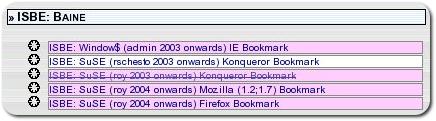 Part of an on-line bookmarks collection; click for full view
Wednesday, March 16th, 2005, 5:32 pm
 icrosoft are beginning to see information about Internet Explorer 7 leak. For those who have not followed recent events, Microsoft decided to make the exception and release a browser that is not bundled to a particular version of Windows. This is due to the threat of Firefox, which now accounts for the majority of traffic on some sites. Internet Explorer 7 is expected to have improved security (presently a predominant flaw), tabbed browsing, a built-in news aggregator and more. Plenty of details are to be found in this article.
Wednesday, March 16th, 2005, 4:39 am
Ralph from alt.comp.os.palm posted the following scoop:
The information I got yesterday from an unofficial announcement of the Palm developers is that the new (T6) will be called Tungsten 2005 and should have the following features:
- OS 6 (with scalable fonts)
- Bluetooth
- Wavelan
- 1 GB Flash
- 3 Megapixel Cam
- New connector (ethernet included)
- VGA resolution 640 x 480
- Graffiti 2 plus (with voice commands)
- Interface to iTunes (Apple iPod)
- The device is maximum 200 grams
- Automatic software update over internet
- Compatibility mode for pocket Windows is built in
- Initial price is around $400
- Launch date approx end of April
 To me this sounds like PalmOne are back in the game with an excellent range of features, all for a reasonable price.
Cited by: PalmAddict, PDA Expertos, Palm 247…
Wednesday, March 16th, 2005, 4:10 am
According to Mishoo, Internet Explorer leaks memory.
The problem I’m discussing here is that Internet Explorer leaks memory on certain occasions. If your script complies to this behavior, you will usually notice an abnormal slowness when IE executes it, usually after 40-50 requests made within the same browsing session…
This comes as a surprise to some and nonetheless it gives another reason to upgrade to Firefox.
Tuesday, March 15th, 2005, 1:22 am
 hat follows is a succinct comparison between dominant desktop environments/window managers for Linux. It is based on personal experience with KDE (under SuSE and Fedora) and
GNOME (under Ubuntu and RedHat).
|
KDE
|
GNOME
|
|
Heavy
|
Light
|
|
Highly-customisable
|
Relatively standardised
|
|
Well-integrated
|
Depleted
|
|
Resource-demanding
|
Somewhat minimal
|
Monday, March 14th, 2005, 4:27 am

 he Internet Archive may be one of the most fascinating tools around the Web. It holds over 100 terabytes (100,000,000 megabytes) of material, going back to 1996. You can now see your favourite sites and today’s large companies as they appeared in their ‘diapers’. Here are a few examples:
Yahoo! Inc. in 1996 and today; Slashdot in 1997 and today. Also have a peek at Jeff Zeldman, one of the fathers of Web standards and design, in 1996 and today. Chasing your favourite sites back in time can provide long hours of fun.


 Filed under: