Introduction About Site Map

XML
RSS 2 Feed RSS 2 Feed
Navigation

Main Page | Blog Index

Thursday, November 10th, 2005, 6:50 am

Longer Posts, Shorter Posts

Book scanning

LAST year I praised a habit of posting short blog items which address the main point and then end it. I have come to realise that my blog items are becoming quite long. I get carried away and feel guilty to have pages with little content that makes them unhelpful.

I promise to change that bad habit of mine whenever the story permits it. From now on I will attempt to ensure all posts are fairly short. Pictures are worth a thousand words and I hope they can complement brief sequences of text.

Wednesday, November 9th, 2005, 5:58 pm

Favourite Firefox Extensions

The Web Developer extension in action

Firefox Web Developer extension (click to enlarge)

SOME time in the past I mentioned my ‘Firefox essentials’ and a variety of Firefox toolbars. As it has been many months since then, I would like to list extensions and hacks which I am still pleased with.

  • CSS-based ads blocker – get rid of nasty advertisements (even the ones that sometimes appear in my site)
  • Mouse Gestures (particularly from Optimoz) – browse using your hand motion
  • Flashblock – block Flash and permit its invocation using mouseclicks
  • Googlebar – better in many respects than the Google Toolbar
  • SearchStatus – highlight rel="nofollow" links in red; display PageRank and Alexa rank in the status bar; check for inclusion in the Google Directory and DMOZ
  • Web Developer – the ultimate designer/debugger extension (see picture at top)
  • Netcraft Toolbar – detailed and rather technical site information
  • AdSense Notifier – little notifier for accumulated earnings – updated merely at real-time in the status bar

Redundant extensions that I no longer use or have disabled over time:

  • FlashGot – mass downloads (can use wget instead)
  • SpellBound – spellchecker in textareas (does not work consistently)
  • PRGoogleBar – Googlebar with PageRank (Googlebar has evolved more though)
  • Live HTTP Headers – if you are curious or develop for the Web and delve into headers-level
  • A9 Toolbar – good for boosting your Alexa rank (via history log)

Wednesday, November 9th, 2005, 5:22 am

Gates Fears Web Services

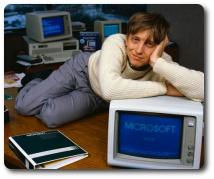
Bill Gates
Bill is still determined to win

The following item was published just half an hour ago. It speaks of a memo from Bill Gates, which reflects on fear from the Web giants.

SEATTLE – The technology industry shift’s to Internet-based software and services represents a massive and disruptive “sea change,” Microsoft Chairman Bill Gates wrote to top-level executives in a memo aimed at rallying his troops against the new competitive threats the company faces.

Gates compares the push toward such services — which range from online business software offerings to free Web-based e-mail — to the changes he saw nearly a decade ago. Then, he wrote a now-famous memo, called “The Internet Tidal Wave,” the (sic.) prompted a massive shift at Microsoft toward Internet-based technology.

This is closely related to an article from CNN on AJAX and its effect on Windows. A few days ago Gates announced the creation of Internet-based Office and prematurely unveiled live.com.

Yesterday I discovered a user-friendly AJAX development environment called Morfik. It resembles Visual Basic in terms of productivity, I’m informed. Will Web applications soon be constructed as easily and rapidly as desktop-based applications. If so, will Morfik, the sponsor of the recent Web 2.0 conference, take a strong lead? Let us remember that Web applications require no installation, to name just one among the distinguishable traits. This makes them easy to market and promote.

Tuesday, November 8th, 2005, 5:38 pm

Desktop Mouse Gestures

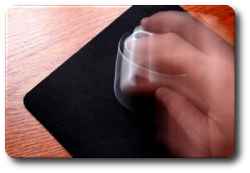
Mouse shaking

MOUSE gestures are the means for commanding actions using movement of the mouse. The user, for example, could jiggle the mouse and/or use combinations of mouseclicks to flip from one Web page to another or insert a piece of commonly-used text such as an E-mail signature. More usefully, programs can be opened by drawing letters and numbers that menmonically characterise them.

There are free software packages for enabling mouse gestures, all of which are rather light-weight:

Linux: WayV – Supports text commands, e.g. quick insertion of names, frequently-used Web site addresses, form filling, etc. WayV supports binding to either a mouse key or a mouse combination with keyboard triggers such as SHIFT or ALT, which avoid collisions. There is no front-end for configuration of actions and gestures, yet (as of 2001).

Windows: StrokeIt – A graphical interface for configuring mouse gestures, which supports plenty of actions. A clear distance is taken from the command-line approach (as in WayV), so there is good abstraction which helps any beginner. The application, however, does not look very modern. It is said to be the ‘standard’ mouse gesture application for Windows users nonetheless.

Note that both Windows and Linux applications don’t appear to have been maintained (nor extended) for a very long time. Regardless, they still are compatible with modern desktop environments.

Firefox (cross-platform): Optimoz – One extension which I personally consider to be a Firefox essential is the Optimoz Mouse Gestures extension. It is only one among several mouse gestures extensions, of which I tried a few. Opera includes mouse gestures ‘out of the box’ and is apparently the root of browser mouse gestures.

Alternative: Keyboard accelerators – Keyboard shortcut keys (for Linux/Windows) can be quick provided that the user gets the mouse and keyboard positioning right and has memorised the key-to-program assignments. Keyboard accelerators are only one among several methods for invoking programs.

All in all, I still find use of the keyboard accelerators to be faster then mouse gestures. This is also a matter of habit.

Tuesday, November 8th, 2005, 3:54 am

Tight Deadlines

First mode of an appearance model of the brain

Appearance model of the brain, ±2.5 standards deviations shown

IT is difficult to submit a reasonably decent paper to an international conference. It is also rather unfortunate when two papers need to be completed before strict submission deadlines that are only one day apart.

I am planning to submit a paper on image registration assessment to ISBI 2006 and another on appearance model evaluation to CVPR 2006. Both deadlines have been set to the beginning of next week. That possibly, if not probably, warrants scarce blog activity. Both conferences will take place in the States and I will wind up attending at least one of the conferences.

As the documents adhere to IEEE-styled templates, I have finally descended to the level of raw LATEX. I preferred to have avoided it for the past 4 years as I discovered the front-end LyX, which has its pros and cons. LATEX. feels like a step back nonetheless as failed attempts to compile a document are time-consuming. This is just one among the many deficiencies I could list.

Monday, November 7th, 2005, 3:36 pm

Cookie-Based Search Results

Google Cookie

The Google cookie

LAST week, amidst discussion in an SEO forum, I raised the prospect of tailoring content based on browser cookies. Cookies may contain a person’s full search history, but potentially much beyond that. As I shall explain in the remainder of this item, it was only short time later that my predication became a reality. This development is bad news, as well as good news.

…People are described by their cookie and Google (can) builds a profile, i.e. history of all searches that an individual runs (and potentially link s/he follows). Sooner or later, for competitive advantage, the SERP we all see may differ.

Example:

Google can tell that you like a lot of pop music. Search for ‘Aqua’ and get the Danish band at number 1. If you are a scientist, you may have a page on the chemical element at number 1.

I hadn’t realised something when I made the above statement. This was bound to become a patent, courtesy of Google.

4. A method of personalizing placed content associated with a search query, comprising: receiving a search query from a user; accessing a user profile associated with the user; identifying a set of placed content that matches the search query; and ordering the set of placed content in accordance with the user profile.

This seems too fundamental to be patentable, which is probably what controversy over software patents is all about. Not in the EU though. Has anyone yet pondered the implications it has on privacy? Might this be as tactless as book scanning, which is damaging to public opinion?

Monday, November 7th, 2005, 9:21 am

Windows Fragmented

Longhorn beta
Longhorn beta – old screenshot

MICROSOFT are said to offering too much choice in their upcoming Windows Vista. Some would even say that they are bound to failure due to this strategy. 7 editions of Vista are simply too much and customer confusion is foreseen.

As if a dozen editions/versions of Windows1 was not excessive, Singularity — a research O/S — has recently been introduced by Microsoft. It is probably intended to address the many inherent deficiencies in Windows, primarily security and customisability. Singularity will in fact be built from scratch, which is reminiscent of what was previously said about Vista as words leaked out from Redmond.

If Microsoft pursue a research O/S, then so be it, but researchers are largely not fond of Windows, especially in scientific research domains. Windows is simply too restrictive and insufficiently flexible (unless one pays). The move to Singularity is absurd, in my opinion, as people do not want to completely separate research environments from other activities.

Research involves writing documents and surfing the Web, for example. Having one operating system at home a yet another O/S, which is dedicated to research at work, is utterly confusing and unnecessary. It also support the point regarding confusion in Vista, which will be distributed in 7 editions. To use analogies, it is like having a truck and a motorcycle both for the puspose of transporting one passenger. More so, it is like having completely separate sets of dishes for chicken and ham.

1 Windows ME, 2000, NT, XP Home+Professional are still supported, but only partially and not for long either.

Real-time Posts

Posts by @schestowitz

Retrieval statistics: 23 queries taking a total of 0.093 seconds • Please report low bandwidth using the feedback form
Original styles created by Ian Main (all acknowledgements) • PHP scripts and styles later modified by Roy Schestowitz • Help yourself to a GPL'd copy
|— Proudly powered by W o r d P r e s s — based on a heavily-hacked version 1.2.1 (Mingus) installation —|